
Your employee has changed – new ways of management in post-covid times

We all feel that the pandemic may or may not be over yet. In fact, it seems that we may just be entering a 4th wave in many European countries, and are already in the middle of it in some other parts of the world. However, several countries experienced a relieving break recently after the 3rd wave, in many cases with employers opening up their offices for workers again for the first time since the virus hit us all so badly. And many of these employers experienced a subtle change in the character and attitude of their workers at the same time.

We at Codecool decided to open our offices when the time was right, and not much later invited our students back to the classrooms, too. But we also felt that the pandemic has changed us, our colleagues and our students (among whom may be your next junior programmer colleague, who knows). We felt that we’re just not the same anymore, but also that it’s not so easy to get around this feeling. It’s not so simple or black-or-white. We may be facing another lockdown and return to stricter work rules, and possibly a full WFH (work from home) setup in the coming weeks or months. But we want to be aware of the nature of change we’ve already went through, get prepared for whatever may come next, and maybe adjust the ways we do management in the meanwhile.

Adapting to Change

So how are we all different after 1+ year of isolation? Why exactly? What should we do or not do about the change? How will Codecool graduates be different from previous years’ alumni, and what will they be like at their brand new work places?

We decided to dig in just to find a load of amazing research and articles already written on the subject. And then opted for a brief summary of the insights we found most interesting and eye-opening.

We then grouped the insights around 4 topics:

  1. Work from home
  2. Speedy digitalisation
  3. Health and wellness prioritised
  4. Global crisis mode

Let’s jump in! See if you find some of these insights familiar or inspiring yourself.


1. Work from home

With the abrupt enforcement of social distancing as the primary means to slow down the new pandemic, WFH quickly became the standard way of working early last year. A Eurofound research showed that about 37% of the EU workers transitioned to WFH, 24% for the first time ever. Previously an employee benefit, WFH was now enforced in a non-negotiable way – only wherever it was feasible, of course. Essential / non-essential service, as well as work requiring physical proximity / work allowing remote setup quickly became relevant labour categories.

The solitude and isolation of single-household workers impacted introverts and extroverts differently, but in general increased depression, boredom and anxiety. In larger households WFH increased familiar disruption taking our focus, and therefore leading to stress. It also shifted our priorities to family and private life. 

With management moved to remote mode, too, self-management became key and many times a challenge, including flex time management, and especially over-work, paired with unchanged performance (resulting in lower efficiency). Previously rare Zoom calls taking over our work days proved especially draining and stressful in this period.

On the upside, some people experienced a bigger freedom in parallel with the breakdown of physical ties to the office. They started to appreciate the mobility, digital way of work and their new-found relative independence from day-to-day micro-management.

Makes sense, right? Been there, done that. Now wondering, how did all this change your employee and how you should change your ways as a manager?

Here are a few changes paired with useful tips:

→ Balance out changed productivity

Long isolation makes socialising and personal connection both desired and unusual.  Workers may be less productive in the office, too, especially in the beginning, because of spending too much time enjoying each others’ company. The experience may also be draining for them, too, because it’s all new and tiring to have people around again. What can you do? Let them be. Let your workers enjoy just being with their colleagues and take their time talking over coffee or take long lunch breaks. They need this for a healthy balance, to be able to perform on WFH days or overtime.

→ Take back from hands-on management

After experiencing self-management your team might react to your old management style differently now. Take back from managing your workers in general, including micro-management, encourage self-management, increase scope of ownership, make conversations instead of directly assigning tasks, build on the trust you have built out during the remote work period. This will not only help your colleagues deal with the situation, but also you, to grow as a leader.

→ Leave WFH options open

WFH can grow on you, even if you had trouble getting used to it in the beginning. It used to be an employee benefit before for a reason after all – it’s convenient, comfy and practical. Even those workers not particularly fond of the new setup might now expect having the option to work from home time-to-time. Others may not want to return to the office at all, and there are many preferences in between. Make sure to find out how your colleagues feel about the topic and try to take their preferences in consideration when updating your WFH policies. A little flexibility and generosity will go a long way and might actually become a decisive factor for your employees in the end when planning their future career at or outside your company.  Plus, WFH might mean faster, simpler and less expensive labour for your company – you just have to adjust your management style in the long run (→ see also previous point)

2. Speedy digitalisation

In parallel with transitioning work to employees’ homes, companies were forced to move their products, services, processes and channels online, too. Meaning those, that were actually able to, because of their industry, competency and agility. Many others, outside of the non-essential service categories experienced severe disruption, sometimes irreversible losses and went down together with whole industries. And we could see anything in between, too, in different industries, including layoffs, hiring freezes, working time caps, mandatory holidays and pay-cuts.

Workers of digitalising companies had to face further challenges in parallel with moving work home. They had to get used to and manage brand new digital work tools, processes and products, all of these sometimes requiring new tech skills, too. This made them question their own work status, abilities, confidence and blurred the lines of previously clear career prospects. And they had to get to learn to work with a new type of connectedness, digital connection, which gained so much ground in times of social distancing.

They also saw the world of work becoming not just a much more digital, mobile, connected and global, but also an insecure place where people can lose their jobs from one day to another, many times with no feasible “plan b”-s to quickly bounce back to.

Sounds familiar? We’ve all been part of this and we’ve all been impacted one way or another. 

Here are a few things you can do about some of the changes left on your employees:

→ Go agile now

One shared trait of organisations surviving and thriving after the 3 waves of the pandemic is agility. It’s not too late to go (more) agile even now, it’s rather a must. We just learnt how an unforeseen global crisis can stop our world and force us off our beaten paths. Can we really expect something like this to not happen again? Better get prepared now. Prepare your teams and processes to act fast on change in opportunity or demand, recover from an unexpected fall and continue to operate in some alternate setup. Go creative and think out of the box together – and don’t try to predict the way things will turn out, rather hack your future by preparing for as many options as possible building on an agile way of thinking and frameworks.

→ Apply new ways of reskilling fast

Newly digitalised businesses require new digital skills from employees.  It’s high time to prioritise strategic skill planning and rapid reskilling. According to Forbes the 2 key skills needed to manage uncertainty and digitalisation of the future are coding and empathy. Codecool‘s developer courses help build a strong foundation of both coding and soft skills, using a project-based curriculum and agile workplace-like setup. They are available for individuals and companies, too, both for absolute beginners and more advanced professionals. 

→ Automate part of the work

Whatever can be automated, should be now. Maybe it’s a bigger challenge in your industry than in some others, but think tasks instead of whole jobs. Especially routine tasks which used to be done in-person previously, but must now be solved online can be good candidates for automation. Think of it as just one more step ahead, to manage higher demand, changed WHF work-load and also, your employee’s motivation.

3. Health and wellness prioritised

With a global pandemic at the center of all the shake-up, our and our loved ones’ physical and mental health quickly gained priority on our list of concerns. What contributed to this? The strictness, urgency and extent of different protective measures, the questions around the nature and seriousness of the new virus induced disease, the risk to our health, isolation and / or being closed in together with our families, plus the media hype on top of it all had their share. 

Stress levels rose, and depression and anxiety cases became common even in people not directly impacted. Those who fell sick got an extra dose of the mental burden, too, plus experienced mild to serious physical symptoms and even have had to start getting used to the fact that some kind of post-covid symptoms might also impact their lives even on the long run (possibly hindering their performance at work, too). And many others, who experienced loss and tragedy have still have to learn to survive and live a full life, or at least regain some of their motivation to be able to function, and not just at work. All this resulted in people in general starting to reprioritise health and wellness, valuing rest and off-work time more than before, turning inwards and also to others with more compassion. 

You can help your employees with these issues, too.

→ Make their physical health your priority

Supporting your employees in keeping safe from or dealing with health issues should be a no-brainer. It’s also in your best interest to do everything you can to help your workers maintain their good health. Consider how you can contribute from facility management through work-time policy review to employee benefits system adjustments. Small changes matter, too. 

→ Use office space to help mental recovery

Let the work place take on a new, important role, to give space to healing through community experience. You might even want to adjust the size, function and outlook of the work space to support this new role. It should encourage team and 1-to-1 connection, fun moments and quiet withdrawal, too. Provide for random encounters, scheduled social ceremonies and sufficient personal space and time.

→ Provide access to professional mental support 

Endorse and communicate the idea that it’s OK not to be OK. Notice and avoid toxic positivity. But in the first place, accept that as an employer it’s in your best interest to care about the mental health of your workers. Don’t try to solve the new challenge in-house, find a professional partner to help your employees with consulting, coaching or team sessions.

4. Global crisis mode

Accept that the global pandemic is in fact a crisis, and you’re crisis managing. We’re all in this together, which makes the situation even more overwhelming for everyone. We all feel lost in the middle of the information overload, sensationalist news and conspiracy theories. We question our priorities and values, and also our purpose. Not so sure anymore what we should want from life. 

All of these problems may sound like aspects way beyond your managerial scope and competence. But you should care if you want to retain and motivate your employees once again. And the good news again is that you can actually make a difference.

→ Stop the infodemic 

This pandemic is also a “digital epidemic” causing information overload. To stop it on an individual level “social media distancing” can help. As a manager you may want to share only relevant and updated information about the situation. 

→ Make the situation clear 

Management in times of uncertainty, change and complexity requires clear communication. Aim at simplicity and transparency. Besides telling your employees what will happen, what will not happen and what you expect from them, make sure to use their words, ask for their feedback and answer their questions the best you can. You can’t and shouldn’t know everything, but whatever you know communicate with clarity. It restores a level or safety, strengthens trust and creates openness in the organisation. 

→ Give a sense of purpose 

Reinforcing your shared purpose might also be important for your employees in these uncertain times. When everything is being questioned, including what we should believe in and strive for in life, a sense of purpose and connection to work and how it benefits customers might help them more then ever. Make sure you make the occasion into a discussion rather than an announcement. Spend time to understand their needs and expectations and build on these.

Sounds like a lot of changes and to do’s? We feel you. 

But instead of thinking expectations, try to look at all these tips and insights as opportunities. We at Codecool do our best but still don’t yet do everything suggested above. The point is that we do our best and that we show that we care.

And we also do care about your future employees, also because we are training them right now. Besides turning our students into the best junior programmers you’ll find on the market, we’re helping them strengthen their soft skills and work together with them in an agile framework. 

All this to make sure they’ll not only be able to code, but also to cope – whatever challenges we all might face next. 

Follow us for more on Linkedin!

Whether you need IT specialists or you are looking for company trainings, you will find the solution with us.


 

The Codecool Way: 4 Core Values we Follow to Disrupt Tech Education

Company values are important: they can define a company and its brand, help communicate corporate identity and keep everyone aligned with the agreed strategic directions. If done well, they have a direct impact on core activities, shaping the way everyday work is being done at the company.

We at Codecool have been trying to follow 4 simple values for years in our everyday work:

  1. Courage – to explore new things and push limits.
  2. Transparency – sharing information and expressing ourselves, not just when comfortable.
  3. Quality – in whatever we do.
  4. Fun – to also enjoy what you do, so that you become even better at it.

But words are just words. They may sound cool, and we may check out an invisible to do list with them as any serious organisation that should have a list of core values does. But if there is no action behind them, they mean nothing.

So the tricky part about values is not even defining them  – especially that you better define them based on what you really believe in and what you actually do. It’s much more challenging to be always true to our values. How to apply them in different situations, with everyone and at all times. Even when it would be faster, cheaper or simpler to just not bother.

We follow our values in internal processes and ceremonies, among ourselves “in the background”, the way we talk to each other and do our daily work. We follow them when we meet external parties, like our business partners, and they experience them first hand, too, when they welcome graduate Codecoolers in their organisations.  And that’s because we also follow these values when we work together with our students, in the way we facilitate their learning and help them restart their lives in brand new tech careers.

But how exactly do we apply our core values in our training and make them work for everyone impacted?

Let’s dive in.

1. Courage: We step out of our comfort zones

Having courage to explore new things and break conventions is very attractive, but failing can be scary. So pursuing new challenges comes with a price: if we want to stay true to ourselves, we can’t always go the safe way.

You can’t have innovation or deep learning without trying new things. And trying new things naturally comes with failing a few times first. On the upside: the earlier you fail, the earlier you can fix what went wrong, and with the smallest cost possible. 

So we encourage learning by doing and learning from mistakes. We appreciate each failure together. We always give feedback and do a positive reinforcement on failures, as they are a valuable part of the process. For example: “It’s great, that you tried this option and found out that it doesn’t work. What have you learned from this?” 

To achieve innovation and learning via natural failure, we focus on processes rather than outcomes. We aim to create a supportive, fail-safe environment, where real growth can happen, so we also focus our feedback on behaviour, not on personality traits.

For a start, our mentors (we call our trainers ‘mentors’) cultivate a growth mindset. This means that we make sure our students understand and fully believe that with a growth mindset, their skills and abilities can be developed through dedication and hard work. Not by talent, luck, good grades from high school, or an IQ test’s result from last year. It depends on how much they believe they are capable of learning to code. This view creates a love of learning and a resilience that is essential for great accomplishments. To achieve this, we rephrase “fixed mindset” statements. For example, instead of saying “I’m not good in solving math problems” we suggest: “You might not have found your way in solving this math problem, yet. But have you tried … ?”

Learning new things can be intimidating, too. Once in a growth mindset, we finally dare ourselves to move out of our comfort zones to change and to grow. When defining challenges for our students, we concentrate on the “learning zone“, or the Zone of Proximal Development. The learning zone is between the comfort zone and the panic zone – neither of which is a place for learning. In the comfort zone there is nothing new, but in the panic zone there’s way too much. In the learning zone, however, you have the right amount of challenges to tackle. The Zone of Proximal Development inside the learning zone is where the learner gradually moves from learning the first steps with support (of a mentor or peers) towards learning further steps without help (or without ‘scaffolding’).

During the learning process, we make sure to always go step-by-step (sometimes in baby steps). We start routinely questioning ourselves, our beliefs and ways. We turn old stones, reinvent the wheel, understand how and why things work or don’t work, and then most of the time come up with ‘lousy’ new ideas – or at times, with truly ingenious ones. And in the meantime: we analyse, we open our minds, understand how to tackle problems, grow our confidence and learn. We grow – and have a lot of fun in the process.

Besides all this, we do follow-ups and retrospectives regularly. Our mentors also take the courage to face any feedback from our learners, and admit if anything went sideways – then, they focus on these areas of improvement, and turn the feedback into learning opportunities.


2. Transparency: We share and express

Transparency for us means more than just being honest. It means telling the truth at all times and sharing as much information as possible for everyone’s benefit – also with the learners during the learning process.

To support transparent communication, we first establish psychological safety, an atmosphere that facilitates mutual trust and growth.  In a team with high psychological safety, teammates feel safe to take risks around their team members. They feel confident that no one on the team will embarrass or punish anyone for admitting a mistake, asking a question or offering a new idea.

To achieve this we:

  • strive to recognise our own tensions and notice tension in others, that distracts us from being present or feeling comfortable, 
  • communicate tensions in a way that doesn’t hurt others,
  • give a context or a greater perspective about a decision or a behaviour to further enhance involvement and trust,
  • organise ceremonies (sharing/syncing) outside our daily work for bringing up questions or information transparently about things experienced in various situations.

We basically set a good example by communicating transparently, also to encourage others to start communicating transparently, too.

We can use this principle in the following situations:

  1. We give upfront information about the trainings, workshops, etc. We don’t hide any useful information from learners. We tell everyone what will happen, when, how.
  2. We clarify rules, roles and expectations. Then we have a ground to say “no” to learners, if they ask something beyond our agreement.
  3. We consciously avoid having secrets or taboos. What, how and why the mentor/trainer does what she does? It has to be clear for everybody. For example “Why are we doing this exercise?” We give context to the learners – with careful timing of the information, so it helps their learning.
  4. We do regular mappings. We map out our day, the next hour, exercise and even the whole course for everyone in advance. Learners always have to understand the process and where they are in it.
  5. We express our feelings. When our mentor has any tension, they also express it freely. The mentor is not perfect, either, they are a human being with feelings, emotions. For example when learners don’t pay attention, the mentor expresses their feelings about the situation and then asks them to pay more attention.

3. Quality: We put extra work in providing real value

We pursue quality and craftsmanship in everything we do or expect from our students or partners.

For a start, we significantly increase quality of learning outcomes by maximising learning time efficiency through guidance, support and motivation provided by our pro mentors. As opposed to self-paced learning, instructor-led course students are much more likely to finish their studies, and to end up with usable, practical knowledge and skills they can actually implement later in a work environment. They also have much more fun.

One way Codecool mentors engage students and partners for even better result is empowerment. As a start, we define quality together and how exactly we’ll get there.

We follow the principles of subsidiarity – which may sound complicated, but it only means that we tackle problems on the lowest level where information is available to solve them. Meaning that if there is a solution available for the students already for a certain problem, based on their previous project experience, then their mentor will encourage them to find the solution themselves and will not hand it over to them.

Solution focus is a technique we borrowed from Solution-Focused Brief Therapy. It requires future-based thinking and resource consciousness and builds on the notion that “the solution doesn’t care about the problem”. Instead of analysing the problem, we analyse the preferred outcome together with available resources, and derive the possible ways to get there from “top down”, rolling it out backwards from the desired state of final outcome.

The agile methodology is a no-brainer go-to toolset to use in software development context, and we use it extensively, too. We actually go as far as to build our learning schedules around agile ceremonies, and have our students demo their projects in front of real-life “clients”, represented by our hiring partner companies every Friday, from week 1 in their learning journey.

We also believe in efficient, goal-focused meetings and learning sessions. We respect each other’s time, arrive on time and keep timeframes at all times – but that’s only one side of the story. 

We start every meeting with a check-in round where we discuss how everyone feels, so that we can “arrive”, that is put outside problems behind by acknowledging them and sync the mood of the team. This may sound like an overkill or waste of time, but skipping it is just not worth the 10 minutes it saves. People tend to focus and participate more actively and efficiently after this short routine, and the time saved indirectly is a lot more than how long the whole thing takes.

We also do a check-out in the end, to share how we feel then and if there’s anything more to share, to make sure we maxed out our time spent in the meeting together.

Apart from these generic meeting routines, we also do short attendance meetings each and every morning with our students.  At this meeting everyone (including mentors) answers one simple, casual random question generated by a bot (like what’s the one TV show that always makes you laugh, or who is you favourite superhero and why). We don’t react to replies, we just share and listen. The purpose is to kick-off the day on a positive tone and consciously bring in the human element into our work and learning every day, which is also a key tool for building a teal organisation with high standards for quality.

And last, but not least, we build on the 4 principles of doing by non-doing, which in our case is basically a coaching attitude pursued by mentors. The principles are the following:

  1. We don’t know the one single truth: The mentor/trainer doesn’t know the truth, only shares knowledge by her experience. Everyone can challenge the mentor’s or others’ thoughts, ask open questions and start a constructive debate.
  2. We don’t judge: We give specific feedback on behaviours, and we don’t apply labels to people.
  3. We don’t take over responsibility from others, especially from learners: The one who is working hard is actually learning by doing. If the mentor/trainer works hard, it means they learn a lot themselves, but not necessarily the learners. For example that’s why the mentor cannot touch the keyboard of a learner as a rule. We also say: learners should spend most of their time practicing, communicating, elaborating on a task. The main responsibility of the mentor/trainer is to facilitate learning, but the ownership is with the student – they own their own learning, for the best possible result. 
  4. We don’t give solutions: We don’t tell the tricks and give final answers. The learning process is more important than the final answer. Our approach is coaching – we help the learners with questions, guidance, motivation.

Some people intuitively interpret ‘non-doing’ as something passive, laid back or lazy. But if no action is needed, then doing anything may already be ‘overdoing’. In fact, sometimes action can do more harm than good.

If we are growing a plant and we have created the right conditions for growth with healthy soil, sun and water, there comes a time when the very best way to ensure the growth of the plant is simply to leave it alone. More water, more sun, more fertiliser won’t help, in fact, too much of any of these may stifle the growth of the plant. We remain attentive, connected to the plant’s needs but for the time being, doing nothing is just what is needed. 

We do our best not to kill our plants, but let them grow and reach their highest quality.


4. Fun: We make sure everyone enjoys the ride

Choosing Codecool is a life-altering choice for both our day-time course students and our colleagues – so we always put fun high on the list of priorities. If you enjoy something, you’ll become better at it. It’s that simple.

We do believe that learning and work can and should be a fun, light-hearted, and possibly a flow experience, too. We don’t take ourselves very seriously either. We make sure to be able to laugh at ourselves as much as possible.

Our students learn technologies and new skills via life-like, but still playful and fun project assignments, instead of boring, heavy textbooks and frontal lectures.  

A fun learning experience will bring a better end result because of the positive association:

  1. We experience how we all (including the mentor) are just human beings. We all make mistakes, and we laugh at ourselves, together.
  2. We focus on the journey, the experiment of learning something new. This adventure, the discovery can be very enjoyable, genuine fun.
  3. We share interesting small details, fun facts, all related to the topic.
  4. We do more interactive, practice-oriented sessions, and fewer frontal sessions and presentations. Learners will remember the “experience” most: when they were moving, talking, practicing, laughing, etc.


That’s basically it – and of course a lot more. But listing all the ‘secret’ ingredients of our learning method and routines is just not possible in one article. 

We know that every company is different, and your values at your company must be different, too – not better, nor worse, just different. Hope you found this insight to the Codecool values and our ways of working with them inspiring, and that we made you think about yours. 

What core values do you have at your company? What do you do to follow them every day?

Stop and think about them sometime, and find more creative ways to be true to them. It will be well worth your time.

Boost Team Productivity: Follow These 4 Rules of Doing by Non-Doing

Looking to learn new ways to make your team productive? Non-doing doesn’t exactly sound like a productivity spell, but it can become one. Let’s see, how. 

As we are slowly returning to some kind of a new normal and exploring hybrid work options, productivity challenging online meetings, home office days and virtual team setups remain our reality.

Managing a learning organisation, team energy and effectiveness has never been more more tricky, than in this almost-post-pandemic era. We have to learn new ways to stay productive again, even if they make us leave our comfort zones for a change.

Non-doing doesn’t exactly sound like a productivity spell, but it can become one. The idea is not new at all, but it might just be time to revive it.

Where does the concept come from and what does it even mean?

It’s an ancient idea that’s certainly stood the test of time, having first appeared in the great Chinese philosopher Lao Tzu’s writings over 2000 years ago. And although “wu wei” literally means non-doing or non-action, it’s anything but a form of passivity.

Think of non-doing as effortless action: getting the greatest outcome possible by doing the least possible.

Why is it relevant today?

But why should we embrace this very concept in an age of constant change, competition and pressure to perform?

For starters, because it’s time for leaders reinventing their management styles.

In the golden age of the knowledge society, autocratic management (even the parental style, with the kindest possible intent) is hardly ever a good strategy. The most successful companies and teams out there aren’t the ones that always follow the rules but the ones that don’t think twice before completely rewriting them. And they tend to have managers that expect the same from their employees.

In a game where creativity wins it all, good leadership isn’t about instructing, dictating or checking. It’s more about asking, inspiring and supporting. In other words, non-doing.

Here are our 4 don’ts, if you want to master the art of effortless action.

1. Don’t try to be a know-it-all

A company culture based on non-doing is built on the fact that no one holds the Philosopher’s Stone. Meaning that no leader or team member has the ultimate truth.

Why is this important?

First, because there is no Philosopher’s Stone – and noone is infallible.

Second, because if you obsess about single truths, you’ll encourage unhealthy group dynamics. Whether you’re in a meeting or in a classroom, if your feeling of being right shoots up, so does your feeling of authority right away. Authority limits flow, creativity and innovation.

When building a supportive environment instead of a domineering one, finding a single right solution or flashing your insight will loose its significance. You’ll embrace the search and remain open to experiment, take risks and even stay silent, as needed.

2. Don’t put people in boxes

Aka the number one rule for a strong feedback culture: try not to stick labels on people, whether positive or negative.

For example, if you say “You’re smart!” to someone, nobody will know what exactly was good about their work, including them. Similarly, if you tell someone they’re slack, you basically imply that there’s something wrong with them as a person, not helping with constructive feedback to improve.

That’s why labelling is one of the biggest obstacles to development both for individuals and a company as a whole.

Don’t put stars or talents on a pedestal, but put the valuable behaviours in the spotlight. Make sure these are transferred among people, supporting learning, growth and motivation at company level.

3. Don’t offer ready-made answers

In a non-doing organisational culture, employees value attention more than solutions.

So if someone has a problem, others shouldn’t tell them how to solve it, but help them find the answer instead. Even if this means that a task will take longer or require more attempts.

How will that help?

If you hand ready-made solutions to someone on a plate, you also take away something crucial: the opportunity to learn. If you want someone to grow, you need to assist them with creating a learning environment in which they themselves go through trial and error.

On the side, you’ll boost their motivation and who knows, even you might learn something new in the process.

4. Don’t take away responsibility from others

In other words: “No pressure, no diamonds”. The saying rings as true as ever: people can only improve if they’ve got responsibility, if what they do is meaningful and has consequences.

Autocratic leadership (including micro management) withdraws this power, as it takes away the possibility from others to become and remain in charge of their own work and growth.

So just because you think you’re better or faster at a task, don’t take it over from others.

If an employee would like to change something at the company, and it doesn’t directly violates shareholder interest or personal safety, consider letting them do it. The company is as much theirs as yours, and they need to experience this. Try make every project run by whoever is the most motivated. Work actively on creating a sense of ownership, and enjoy the benefits.


We at Codecool actively and consistently practice non-doing, or non-teaching at our courses. We facilitate discovery by learning instead of providing all the answers upfront. This way Codecoolers gain a deeper knowledge, enhance their creativity, develop a passion to learn more – and have much more fun.


Obviously, there are situations when non-doing is not  good idea. If a fire breaks out, please ring the alarms, and don’t wait for a team consensus on possible even better solutions and learning opportunities.

The point is: the house is not always on fire, and you shouldn’t act like it is. Start with noticing if you do, and try something different for better results: try non-doing instead.

The New CEE Digital Talent Hub: Our Proposal to Tackle the Global Tech Skills Gap

By now we all know that we’ll never go back to the „normal” we once knew. The new normal we are headed may not be fully clear yet, but it’s definitely going to be digital. To get there we’ll have to make at least one big jump in the process, over  the ever-widening digital skills gap. What can help us to make the jump? For one, remote work combined with global recruitment, and a future vision called ‘digital CEE talent hub’.

RecruiTECH Romania conference was created to act as a compass for the recruitment profession, to gather and share the best international and national white collar recruitment practices. This year’s event was centered around “(making) the most of a changed labor market with a new perspective and digital tools”.

Codecool CMO, Anna Ferenczy has been invited to share her view on Covid-accelerated digitalisation, it’s impact on the global tech skills gap and a possible solution called ‘CEE digital talent hub’.

Here’s a recap of some key points from her presentation.

Old digital goals and obstacles are so out

Remember the time when we all tried to justify digital transformation plans by cost-cuts and find solutions to organisational siloes and cultural problems? Good old times, right? We never knew our clock was ticking. Would you believe this was just a few years ago, before Covid. In 2017, 48% of corporate leaders used to list scaling down cost as a top 3 digitalisation priority, and listed cultural and organisational bottle-necks as major concerns. And this was just in 2017, according to McKinsey.

And then, a pandemic happened.

Today, digitalisation is a matter of life-or-death, and the global hunt for tech talent is like the 19th century California gold-rush. 87% of leaders see digitalisation as a means of survival, getting ahead of competition or reinventing their business, with only 10%  of them listing cost-cuts as a top priority. And 75% of leaders struggle with hiring the right fit for digital positions.

Quite a turn of winds for digital strategies and efforts, in a blink of an eye.

It’s not just about the future of your business – it’s personal

Today there are about 41 million tech jobs to be filled globally. On top of this 41 million, an additional 149 million new ones will be created by 2025, waiting to be filled.

The new 149 million include jobs in:

  • software development (98 million),
  • cloud and data management (23 million),
  • data analysis, AI and machine learning (20 million),
  • cyber security (6 million) and
  • privacy and trust management (1 million).

Next to the business side of the story, there is a personal aspect as well. More and more people are losing their jobs to digitalisation, forced to reinvent themselves for a high-tech future. The trend has not started today, it has been going on for decades now, but it definitely got a boost last year.

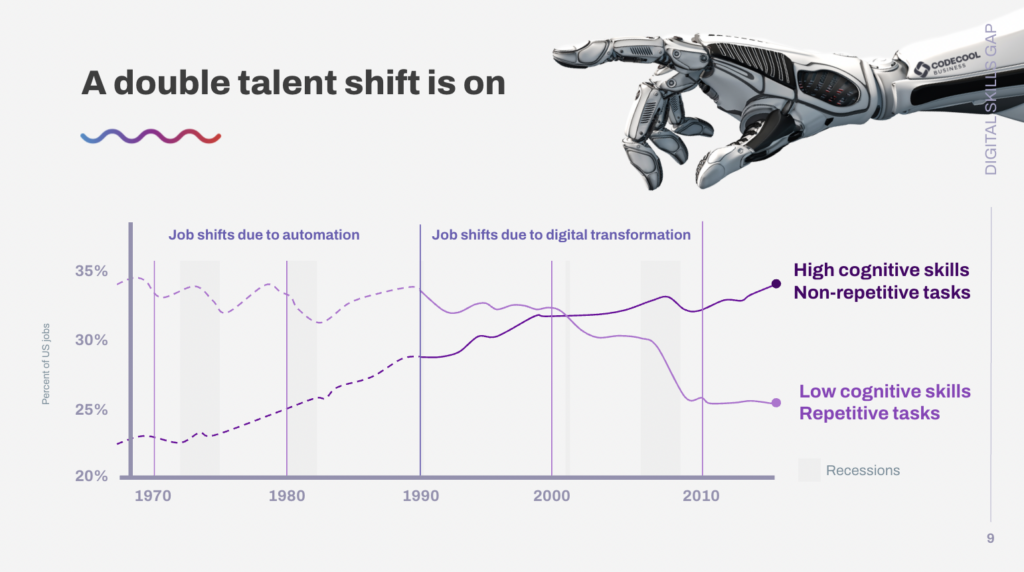
Today we’re in the middle of a new, and very special industrial revolution. For the first time in history not high skill jobs are taken over by the machines, allowing people easily find work in lower skill professions. On the contrary: machines are now taking over repetitive, low-skill tasks, while jobs requiring high cognitive skills are on the rise for the human work force.

This time people will need to substantially re-skill and up-skill to reinvent themselves, or they’ll fall behind. It’s not only digital strategies and corporate competitiveness at stake, but individual lives, too. What does a good up-skilling strategy has to focus on, to prepare for an unpredictable, but surely digital future? Some say, the focus should be on coding and empathy. Coding because the digital future will not just happen by itself, we have to build it first. And empathy, because we’ll have to manage brand new challenges, and reinvent our ways again and again in the meantime.

The gap keeps widening

On the booming digital job market talent is gold. But people are much faster in adapting to a digital lifestyle and way of working than building digital skills or switching to tech jobs. The tech skills gap is wider than ever and it seems to be growing.

There are multiple additional factors at play here:

  • Digitalisation beyond IT – the 149 million new jobs are more or less just the IT positions. But we are also seeing a digitalisation of  classic business functions and traditionally non-tech industries. The trend is viral and no business seems immune to it. This also means that there are now not just tech and IT, but several other industries, companies and departments competing for digital talent, too.
  • Covid-driven digitalisation – last year we were forced to deliver about 10 years’ of digitalisation in 10 months by moving our lives, work, channels and products online.
  • Growing funding –  partly related to the previous points, local governments and the EU alike started to pour money into innovation and digitalisation, creating further openings to fill.
  • Inflating prices – due to economic recession of our turbulent times price have climbed, followed by a a raise in wages, making high-quality talent even less affordable for businesses with a limited budget.
  • Talent mobility – While looking to future-proof their careers, individuals are more open to change their employers, too. And moving their offices online, companies are not restricted by physical distance from talent either. Businesses are now hiring from anywhere (68%), and people are more-and-more willing to apply to jobs anywhere (21%). While flourishing digital hubs like London, UK and Silicon Valley, US are big time winning in the race for talent, local hiring efforts in some countries suffer talent migration.
  • Hiring for a degree – is actually a trend we could change ourselves, unlike the previously mentioned factors, outside our direct influence. By maintaining an outdated preference for tech university graduates hiring managers many time miss the opportunity to grab programming school talents re-skilled in 1 year instead of 5, many times equipped with much more relevant hard and soft skillsets, and and previous work experience.
  • Low diversity – is another trend connected with discrimination we should all strive to change. Changing tech into a gender- and age-inclusive field, as it should be, can only happen via hiring much more women and 30+ or 40+ professionals in tech positions, than we ever did before.

Our proposed solution: the new CEE digital talent hub

The talent gap will not close itself,  especially when even the Silicon Valley is impacted. We must put a lot of work into closing it, and closing it in a way that local businesses become net beneficiaries of the outcome, too, not just business like Google and Amazon.

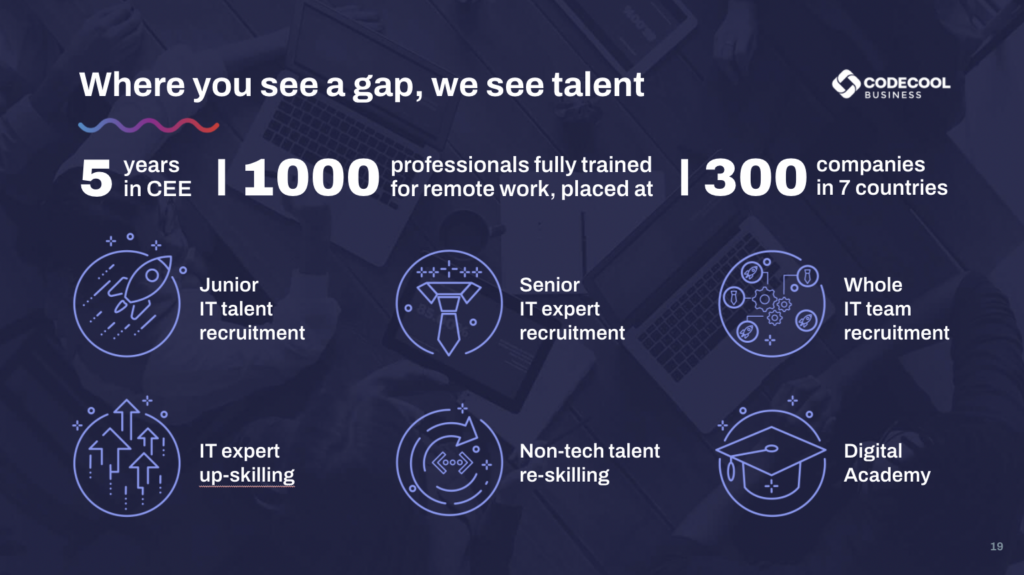
We at Codecool take our part in this work by re-skilling and up-skilling CEE work force and sourcing digital talent to our partner companies. Instead of university degrees, our graduates have extensive project portfolios demonstrating solid skills in 4 to 6 programming languages and multiple tech platforms, as well as valuable soft skills. More than 30% of them are female (and we are continuously working on raising this ratio), and many of them are 30+, with previous work experience and a high-level of self-awareness on their profiles.

We all need to up our game, and build a massive CEE talent hub together, to fuel global and local innovation at the same time.

We need to act now, tomorrow is already too late.

How will you contribute, starting from today?

Motorola Solutions Launched Developer Academy Powered by Codecool

Motorola Solutions in Poland teamed up with Codecool to train 26 developers in the newly established Motorola Solutions Academy last year. The selected participants attend the 7-months long training programme for free. 

The Academy was founded by Motorola Solutions to tackle the IT talent gap hitting many IT companies across Poland.

Almost 500 people applied to Motorola Solutions Academy, a special training programme developed by Codecool Poland for Motorola Solutions. From the 500 the 26 best were selected in a thorough selection process. 

During the 7-month long education programme the participants learn solid back-end or front-end developer skills from scratch. Graduates are guaranteed to be employed at Motorola Solutions in Krakow.

How were the participants selected?

The recruitment and selection process, as well as the learning path of the programme was tailor-made for Motorola Solutions by Codecool, a leading programming school in CEE. Codecool provides full-stack developer and short-term IT specialists courses across Poland, Hungary and Romania. 

To find the most suitable candidates for Motorola Solutions, the school’s mentors and recruiters:

  1. filtered almost 500 applications,
  2. conducted 100 interviews and
  3. evaluated 80 beginner level coding task submissions.

What's next?

The free training programme started in December 2020. Students are spending 6 to 8 hours per day from Monday to Friday for 7 months to learn their brand new profession. 

The curriculum is structured around an alternating weekly schedule. One week participants have lectures and workshops at Motorola Solutions, as the pandemic situation and the current regulations allow. The other week they work individually or in teams on their own projects. 

Students not only learn the latest technologies, but also improve on their soft skills to ensure a smooth onboarding to the Motorola Solutions after their training.

The Motorola Solutions Academy vision

“Motorola Solutions is an ever growing company with a high demand of IT professionals. Multiple new employees join our Krakow office each month. We run different software projects from developing critical communications, command & control systems or intelligent public safety applications, to creating an image analysis software with artificial intelligence. 

As finding the right talent on the market is often time-consuming and challenging, we decided to walk a different path. 

With the support of Codecool we set up the Motorola Solutions Academy to train the exact talents we need. This cooperation gives us an opportunity to benefit from the proven, practice-oriented education method of Codecool, and combine it with the knowledge and values important for us.

We look forward to starting working together with these highly motivated students Codecool found for us”, commented Jacek Drabik, President of Motorola Solutions Polska.

We are proud to make Motorola Solutions Academy happen

“Working on Motorola Solutions Academy has been one of our most inspiring projects in Poland. 

We truly believe that the way Motorola Solutions chose to fight against the labor shortage is one of the most effective ones. While the recruitment process, the development and the implementation of the education programme was outsourced to Codecool, the integrated programme fully reflects Motorola Solution’s needs. 

At the end of the 7-month training 26 ready-to-work employees will join their team. They will know the technologies used by the company, the projects they are going to work on, and the company itself. Onboarding costs will have been saved as well“, said József Boda, CEO of Codecool.

Codecool Receives EUR 7,000,000 Investment Capital and Expands in the Region

Codecool, supported by its new partner Integral Venture Partners and its earlier investors Lead Ventures and PortfoLion Capital Partners has received an investment capital of EUR 7 million. This investment allows us to open new campuses in the region.

Codecool, supported by its new partner Integral Venture Partners and its earlier investors Lead Ventures and PortfoLion Capital Partners has received an investment capital of EUR 7 million. 

This investment allows us to open a new campus in the region in the first half of 2021 already.

The challenge created by the labour shortage in the IT sector will persist in the forthcoming years

44,000 IT professionals could be hired in the upcoming two years in Hungary only, if there were enough candidates with the right skills on the market, according to a survey commissioned by IVSZ, ITM and KIFÜ. In the EU, on the other hand, there were about 825,000 vacant positions in the infocommunications sector in 2020, based on data provided by the European Commission. More than half (58%) of the businesses in the sector claimed that it was challenging for them to find IT professionals with the right skills. Labour shortage in the tech industry may jeopardise the competitiveness of businesses, and therefore, overall economic development, as well.

A solution to this problem is to improve and support alternative IT training programs, besides traditional university courses. The opportunities created by demand for new forms of education have already been recognised by investors, too. Based on an analysis by Dealroom, the value of new capital investments in EdTech increased by 94% in 2020, reaching USD 13 billion.

Targets by 2025: more than 10 campuses, thousands of graduates a year and dozens of corporate training programs

We have completed our third successful investment round by its HUF 2.5 billion agreement concluded with Integral Venture Partners, with financial advisory support by Clairfield. With the EUR 12.5 million capital raised so far in total, Codecool matches up in investments with top European actors on the IT education market (Ironhack: EUR 22m, Le Wagon: EUR 16m). At present, we operate campuses located in Hungary, Romania and Poland, and over 1,000 of our graduates work in tech across Europe.

“The investment enables us to continue our European expansion. We’re planning to enter two new markets this year – we consider Austria, Serbia and Bulgaria. Our target is to operate more than ten Codecool campuses by 2025,” says CEO of Codecool József Boda. “Expansion, however, does not only mean increasing the number of our schools. Further development of our corporate re- and upskilling courses are also in our focus. Our experience shows that executives are increasingly open to train or reskill their existing employees, as it is often time-consuming and costly to find new experts with appropriate skills on the labour market.”

At the same time, we are also continuously extending the range of our open courses. In addition to our full-stack course with a job guarantee, specialised 3 to 4-month online IT courses were added to our portfolio last year. In line with the demands of the labour market, further training programs are under development. The target number of graduates in 2025 will increase to thousands per year.

“Codecool supports a fundamental, long-term macro and labour market trend – the promotion of digitalisation and the increasing significance of programming skills – through a unique and flexible business model. This model puts equal emphasis on the training of high quality coders, and the fast and effective satisfaction of corporate demand for human resources. These, together with the regional coverage and the expansion plans make this company especially attractive for Integral Group and its investors, as education is one of our key focus fields. The partners of our investment fund are from the region, and they invest in innovative, high quality CEE companies. Therefore, Codecool perfectly fits into our growing portfolio”, concluded Investment Executive of Integral Venture Partners, Ádám Szalai.

“Codecool’s 12-month, intensive, practice-oriented programming course is a unique proposition, there is no other course like this at competitors on the local market at the moment. The method is proven: 98% of the more than 1,000 Codecool graduates have already landed an IT job” highlights Ábel Galácz, CEO of Lead Ventures, operator of MOL and MFB invest (Hungarian Development Bank), founders of Enter Tomorrow venture capital fund. According to the investor, Codecool’s market outlooks are even brighter considering the fact that the Hungarian higher education cannot deliver the necessary number of IT professionals, even with an increased capacity.

“As the very first institutional investors of Codecool we have known the team for years now, and our trust in them has always been very strong. For us it was a no-brainer to participate in their 3rd investment round, too. They were able to react quickly and effectively during the pandemic, which is the essential characteristic of a successful scale-up. And they are a key player in EdTech (education technology), which is one of the hottest sectors today. Impacted by the recession, a lot of people feel the need, or are even actually forced in some unfortunate cases to start new careers and further develop their skills. So we believe to see further growth” – added Zsolt Mihály, Investment Manager of PortfoLion Capital Partners, a venture capital and private equity firm with investors like OTP Group and Eximbank.

International contribution to the development of digital skills

In the Autumn of 2020 Codecool, started the development of a new, EU level software development skills strategy and curriculum, as member of European Software Skills Alliance, together with leading large corporations like Amazon Web Services and Adecco. Via the Alliance the experience of the school in the field of training software developers will not only influence training of IT professionals in the region, but also on the entire continent.

Last year, the achievements of Codecool were also recognised by a top IT forum: the Amsterdam-based The Next Web listed Codecool among the 20 most exciting European companies on its Tech5 list featuring the most promising scale-ups.

7 Reasons Why the IT Talent Gap is Still Growing

We have been aware of the IT talent gap for years now. How come it is still an issue? Why haven't we been able to close the gap yet? Are we all not trying hard enough?

The above question was raised by someone in the audience during the Q&A session of a webinar held by the IT Association of Hungary (IVSZ) last week. The topic of the event was the IT talent gap market research they supervised in 2020 and its results.

Though the research focused on Hungary, we found that the results could be applicable in much of the EU, and challenges and solutions would stand globally with few exceptions – especially considering the growing globalisation of the tech talent market (and gap). And that the above question would definitely be valid anywhere in the world.

Obviously, everyone has some idea about why the gap is still growing, like the exponentially accelerating digitalisation of life and work in general must be one key reason. The preliminary results of the IVSZ research gave a good indication about some more surprising contributing trends, too, like the unlikely high occurrence of hiring for a degree in tech, too.

The discussion at the webinar, however, raised a whole list of reasons, giving a much more complete and complex picture of key factors. We found the list quite inspiring and relevant, and decided to dig deeper.

So, let’s see: why is the IT talent gap still growing, despite the fact that it has been there for us to tackle for years now?

1. Going digital beyond IT

Not only tech companies hire IT talent anymore, and not only IT positions are filled with tech people at those companies. Brand new digital roles are created in traditionally business departments and brand new digital departments are created within business units every day, requiring new, mixed skillsets. Like in the case of Digital Business Analysts, Digital Marketing Managers and Digital Sales Specialists – all new roles, created in the last few years.

The pressing need to fill these new tech-heavy positions and the shortage of perfect fits on the talent market sometimes even lead to the compromise of hiring a fully tech person for a business-side job, outside the IT department.

2. COVID-driven digitalisation

As we are all very well aware, the pandemic further accelerated rapid digital transformations. Work and life went online from one day to another, and suddenly long term ambitions about digitalising products and services, communication, processes and solutions turned into urgent priorities.

Forced digitalisation of the otherwise functioning business-as-usual operation also used up considerable resources and scarce relevant skills from previously planned strategic digital innovation projects, only adding to the existing resource needs. Digitalisation meaning not only software development, but also new types of implementation, maintenance, support and cyber security tasks.

3. Inflating prices

This is the most country-specific factor of all on the list. Inflation has been showing a definite growth in Hungary in the past few years, yet it has been steady on a global level and decreasing for example, in the US.

In those countries with a growing inflation, increasing prices raise salaries, too, making it more expensive and challenging to fill anyway high-priced roles, like most IT positions.

4. Growing funding

EU Cohesion Policy was aimed at contributing to “making Europe fit for the digital age”, in particular through  the European Regional Development Fund (ERDF) – which also funded the research mentioned in the beginning. The objective was “enhancing access to, and use and quality of information and communication technologies”. The funds totalled around 20 billion Euros between 2014 and 2020, contributing to the creation of major innovation projects and thousands of tech jobs – some of them still waiting to be filled.

Further growth in digital financing was due to increased VC funding in 2020, in spite of previous expectations and a weakened economy, partly due to the pandemic.

5. Talent mobility

Digitalisation of work itself, accelerated by the pandemic, and EU policies all have been contributing to globalisation on the talent market. On one hand this brought companies and talents closer across borders, and opened up new opportunities for filling jobs regardless of location.

But on the other hand it also in resulted migrating local digital talent (at least virtually) to big European and global tech hubs, like the UK and the US, leaving other countries more in the beginning of digital journeys at an even greater disadvantage regarding access to in-demand tech skills.

6. Hiring for a degree

Another trend making tech jobs harder to fill is about favouring uni graduates when hiring for tech roles.

It is not only counter-productive as an extra filter in case of hard-to-fill positions, but also not a guarantee for higher quality, and a kind of discrimination towards a narrow, more fortunate and well-off segment in society, as we already discussed previously.

7. Low diversity

Speaking of discrimination, one of the biggest challenges in the tech talent market remains discrimination based on race, sex, and age. 

The problem is only partly related to the positive bias toward university graduates, usually coming from privileged families. Tech careers in general are still considered masculine, and limited to super innovative roles, all requiring young energy and creativity.

While half the world and users of digital products are female, digital tools and processes are almost solely designed by men – and therefore inherently for men. And while majority of tech jobs are still repetitive, limited in scope and easy to pick up by anyone with basic logic skills, we still think about IT professionals like they each should be highly creative and innovation driving digital magicians – and therefore, young and dynamic.

Obviously, there have been important and successful initiatives aiming at narrowing the digital talent gap, like different tech education programs.

Also, we must not forget that although there is still a gap, we should not consider it as a shortage, but rather an opportunity – as one webinar panelist highlighted. An opportunity to grow up to the challenge of not only closing the gap, and fulfilling corporate ambitions of digitalisation, but also giving a chance to people choosing a new, future-proof tech career for themselves, at the same time.

Codecool is a leading programming school and tech sourcing agency, with campuses and offices in Hungary, Poland and Romania, and over 2000 graduates working at 250+ companies all over Europe. Besides super fast end-to-end hiring services, we offer up-skilling and re-skilling courses, as well as full-scale corporate academy programmes covering hiring, onboarding and continuous tech training for organisations. 

We are proud members of The European Social Simulation Association (ESSA), actively contributing to the innovation of digital education in Europe.

New to Recruiting Tech Talent Globally? 3 Ways a Local Partner can Help

Going global in hiring tech talent seems more and more not only a viable but also an inevitable option. Let's see what are the key challenges and how a local "friend" could make it easy to overcome them.

The pandemic challenged us to move work online last year fast, with the hope that we will soon return to normal. But then we slowly started to realise that “normal” is just one way we used to do things before and we may never really return to it. Partly because we will not be able to for a bit longer, and partly because it proved surprisingly productive and can also help us tackle the climate crisis.

Today, online work looks to stay with us and be very much part of our long term futures, too, part of a new normal.

The side effects on tech recruitment?

  • Digital industry going strong: Companies soon realised last year that they needed to speed up digitalisation to accommodate to a new, virtual way of work and living, and also to stay relevant. Investments in European tech grew last year, and together with government intervention to tackle the economic recession helped the industry to further expand.
  • The tech talent gap narrowing down: Several other industries suffered, and thousands lost their jobs or started to worry about job security. In some countries this led a trend in re-skilling to tech and the narrowing of the tech talent gap narrowed in some countries for the first time in a long time.
  • Recruitment going global: All those miles and kilometres between companies and work force seem much less relevant than before. Remember, tech is the field where 99% of workers can sit behind their laptops and do their work from anywhere in the world. Or at least from parts of the world in similar time zones. Our new, online way of life just opened us to a new, global tech talent market.

To fuel further digital growth and  find the best of the international tech talent, however, you must step out of your comfort zone and focus on 3 key challenges in this new, global playground. We believe that getting help from a great local partner might not just help with these challenges, but in the end make all the difference for you. Let’s see exactly how.

1. Don’t compromise: Find your true fit

"Though helpful, it is not about whether the person was from MIT, Harvard or Google.

The first thing to look out for is a fit. The values of the company and candidate must align.”

[Desmond Lim, CEO and Co-founder, Workstream / recruitment.com]

Once we presented a selection of junior tech developers fitting the requirements of one of our clients. They interviewed each and we were surprised to learn that they did not finally pick the person with the most relevant project experience. We asked our client why. It turned out that the student they picked was an enthusiastic table football player. Our client has football tables in their office and the game is a big deal for them, core part of their culture. They saw a group of similarly skilled engineers, and in the end, this small detail made all the difference for them.

Fit is obviously not just about hobbies. Often it is about values, drive, communication skills, feedback style, attitude to failure, openness to challenges, resilience to stress, a good vibe, and many other soft traits and skills.

But how do you find your true fit outside of your direct network, during some zoom interviews, from another country, probably with subtle cultural differences? This is the first challenge.

What works for our clients from around Europe is to let us use our local presence to hand-pick the best talents for them and offer them a short list of candidates matching their corporate style and culture. This works only because we make sure we get to know each other well in the beginning.

Also, we develop tech professionals that we ourselves would be happy to work with. We make sure to grow and nurture talents to become not only the best digital experts, but also great international team members, too.

2. Don’t lower the bar: Demand quality

“Recruiting tech talent is about finding the right mixture of technical skill and culture fit. Neither can be sacrificed for the other — you really need both.”

[Marc Boscher, Founder & CEO, Unito / recruitment.com]

Sure, fit is must have, but skills and experience are just necessary, too. You need the best competences in place for each specific role and task to get work done fast and in the top quality.

But how do you make sure there is real, practical and relevant craft behind the degree, the confidence and the industry terminology your candidate is flaunting at the interview, when you are out of your own networks, without your usual points of references? When a growing number of non-tech workers are looking to re-skill to tech fast, taking the easy way with short bootcamp courses?

And how will you find knowledgable experts in an international market with experience in your technology, which may be big in your country, but possibly less relevant in others?

First of all, a local “friend” with credentials and a proven track record can help you our here. Obviously no one will know better the quality of local tech resources than a really good local tech talent agency or training partner. You will want to look for one with a transparent, thorough selection process and a tried-and-tested training methodology.

To make sure your demand for specific technologies is also met, sometimes tailor-made trainings are the best and cheapest solution. When looking for a partner, make sure to check flexible curriculum options, too, adjusted to your needs specifically.

In the end, what really takes the pressure off is to have guarantees in place, like flexible trial periods and different sourcing and training options. Hiring is a huge commitment. Make sure you have a chance to try and test candidates first, and make big decisions only later.

3. Don’t lose momentum: Hire fast

“The number one gap I observe in the market between candidates and employers is hiring timeline!”

[Chris Menendez, Lead IT Recruiter, Hays PLC / recruitment.com]

Regardless of wherever you hire from, your deadline remains the same. Digital change is faster than ever and you need the right people to make it happen today – tomorrow is already late.

How do you manage to find and get the best candidate with the right fit and skillset fast enough in a vast global talent market without your well-known channels and processes? 

We suggest you look for a partner with a big and active network of quality tech talents readily available and flexible recruitment processes, offering you access to a top talent fast lane. The complete hiring process from our students and graduates normally takes 4 to 7 days for our clients, from briefing though short listing and interviews to sourcing agreement. Why waste time when there are resources available and work to be done?

These are just a few of the challenges that a local digital training and hiring agency can help you out with in global recruitment. Local laws, tax rules, international security regulations and bureaucracy are also so much easier to navigate with the help of a competent, experienced partner with end-to-end service offerings. With all these off your shoulders, global recruitment might not even push you out of your comfort zone in the end.

Codecool has offices and programming schools in Hungary, Poland and Romania currently, and is opening new offices in two further European countries this year. We’re serving 200+ clients all over Europe and our 1000+ graduates work at companies around the world. With our proven training methodology and flexible curriculum, hands-on selection process and pro recruiters we are ready to help you, too, as your local tech talent development and recruitment partner.

Follow us for more on Linkedin!

Whether you need IT specialists or you are looking for company trainings, you will find the solution with us.


Starting the New Year Stronger and More Mature than Ever Before

József Boda, Codecool co-founder and CEO tells us about why he thinks we should count 2020 as a „dog year”, how Codecool will shift to rocket gear in 2021, and what he wishes for all us for the new year.

2020 was a really good year for us at Codecool. I am actually admitting this with some reservedness in the middle of a global pandemic. When we were deeply shaken to witness the collapse of whole sectors, the shutting down of hundreds of companies around us. Thousands losing their jobs, all of us worrying about our loved ones’ and our own health. But we at Codecool have delivered all our key targets last year, and exceeded our own expectations by going online practically seamlessly, and growing our business at the same time.

If you asked me around this time last year, if we would be able to enroll our students fully online, take all our classes online, build partnerships online and place our alumni at those partners also online, I would have replied: „Are you kidding me? We surely would not be able to do that.”

And to do this all practically from one day to another? When our very essence is the Codecool vibe at the school where we spend long hours together everyday? And at the same time achieving a record number of yearly enrollments in the 3 countries with a 1.000 students joining us in total? Never ever. But then we did just that. Successfully. We were the most amazed that this was not all impossible.

After the first shock we quickly switched to agile mode. We wanted to help at once. We developed two apps for the National Ambulance Service in Hungary, and support guides about online education for public school teachers in Poland and Hungary. In the meantime, we have moved all our courses online without any considerable hiccup, and enrolled over 300 students to our government supported courses in the autumn. These courses are still going strong in all four specialisations, and we really hope that this forward-looking, popular programme will be continued in some way. In Poland, we have scaled up our weekend courses, and launched our first ever strategic corporate partnership programme with great success – a new service which we would like to roll out in all the other countries, too. In Romania, our first students have completed our first courses, we have forged new partnerships, and the first Codecoolers have started in their first IT jobs. Huge successes to all of us!

Let’s make something clear: these things have not just accidentally happened to us.

We must remember that all of us who have survived last year have been lucky. The only „mistake” that many others made was just being in the „wrong” industry, or they simply became the victims of circumstances.

On the other hand, the huge work done by our colleagues, mentors, students and obviously, our partners all contributed to our success. While, just like many other companies, we were running on non-stop crisis management. In Romania and Poland even without a „Summer break”. (In Hungary we had a chance to literally breath a little freely between the first and the second waves of the pandemic.) I personally felt like on an emotional roller coaster, daily fluctuating on the wide scale between desperation and „yess, com’on, we can do this!”. And I’m pretty sure I was not alone. But all this just made us stronger and brought us closer somehow. And I am so very grateful for this. Without the tireless work, infinite enthusiasm and full trust put in Codecool by everyone in 2020, we would not be anywhere near, where we are today.

Because today, we are actually starting the year stronger than ever before.

Stronger and more mature. Today it is not only the last year, but already five years behind us. (Though I used to say sometimes jokingly that we should count 2020 as a „dog year”, because it really felt like seven, but let’s just count it as one.) And these five years were spent learning not only by our more than a 1000 graduated students, but also ourselves. We have learnt to grow up to our goals, tasks, and the endless trust we have received. And so we have been getting ready for the new year in a much more structured manner this time, with much more detailed plans and in general, with much more control, than ever before.

And to say that our 2021 plans are ambitious would be an understatement.

We will open schools in two further countries next to Hungary, Poland and Romania – one planned for the first half of this year and one for the second. Having listened to our partners, we are widening our corporate services in each country, and enhancing our strategic partnerships. Building on last year’s learnings and international best practices we are lifting the online Codecool learning experience to a new level. And as soon as possible, hopefully by the summer, we are slowly, gradually returning to our favourite places, to the offline schools, too. Stabilisation and growth – these two words summarize our 2021 plans for me best.

However, if we have learnt something last year it is that anything unexpected can happen and overwrite our plans in a flash. We have also learnt, on the other hand, that we will probably be very much able to manage even such unexpected situations. We have learnt to trust ourselves better, than before.

We have learnt that we can carry out our business plans, and we can save our good spirit in our personal lives.

Just like when together with my wife, we managed to carry on performing in our jobs, even with our three kids at home in ad hoc arrangements controlled by changing elementary and middle school closure regulations. It was quite a ride some days, I must say, though surely not as much as for single parents. Or, when I had to help out my English teacher mother remotely, with no tech skills whatsoever about how to hold classes online. This is actually Codecool core competence, which I had the chance to practice in real life. But besides the challenges there were really pleasant things, too. I felt incredibly lucky to spend every night at home with my family, and I actually put more miles in my bike last year than ever before. (7.500 kilometres. Not a world record, but my personal best by far. 🙂 ) The reason was that I stopped travelling around our offices on a weekly basis, a big change after only sleeping at home max. four nights in a row last year.

In the meantime, we have also learnt that besides managing challenges, we can also keep our promises.

Because what do we promise every day again and again? A new profession to our students. A new career, hobby, self-realisation, even the chance for a better life. New talents to our corporate partners. Talents that are not only easy to work with, but also a pleasure to have in the company. Corporate trainings which can help them keep and get the best out of their own employees. And a workplace to our Codecool colleagues, where each and everyone is equally important, where we trust each other and where we feel like in a second family together.

And I wouldn’t promise anything more for this year, either – would rather just have a single wish if I can.

To see each other again, soon. After all the hardships, the excitement and all the plans, I miss this one thing only – our personal, offline gatherings. So this is my wish, not just for myself but for all of us – that we meet again, as soon as we can in our offices, our schools, at interviews, at meetings, at personal get-togethers. Until then, I just wish a little bit more strength and patience on top of this, and rewarding work. And a happy, successful and hopefully a little bit easier new year.

2020 in Retrospective – 3 Unexpected Success Stories

To end this difficult year on a high note let us we present you with the short recollection of three of our success stories.

With the new year approaching, we have started looking back and making account of everything we’ve been through in 2020. All the ups and downs, the unforeseen challenges and unexpected successes, big moments and big learnings.

We decided to give you a short recollection of what we at Codecool are really grateful for today.

There are actually too many things we could mention and too little space for listing all of them. First of all, our invaluable partnerships with our amazing clients surviving our arguably toughest year yet with us. Then the over 1000 new students trusting us with their dreams and ambitions starting in our school this year, and 160 graduates landing their first tech jobs at our partners and our companies. And also our continuously growing international team of 140 colleagues working hard to make everything happen.

We’ve been through together a lot this year.

There are just 3 success stories we would like to mention in more detail below, that make us proud and grateful around this holiday season. The first one is about how we got to help out those fighting the new pandemic in the front line. The second is about how we took part in changing the lives of those losing their jobs as the crisis rolled on. And the third one is how we got invited to shape digital education and vocation strategy in Europe in the coming years.

1. Sussess Stories: Assisting front-line heroes – saving lives with the national ambulance service

In the beginning of March, Hungarian National Ambulance Service (NAS) were suddenly faced with an unexpected technical challenge. With the global pandemic already full on, their colleagues fighting an increasing demand for urgent medical help and unprecedented health risk in the front line, it turned out they also missedsufficient technical support. Not being able to monitor the real-time stock levels of protective equipment on different locations, the ambulance staff on duty was not sure where they could find masks, gloves and other essential supply at their disposal, on their actual route. Also, supply management lacked the necessary status info to arrange timely stock-up everywhere. This slowed ambulance services down considerably, risking additional lives.

We jumped to help. Our developers created a new app for the ambulance colleagues to report and monitor protective equipment stocks in real-time, by location. We delivered a working prototype of the app in just 2 days and finalised it in another few days. By the end of March it was in use nationwide.

By this time our developers and students have already been working on another app for the ambulance service: tracking the work status of their 8000 employees in real-time, further improving the effectiveness of their front-line work.

We were glad we could help the work of our everyday heroes in our own ways. We are here to help in the future, too.

2. Helping the unemployed to future-proof careers – government supported tech courses

In the shadow of the health crisis, an economic crisis also emerged at the same time. Wide-scale layoffs started and thousands of people found themselves on the street everyday, from one day to another. As an emergency reply, financed from the European Social Fund, the Hungarian government lunched the Redesign Program on 11 May, 2020. In the scope of the Program, unemployed people got the opportunity to attend top quality digital courses free of charge, to build a future-proof, tech career for themselves.

Codecool has applied to take part and was finally selected as one of the partner schools in September. We enrolled over 300 pre-selected students in the following weeks and started their four-month training in October.

We are super proud to be part of this initiative about digitalising Central-European workforce, actually changing individual lives day-by-day.

3. Contributing to a digitalised EU work force – European Software Skills Alliance membership

The skill gap in Europe today is above 50%, meaning that over half of the European workforce needs reskilling to fill open positions. One of the areas with the biggest gap is software development.

To tackle the challenge on strategic level, DIGITALEUROPE and an alliance of 26 software partners launched the European Software Skills Alliance (ESSA), to design and implement the new Software Skills Strategy and vocational curriculum for Europe.

Codecool is proud to have been selected as one of the 26 partners in the Alliance. We will work on creating more flexible, shorter, more diverse educational paths benefitting both individuals growing their digital skills and businesses building their digital future.

Having recollected these stories we are looking forward to a hopefully less challenging, but equally rewarding new year.

We wish you happy holidays with lots of grateful moments looking back and celebrating your own success stories.

Follow us for more on Linkedin!

Whether you need IT specialists or you are looking for company trainings, you will find the solution with us.