Scrum in programming training – Tips and benefits

Businesses go agile for better quality products, happier customers and more productive teams. But agility and frameworks like Scrum are super advantageous during the learning process too. We’ll take you behind the scenes to show you how we implement Scrum into our teaching method, and why this is good for you.

The agile way of working is not just a buzzword in the world of IT. 

Today, more than 70% of companies worldwide use agile methods in IT or for their business processes. While IT was the first sector to implement agile values in software development, companies saw the perks, and started rethinking their whole organisation using agile principles, in the scope of large-scale agile transformations.

In software development, most companies made their pledge to the Scrum framework to implement core agile values. Scrum can be a useful addition in the learning process, too, and we’ve decided to make it an integral part of our teaching method.

But what is it about agile that makes it so effective? And why is it so beneficial to use it to teach programming? 

First, let’s see what it really means to go the agile way.


A quick recap on agile

Agile relies on self-organising, cross-functional teams, and it’s a more reactive, more flexible way of organising your company. 

The 4 basic agile values are:

  • Individuals and interactions over processes and tools
  • Working software over comprehensive documentation
  • Customer collaboration over contract negotiation
  • Responding to change over following a plan

Agile prioritises the human element and holds your customer’s satisfaction above all. And we just have to look at the numbers to see that it’s really working. From the 70% of companies that adopted agile, 98% said that it helped to achieve their previously set business goals.

Why? Because agile frameworks can enable your team to create better products by changing specifications and designs on time. They can get up-to-date feedback from customers, and test parts of the product as the process goes. Mistakes or changes in business needs can peacefully coexist with initial plans, and everything can be dealt with on time.

This overall philosophy leads to more productive teams, higher quality products, and satisfied customers


Transform your business with the power of agility

Agile stopped being the IT sector’s secret ingredient a long time ago. So whatever your business profile may be, you can start an agile transformation to make your organisation respond to change better and faster. 

Going agile just for the sake of it will by no means be a guaranteed solution to all your problems. But it could break silos, and enable a more collaborative way of working within your organisation. For example, your IT, HR, and Sales departments could be working together in a more connected way to solve problems and deliver amazing products.

To go agile, you could:

  • transform one section of your company with agile and build a supportive, more traditional business structure around it, or
  • apply agile values to your entire organisation, and all the different departments within.

To start the transformation you should do a detailed assessment of your business.  And if you’ve been wondering, there’s absolutely no need for an already existing agile team within your organisation, and you might as well start from the ground up.


Go agile in programming training, too

To implement agile values in software development, there are a lot of different frameworks you could use. The most well-known and widely-used is definitely Scrum. To implement Scrum effectively in IT, you’ll need a team of developers who’re clear on agile values, Scrum roles, and ceremonies.

And that’s exactly why we made Scrum an integral part of the Codecool way of learning, too. To make sure that our juniors will be well-prepared for individual and teamwork in any Scrum project, as well as continuous learning in their future careers.

Codecoolers learn and work with Scrum from day 1: they do sprint planning, take on the role of the Scrum Master during sprints, and even work with Product Owners (acted out by our mentors) and real customers (representatives from our partner companies). 

Through lifelike projects and real-life inspired user stories, they also learn valuable soft skills, like teamwork, time management, effective presentation, conflict resolution, and assertive communication. They continuously give and receive constructive feedback, and learn what it takes to study on their own. 

But let’s see in detail, how we do all this.


Scrum in action at Codecool

At Codecool we use the below elements from the Scrum methodology in our flagship Full-Stack Development course:

  • the Scrum Master and the Product Owner roles,
  • sprints (with ceremonies, like planning, standups, reviews, retros, demos),
  • the Sprint Backlog and the Product Backlog.

Let’s see how we incorporate these in our learning methodology for the best results!

Scrum Master

This title belongs to the person who facilitates Scrum to the team. A Scrum Master is committed to Scrum values and principles and ensures that the framework is followed. 

At Codecool, students select a Scrum Master from among themselves while planning their tasks and priorities for their next sprint. This role rotates by sprint so that everyone can try their hand at it.

It’s the Scrum Master’s job to administrate the team’s progress and to keep in contact with the Product Owner. If there are questions emerging or unexpected difficulties, the Scrum Master moves things further. Scrum Masters in Codecool teams also do hands-on development themselves.

Product Owner

The Product Owner acts as the project’s key stakeholder who has a clear vision of where the team should arrive at the end of the project. They’re the ones communicating with other stakeholders and the ones that understand the market, the customer, and the business too.

At Codecool, mentors act as Product Owners, and usually they create and maintain the product backlog

Sprints

A sprint is a time-boxed period when a Scrum team aims to complete a set amount of work. 

Just like professional development teams, our students work in one or two-week-long sprints to deliver projects

On self-instructed weeks, they deepen their knowledge on their own with available help from mentors. 

On alternating, teamwork weeks students work in Scrum teams to get closer to the demands of a workplace. That’s when they actually act as any software development team in a Scrum environment.

Sprint planning

Development teams do the detailed planning of the sprint together to kick off the project. During the planning, the team defines what they can deliver in the sprint and how they will achieve it. Codecoolers do the planning, create the sprint backlog and appoint the Scrum Master on Monday.

Product backlog / Sprint backlog

A Product Backlog is a list of deliverables derived from the project roadmap and the high-level business requirements. The most important tasks are shown at the top of the product backlog. At Codecool, mentors act as Product Owners, so usually they create and maintain the product backlog. 

Sprint backlogs list tasks to be carried out in the specific sprint, taken from the Product Backlog. Sprint backlogs at Codecool are created by the student Scrum teams.

Daily standups

From Tuesdays to Thursdays students have their implementation days when they get to do the development planned out for the sprint. Each morning, they have daily standups, facilitated by the Scrum Master, where they align on daily tasks and discuss any obstacles keeping them from going on with their tasks.

Sprint reviews

During sprint reviews, development teams have a chance to check the sprint’s product, and demo the working app or feature to the customer.

Fridays are Demo Days at Codecool, and these days provide an opportunity to have the sprint reviews, and reflect upon the work that has been done during the sprint. Students demo the result of the sprint in the morning in front of teammates and real customers, who are actually guests from our hiring partner companies. 

The focus at demos is always on practising presentation skills, giving detailed, constructive feedback, and discussing learnings.

Retrospectives

Retrospective meetings are held to reflect upon what and how went down during the Sprint, facilitated by the Scrum Master They give teams a chance to learn from the setbacks that they encountered, and an opportunity to improve for the future. 

The retros at Codecool usually happen after the demos, on Friday afternoon.

Looking for your next agile developer?

After going through a year-long learning journey organised around Scrum projects, our junior developers are at the top of their game in Scrum teamwork and practices. Due to our super-fast sourcing process, your next junior agile developer could be in your team in just 5 days after you contact us. 

We are also here, if you’re rather interested in up-skilling or re-skilling your existing colleagues in Scrum software development.

If you’d like to hire new teams, and get them through an onboarding training in Scrum software development, then an internal training academy, powered by Codecool, tailored to your exact needs might be the best option for you. 

But why not visit one of our Demo Days on a Friday first, and check out the skills and capabilities of our students yourself? We’d be happy to have you.

If you’re interested, or have any questions, please contact us. Can’t wait to talk to you!

What to expect from your junior programmer – 5+1 things to look out for

Junior developers on the job market today can possess amazing skills, and can even show up to an interview with great references. To make your hiring process easier, we created an outline on the skills and hallmarks of a great junior developer in 2021.

Defining what type of professional you need in your growing IT team can be a challenge. Do you need an experienced veteran who is able to make quick decisions or is ready to mentor their colleagues? Or maybe you could achieve more by hiring a motivated junior professional, who’s willing and eager to deliver high-quality work under supervision. Your business needs both juniors and seniors to thrive because they add value on different levels.

There’s a catch: one company’s definition of “senior programmer” could be the next company’s ideal junior developer. For example, one developer could be considered “senior” with respect to Java development, but at the same time be considered “junior” at HTML5. So categorising and labelling applicants according to their experience is not a cookie-cutter process. Plus, there are many more things you can expect from your next junior colleague apart from having some experience. 

On another note, age-old hiring practices are becoming outdated. For example, university degrees are becoming less and less of an expectation, and you can expect juniors to have some experience nowadays. Plus, more and more companies are opening up their positions globally, even overseas due to the changes that the pandemic has brought. You have the option to recruit junior developers from all over the world and offer them remote positions.

But before we dive into the topic of juniors, let’s quickly explore the skills and capabilities of a senior developer for some context.

What can you expect from a senior developer?

Programmers in a senior role usually have 5+ years experience at a certain technology.

Seniors should be critical thinkers and practice full ownership. They are the ones you can trust in an organisation to keep the big picture in their minds as challenges and problems arise. Seniors ideally place responsibility on themselves first, whether or not their team is succeeding. Apart from being responsible, seniors are generally experts at:

  • Liaising with internal and external customers and stakeholders
  • Leading and mentoring teams
  • Driving projects and keeping the big picture in mind
  • Having an innate understanding of software systems and architecture 
  • Advanced understanding of frameworks, technologies, testing, and troubleshooting methods
  • Analysing business needs and user expectations
  • Ability to lead and mentor teams and drive projects

There are a number of areas where a seniors excel. However, having a team full of seniors could be an over-kill, because junior developers can also be a great addition to your organisation.

So what exactly can you expect from a junior developer?

When we talk about a “junior developer” we usually think of someone who has 1 to 3 years of experience in any given technology. 

As a general rule of thumb, we can say that juniors should be able to perform technical tasks independently,  but they will need some governance and consultation on a general basis. They should focus more on the code and sub-tasks assigned to them by seniors, and less on the big-picture, architecture and strategy.

In short, these are the things you can expect from a junior developer in the year 2021:

  • 1) Have a basic understanding of technologies and development
  • 2) Have demonstrable, relevant experience
  • 3) Understand agile practices
  • 4) Deliver high-quality work under supervision
  • 5) Possess great soft and interpersonal skills
  • +1) Have a strong drive to learn and progress

Let’s dive deeper into each point, and explore why they are important to have in a junior developer.

1) Have a basic understanding of technologies and development

A junior shouldn’t focus on the big picture, and should rather get busy with working on specific features of a product. But having a knowledge of what processes are involved in creating a software will make everybody’s life in the team easier. So a junior should ideally know how the development cycle goes, and it’s more than ideal if they’ve been through the entire development process a couple of times before. 

Technology-wise, your business will define what skills are most valuable, but you can expect a good junior programmer to know around 4-6 programming languages. Juniors should be excited to learn the technology stack that’s relevant for your business, so expect them to be eager and willing to learn new things. 

Top junior developer candidates will have an innate understanding of the development cycle and will know their way around the processes and the roles. So expect your junior to understand the software development process and where they fit into the big picture.

2) Have demonstrable, relevant experience

In terms of hiring, experience is still golden in the eyes of companies– but the type of experience someone has is a game-changer. Experience can be gained through personal projects, at a programming school, during an internship, or at university. So experience doesn’t always have to come from a full-time job. The bottom line is to see relevant experience on your candidate’s CV because you can expect any junior to be able to demonstrate some type of work.

You can expect junior developers to show up to the interview with a solid project portfolio and relevant programming experience. 

3) Understand agile practices

Agile software development is the universal best practice in software development right now, and around 92% of business owners think that the key to their company’s success lies in agile.

Hiring a junior developer who knows their way around sprints, or is up to make a team-based decisions will prove to be a great pick when your team works in agile. Of course, you can’t expect every candidate to have worked on a live project with agile methods, however, you can expect your new junior colleague to have a basic understanding of agile practices.

A great junior candidate will be well-prepared to start working in any software development team. You can expect them to understand what Scrum, daily standups, sprints, retrospectives, client demos, and collaborative work are. 

4) Deliver high-quality work under supervision

A junior should be able to work independently, but will need some supervision, guidance, best-practices and mentoring from senior colleagues from time to time to be able to progress and deliver the best quality of work. It’s a more senior colleague’s place to make decisions and to mentor junior colleagues, but a junior should demonstrate the motivation and the energy to learn and progress. Still, you can definitely expect a junior to be able to work on their own and to find solutions to smaller issues by themselves. Having a great work ethic and a keen eye for details will prove to be amazing features in your new junior developer.

An ideal candidate will be a confident, self-sufficient professional who won’t shy away from putting in the work to solve a challenge. Still, it’s great if they know when to ask a question or look for support from their peers. You could ask your candidate: “When was the last time you had to ask for help, why, and were you able to solve the challenge then?” Expect junior developers to have a great answer to this question, and to have an inner drive to learn and excel at their work.

5) Possess great soft and interpersonal skills

Your new junior colleague should be able to adapt to your company culture and team dynamics quickly and seamlessly. This process will be a whole lot easier with a colleague who has great social skills and who possesses certain soft skills.

Imagine a scenario where your new junior developer is expected to demo their work, but appears  to be uncomfortable presenting themselves in a professional way. Or think about initial conflicts that can arise during a colleagues onboarding and first few months. How will your new junior handle constructive criticism, communicate with their colleagues, and adapt to the changes that are bound to happen?

We know that soft-skills are in the focus of many hiring managers today, and they are just becoming more and more important by the day. Skills like presenting, feedback giving and receiving, time management or conflict management will all be invaluable in your new junior colleague. So expect them to have great soft skills, and you’ll have a faster time onboarding and integrating them into your team.

+1) Have a strong drive to learn and progress

Companies work in a changing environment, and digital transformation comes with a continuous change in processes and technologies. A great junior sees changes not as a threat, but as challenges to solve. They are happy to learn and implement new technologies, processes and ways of work. 

Personality-wise, look for a demonstration of motivation and genuine energy, plus a willingness to learn from mistakes when you’re interviewing juniors. Apart from the points on our upcoming list, expect your new junior to be open to constructive criticism, and have a real drive to progress at their craft. By paying attention to these qualities, you can make sure that your new colleague is excited and ready to learn and work in your team.

During the interview, you could ask your candidate to tell a story where they were able to learn from a mistake and get them to explain how they handled the initial criticism. Or you could ask them to tell when they supported their team, even though they did not 100% agree with the direction the team wanted to take. Hearing these stories could give you a great general idea about the type of person your candidate is, and about the level of support and commitment they can give.

Ready to find your next junior developer?

If you’re looking for a candidate who has a checkmark next to every item on this list, consider partnering with Codecool. Codecool graduates are great junior developers that can tick all the boxes on your list of expectations, and help your organisation grow. Our motivated junior professionals can deliver high quality work from day 1 in your projects.

Interested? Get in touch with us and let’s talk business. We’re excited to hear from you!

One step ahead in closing the IT talent gap – the ESSA skills report is out

ESSA (European Software Skills Alliance) looked into missing skills necessary to fill about 1.6 million digital job vacancies in Europe until 2030. Codecool is on mission to close the tech talent gap by disrupting digital education, also as a working member of the ESSA Consortium.

Today in Europe, developers are the most wanted professionals in the software sector and this trend will accentuate. The companies of tomorrow will also need people that have a good understanding of the day-to-day business activities. 

That’s why soft skills and business knowledge need to be integrated — in the way we train individuals for software roles, but also in the way we think and embed software in our organisations.

Developer is the most popular software role

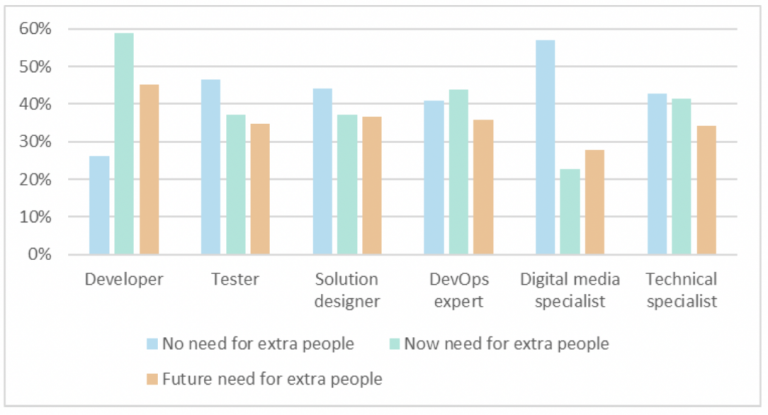
In its 2020 The Future of Jobs Report, the World Economic Forum listed the top 20 job roles where the demand will skyrocket. Almost all jobs on that list are ICT related — with developers firmly holding the 10th position. A trend largely confirmed by our recent findings where 45% of organisations estimated they will need extra developers in the next five years.

ESSA graph 1
2021 ESSA Europe’s Most Needed Software Roles and Skills report “Need for extra people per role profile”

Programming and professional hard skills are in high demand

The ESSA report goes further and tentatively identified the skills in highest demand among software professionals.

Needless to say, hard skills like programming are the most in-demand with Java, Javascript, SQL, HTML, PHP, C++, C#, and Python being the most needed programming languages. But what is important is for software professionals to have a solid understanding of programming principles, so that they can quickly and more easily adapt to new languages.

It has been discussed that profession-related skills are also to be developed.

“Even more important than teaching particular IT skills, like IT framework or programming languages, is teaching how to understand the business. Only if you are able to understand the purpose of the software solution that you are building, you can deliver a valuable product.”

In this regard, our report findings show that security management, agile project management, and software development lifecycle skills are needed and that software professionals with an understanding of the business are the assets organisations are looking for — now and in the future.

Soft skills are key

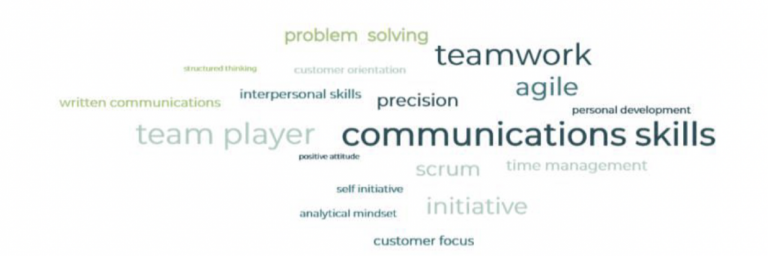
Again, looking at the predictions of the World Economic Forum (2020), we can only confirm and strongly advise people with software roles to not only grow their hard skills, but invest in non-technical (transversal) skills like personal soft skills or interpersonal skills: critical thinking & analysis, self-management, teamwork, and communication skills.

2021 ESSA Europe’s Most Needed Software Roles and Skills report “Soft and other skills for developers”

Of course, soft skills are harder to assimilate when only relying on theoretical knowledge. Thus, it is important to introduce more systematically real-life projects into learning and training curricula.

It's about the details

In October 2021, ESSA released a full report exploring current (and future) needs for software skills in Europe. During the next step, together with the rest of ESSA members we will contribute to addressing the conclusions of the report in a comprehensive document — the European Software Skills Strategy. Visit the ESSA website for more details about the initiative.

In the meantime, we at Codecool are already working hard on bringing better digital education to Europe. Already in 4 European countries, in Austria, Hungary, Poland and Romania, we’re offering mentor-led, project-based developer and other digital skills courses. We’re building on our mastery-based learning methodology and tried-and-tested curricula, and putting an extra focus on developing soft skills, both in our open courses and in our tailor-made corporate solutions. We make career changes affordable and change lives with our job guarantee, post-payment options and the CoderGirl scholarship. 

Learn more about who we are and what we do, and reach out to discuss how we can help filling your software skills needs.

The Codecool Way: 4 Core Values we Follow to Disrupt Tech Education

Company values are important: they can define a company and its brand, help communicate corporate identity and keep everyone aligned with the agreed strategic directions. If done well, they have a direct impact on core activities, shaping the way everyday work is being done at the company.

We at Codecool have been trying to follow 4 simple values for years in our everyday work:

  1. Courage – to explore new things and push limits.
  2. Transparency – sharing information and expressing ourselves, not just when comfortable.
  3. Quality – in whatever we do.
  4. Fun – to also enjoy what you do, so that you become even better at it.

But words are just words. They may sound cool, and we may check out an invisible to do list with them as any serious organisation that should have a list of core values does. But if there is no action behind them, they mean nothing.

So the tricky part about values is not even defining them  – especially that you better define them based on what you really believe in and what you actually do. It’s much more challenging to be always true to our values. How to apply them in different situations, with everyone and at all times. Even when it would be faster, cheaper or simpler to just not bother.

We follow our values in internal processes and ceremonies, among ourselves “in the background”, the way we talk to each other and do our daily work. We follow them when we meet external parties, like our business partners, and they experience them first hand, too, when they welcome graduate Codecoolers in their organisations.  And that’s because we also follow these values when we work together with our students, in the way we facilitate their learning and help them restart their lives in brand new tech careers.

But how exactly do we apply our core values in our training and make them work for everyone impacted?

Let’s dive in.

1. Courage: We step out of our comfort zones

Having courage to explore new things and break conventions is very attractive, but failing can be scary. So pursuing new challenges comes with a price: if we want to stay true to ourselves, we can’t always go the safe way.

You can’t have innovation or deep learning without trying new things. And trying new things naturally comes with failing a few times first. On the upside: the earlier you fail, the earlier you can fix what went wrong, and with the smallest cost possible. 

So we encourage learning by doing and learning from mistakes. We appreciate each failure together. We always give feedback and do a positive reinforcement on failures, as they are a valuable part of the process. For example: “It’s great, that you tried this option and found out that it doesn’t work. What have you learned from this?” 

To achieve innovation and learning via natural failure, we focus on processes rather than outcomes. We aim to create a supportive, fail-safe environment, where real growth can happen, so we also focus our feedback on behaviour, not on personality traits.

For a start, our mentors (we call our trainers ‘mentors’) cultivate a growth mindset. This means that we make sure our students understand and fully believe that with a growth mindset, their skills and abilities can be developed through dedication and hard work. Not by talent, luck, good grades from high school, or an IQ test’s result from last year. It depends on how much they believe they are capable of learning to code. This view creates a love of learning and a resilience that is essential for great accomplishments. To achieve this, we rephrase “fixed mindset” statements. For example, instead of saying “I’m not good in solving math problems” we suggest: “You might not have found your way in solving this math problem, yet. But have you tried … ?”

Learning new things can be intimidating, too. Once in a growth mindset, we finally dare ourselves to move out of our comfort zones to change and to grow. When defining challenges for our students, we concentrate on the “learning zone“, or the Zone of Proximal Development. The learning zone is between the comfort zone and the panic zone – neither of which is a place for learning. In the comfort zone there is nothing new, but in the panic zone there’s way too much. In the learning zone, however, you have the right amount of challenges to tackle. The Zone of Proximal Development inside the learning zone is where the learner gradually moves from learning the first steps with support (of a mentor or peers) towards learning further steps without help (or without ‘scaffolding’).

During the learning process, we make sure to always go step-by-step (sometimes in baby steps). We start routinely questioning ourselves, our beliefs and ways. We turn old stones, reinvent the wheel, understand how and why things work or don’t work, and then most of the time come up with ‘lousy’ new ideas – or at times, with truly ingenious ones. And in the meantime: we analyse, we open our minds, understand how to tackle problems, grow our confidence and learn. We grow – and have a lot of fun in the process.

Besides all this, we do follow-ups and retrospectives regularly. Our mentors also take the courage to face any feedback from our learners, and admit if anything went sideways – then, they focus on these areas of improvement, and turn the feedback into learning opportunities.


2. Transparency: We share and express

Transparency for us means more than just being honest. It means telling the truth at all times and sharing as much information as possible for everyone’s benefit – also with the learners during the learning process.

To support transparent communication, we first establish psychological safety, an atmosphere that facilitates mutual trust and growth.  In a team with high psychological safety, teammates feel safe to take risks around their team members. They feel confident that no one on the team will embarrass or punish anyone for admitting a mistake, asking a question or offering a new idea.

To achieve this we:

  • strive to recognise our own tensions and notice tension in others, that distracts us from being present or feeling comfortable, 
  • communicate tensions in a way that doesn’t hurt others,
  • give a context or a greater perspective about a decision or a behaviour to further enhance involvement and trust,
  • organise ceremonies (sharing/syncing) outside our daily work for bringing up questions or information transparently about things experienced in various situations.

We basically set a good example by communicating transparently, also to encourage others to start communicating transparently, too.

We can use this principle in the following situations:

  1. We give upfront information about the trainings, workshops, etc. We don’t hide any useful information from learners. We tell everyone what will happen, when, how.
  2. We clarify rules, roles and expectations. Then we have a ground to say “no” to learners, if they ask something beyond our agreement.
  3. We consciously avoid having secrets or taboos. What, how and why the mentor/trainer does what she does? It has to be clear for everybody. For example “Why are we doing this exercise?” We give context to the learners – with careful timing of the information, so it helps their learning.
  4. We do regular mappings. We map out our day, the next hour, exercise and even the whole course for everyone in advance. Learners always have to understand the process and where they are in it.
  5. We express our feelings. When our mentor has any tension, they also express it freely. The mentor is not perfect, either, they are a human being with feelings, emotions. For example when learners don’t pay attention, the mentor expresses their feelings about the situation and then asks them to pay more attention.

3. Quality: We put extra work in providing real value

We pursue quality and craftsmanship in everything we do or expect from our students or partners.

For a start, we significantly increase quality of learning outcomes by maximising learning time efficiency through guidance, support and motivation provided by our pro mentors. As opposed to self-paced learning, instructor-led course students are much more likely to finish their studies, and to end up with usable, practical knowledge and skills they can actually implement later in a work environment. They also have much more fun.

One way Codecool mentors engage students and partners for even better result is empowerment. As a start, we define quality together and how exactly we’ll get there.

We follow the principles of subsidiarity – which may sound complicated, but it only means that we tackle problems on the lowest level where information is available to solve them. Meaning that if there is a solution available for the students already for a certain problem, based on their previous project experience, then their mentor will encourage them to find the solution themselves and will not hand it over to them.

Solution focus is a technique we borrowed from Solution-Focused Brief Therapy. It requires future-based thinking and resource consciousness and builds on the notion that “the solution doesn’t care about the problem”. Instead of analysing the problem, we analyse the preferred outcome together with available resources, and derive the possible ways to get there from “top down”, rolling it out backwards from the desired state of final outcome.

The agile methodology is a no-brainer go-to toolset to use in software development context, and we use it extensively, too. We actually go as far as to build our learning schedules around agile ceremonies, and have our students demo their projects in front of real-life “clients”, represented by our hiring partner companies every Friday, from week 1 in their learning journey.

We also believe in efficient, goal-focused meetings and learning sessions. We respect each other’s time, arrive on time and keep timeframes at all times – but that’s only one side of the story. 

We start every meeting with a check-in round where we discuss how everyone feels, so that we can “arrive”, that is put outside problems behind by acknowledging them and sync the mood of the team. This may sound like an overkill or waste of time, but skipping it is just not worth the 10 minutes it saves. People tend to focus and participate more actively and efficiently after this short routine, and the time saved indirectly is a lot more than how long the whole thing takes.

We also do a check-out in the end, to share how we feel then and if there’s anything more to share, to make sure we maxed out our time spent in the meeting together.

Apart from these generic meeting routines, we also do short attendance meetings each and every morning with our students.  At this meeting everyone (including mentors) answers one simple, casual random question generated by a bot (like what’s the one TV show that always makes you laugh, or who is you favourite superhero and why). We don’t react to replies, we just share and listen. The purpose is to kick-off the day on a positive tone and consciously bring in the human element into our work and learning every day, which is also a key tool for building a teal organisation with high standards for quality.

And last, but not least, we build on the 4 principles of doing by non-doing, which in our case is basically a coaching attitude pursued by mentors. The principles are the following:

  1. We don’t know the one single truth: The mentor/trainer doesn’t know the truth, only shares knowledge by her experience. Everyone can challenge the mentor’s or others’ thoughts, ask open questions and start a constructive debate.
  2. We don’t judge: We give specific feedback on behaviours, and we don’t apply labels to people.
  3. We don’t take over responsibility from others, especially from learners: The one who is working hard is actually learning by doing. If the mentor/trainer works hard, it means they learn a lot themselves, but not necessarily the learners. For example that’s why the mentor cannot touch the keyboard of a learner as a rule. We also say: learners should spend most of their time practicing, communicating, elaborating on a task. The main responsibility of the mentor/trainer is to facilitate learning, but the ownership is with the student – they own their own learning, for the best possible result. 
  4. We don’t give solutions: We don’t tell the tricks and give final answers. The learning process is more important than the final answer. Our approach is coaching – we help the learners with questions, guidance, motivation.

Some people intuitively interpret ‘non-doing’ as something passive, laid back or lazy. But if no action is needed, then doing anything may already be ‘overdoing’. In fact, sometimes action can do more harm than good.

If we are growing a plant and we have created the right conditions for growth with healthy soil, sun and water, there comes a time when the very best way to ensure the growth of the plant is simply to leave it alone. More water, more sun, more fertiliser won’t help, in fact, too much of any of these may stifle the growth of the plant. We remain attentive, connected to the plant’s needs but for the time being, doing nothing is just what is needed. 

We do our best not to kill our plants, but let them grow and reach their highest quality.


4. Fun: We make sure everyone enjoys the ride

Choosing Codecool is a life-altering choice for both our day-time course students and our colleagues – so we always put fun high on the list of priorities. If you enjoy something, you’ll become better at it. It’s that simple.

We do believe that learning and work can and should be a fun, light-hearted, and possibly a flow experience, too. We don’t take ourselves very seriously either. We make sure to be able to laugh at ourselves as much as possible.

Our students learn technologies and new skills via life-like, but still playful and fun project assignments, instead of boring, heavy textbooks and frontal lectures.  

A fun learning experience will bring a better end result because of the positive association:

  1. We experience how we all (including the mentor) are just human beings. We all make mistakes, and we laugh at ourselves, together.
  2. We focus on the journey, the experiment of learning something new. This adventure, the discovery can be very enjoyable, genuine fun.
  3. We share interesting small details, fun facts, all related to the topic.
  4. We do more interactive, practice-oriented sessions, and fewer frontal sessions and presentations. Learners will remember the “experience” most: when they were moving, talking, practicing, laughing, etc.


That’s basically it – and of course a lot more. But listing all the ‘secret’ ingredients of our learning method and routines is just not possible in one article. 

We know that every company is different, and your values at your company must be different, too – not better, nor worse, just different. Hope you found this insight to the Codecool values and our ways of working with them inspiring, and that we made you think about yours. 

What core values do you have at your company? What do you do to follow them every day?

Stop and think about them sometime, and find more creative ways to be true to them. It will be well worth your time.

Coding a Better Future – Codecoolers Win Silver at Morgan Stanley’s Hackathon

A team of Codecoolers developed an innovative learning support app, that might change the lives of children with a chronic desease.

Morgan Stanley and the Amigos for Children Foundation asked young developers to help non-profits building innovative learning tools for children and teenagers with chronic diseases, in the scope of a three-month virtual competition.

We’re super proud that the Codecooler team – Zsofia Szonja Kassai, Barnabas Urmossy, Balint Molnar and Kristof Murai – came 2nd place in the Hungarian competition, in an all-university team lineup.

We asked them about their experience at the hackaton and their studies at Codecool.

What motivated you to sign up for the Code to Give hackathon in the first place? Was this your first hackathon?

Zsofi: Yes, this was our first! We were curious about the challenge, we wanted to try ourselves and learn from a longer project. The idea that we might help a nonprofit was very attractive, too.

Barnabas: I wanted to know what it would be like to work together with a client on a project which is much longer than the usual 1-2 projects we are used to. Plus, I knew that we’re a really good team, and wanted to see us as a team develop, besides individual development.

Balint: For me, it was a no-brainer. I’ve never participated in anything similar, and I loved the concept that we can help kids learn languages, sponsored by a huge multinational company.

Kristof: I was also driven by curiosity in the first place. I had no idea what to expect. I wanted to see what we can do being in the 2nd part of our one-year full-stack development training. The idea that we can help kids in need was obviously a huge plus.

You named your team LazyLlamas. Where did this crazy name come from? 🙂

Barnabas: We realised that we shared an interest about llamas at our very first meeting. Then we just sat back like we had nothing else to do until we sign up. We added the “lazy” when we realised that we have just 15 minutes left until the deadline and we still haven’t registered the team in the competition, which was so us, actually.

But it felt good when people mentioned a few times, later, during the competition that based on the way we work we must have meant “lazy” as irony.

What kind of learning support tool have you developed? Can we see it?

Zsofi: Our app has 2 parts, one for students and one for teachers. The part for students is a learning enhancing tool with 6 types of tasks. The part for teacher, or the “Amigos” makes it easy to create tasks, monitor students’ progress and give feedback.

Barnabas: The basic idea was to create an app with templates that help creation of new tasks. And we also wanted to support the communication between the students and the Amigos, so that they can align on tasks and evaluation. On top of this, we wanted to create a gamified system for collecting points to enhance students’ motivation.

Balint: The biggest benefit of the app, just like Barna mentioned, are the templates. We created templates for memory game, word – image coupling, interpretation of written and spoken text, substitution and organisation into categories. We made all of them available on all the languages the Amigos work with.

Kristof: We’re very happy to demo the app to anyone who finds it interesting.

What was it like to participate? How did it feel to get in the finals?

Zsofi: For me it was an amazing experience! We spent the whole time sleeping much less, collecting creative ideas all the time, working together really smoothly as a team. Our original goal was to learn, but we’re so happy we got this far in our first hackaton. And it was super exciting to present our idea to the jury in the finals.

Barnabas: On top of what we have expected, the whole thing required a lot of organisation, project management, copywriting and presentation rehearsals. I really enjoyed being able to practise all this in a real-life development environment. And the experience helped me decide that I want to be a front-end developer after Codecool. Plus, getting into the final showed that we were capable of performing well in such a complex project, even before finishing course.

Balint: The competition was a blast and I was especially happy that I could refresh my web skills, plus learn CSS at the same time. I was really curious how we’ll perform among the university teams, but after the meetings of round2 it was obvious that we’d make it to the finals.

Kristof: I just loved everything about the competition. It was great to see what it takes to organise and put together an app from scratch. We started out super motivated and the ideas just kept coming to us. Then, after we successfully presented our ideas, our motivation got another  boost, and then we just had to fight time to actually deliver on our idea. Getting into the finals felt like a dream come true, and assured us that we did a good job.

What was the biggest challenge in the competition?

Zsofi: Racing with time. We had so many ideas, but it was almost impossible to deliver on them in such short time.

Barnabas: In the last days I found it really difficult to let go of some of our ideas and my maximalism, just like Zsofi. We had to decide what to implement in the prototype and what to put on the next steps slide in the final presentation.

Balint: For me it was CSS! 😀 And as the project kept growing, refactoring. It was really challenging to create and put each task type together, but the end result turned out very organised, thanks to Zsofi.

Kristof: For me, too, the biggest challenge was time, because we just kept getting newer ideas about how to make each task type even better and fancier. We had to draw the line somewhere eventually.

What skills could you use in the competition that you got at Codecool?

Zsofi: Like everything. 🙂

Barnabas: There were 1 or 2 technical solutions that were so specific that we haven’t seen anything similar during the course. But since we also learnt at Codecool how to find new solutions on the internet, we managed to find and apply those, too.

Balint: We had a huge advantage in the finals because we pracised so much already at the Friday demoes in front of clients at Codecool. As for hard skills, for me the hackaton was like “and add-on” to the web modul of the full-stack course. Our app turned out a Flask based, JavaScript-heavy website, with a complex database structure.

Kristof: I got all my coding and developing skills from Codecool, so I used what I learnt there. And when I got stuck, I could always turn to a Codecool mentor for help.

Where are you now in your Codecool studies? What are you learning about now?

Zsofi: We’re at the end of the OOP (Object-Oriented Programming) module, which is the 3rd or the 4 modules of the one-year full-stack development course. We signed up for the hackathon at the beginning of this module.

Barnabas: Yeah, the competition lasted the whole time of the module. Let me take the opportunity to send our thanks to our teammates who put extra effort into our shared Codecool projects, so we could focus on this challenge. 🙂

Balint: It was refreshing to work on something totally different while also coding in Java (but obviously the last weeks of OOP were also about web based stuff, databases and such). I’m actually just about to start my last module, I’ll specialise in Test Automation.

What are your plans for after Codecool?

Barnabas: I will start looking at web app front-end developer jobs with real confidence after this competition.

Balint: Precision planning is far from me, I have always been going with the flow. I’m curios about the Test Automation specialisation at the moment.

Kristof: I liked the web modul best so far and especially after this result I’m looking forward to become a web developer, too.

What will you do with with your prize? You’ve got some EMAG vouchers.

Zsofi: I haven’t decided yet. I want to make good use of it.

Balint: I killed my laptop a few months ago, so I got a new one from my prize.

Kristof: I have always wanted a smart watch, but I’ve never came around investing in it. Now I have.

What is the biggest learning for you from the competition? Is there anything your would do differently in retrospect? Would you ever enter a hackathon again?

Zsofi: The biggest learning for me, how much I actually learnt during the ride. I’m satisfied with our performance and would definitely go for another hackathon, too, sometime.

Barnabas: In the beginning I haven’t even realised how big of a task we took on. It even started to get a little scary after a while. But seeing that we can do all this, I started to come up with new ideas and challenges in the last days. I would definitely do something like this again.

Balint: i would do a lot of things differently, for example I would stick to naming conventions form the very beginning, and make SCRUM standups regular. But we all did our best, and I would definitely do this again.

Kristof: Since this was my first hackathon, I would do many things differently. But it was an amazing experience and I would definitely be up for the challenge again.

Inspired by this success story? Want to work with juniors like these amazing Codecoolers?

Our fresh graduates are waiting. Reach out and let’s discuss how we can help you.

We can’t wait to talk to you!

Boost Team Productivity: Follow These 4 Rules of Doing by Non-Doing

Looking to learn new ways to make your team productive? Non-doing doesn’t exactly sound like a productivity spell, but it can become one. Let’s see, how. 

As we are slowly returning to some kind of a new normal and exploring hybrid work options, productivity challenging online meetings, home office days and virtual team setups remain our reality.

Managing a learning organisation, team energy and effectiveness has never been more more tricky, than in this almost-post-pandemic era. We have to learn new ways to stay productive again, even if they make us leave our comfort zones for a change.

Non-doing doesn’t exactly sound like a productivity spell, but it can become one. The idea is not new at all, but it might just be time to revive it.

Where does the concept come from and what does it even mean?

It’s an ancient idea that’s certainly stood the test of time, having first appeared in the great Chinese philosopher Lao Tzu’s writings over 2000 years ago. And although “wu wei” literally means non-doing or non-action, it’s anything but a form of passivity.

Think of non-doing as effortless action: getting the greatest outcome possible by doing the least possible.

Why is it relevant today?

But why should we embrace this very concept in an age of constant change, competition and pressure to perform?

For starters, because it’s time for leaders reinventing their management styles.

In the golden age of the knowledge society, autocratic management (even the parental style, with the kindest possible intent) is hardly ever a good strategy. The most successful companies and teams out there aren’t the ones that always follow the rules but the ones that don’t think twice before completely rewriting them. And they tend to have managers that expect the same from their employees.

In a game where creativity wins it all, good leadership isn’t about instructing, dictating or checking. It’s more about asking, inspiring and supporting. In other words, non-doing.

Here are our 4 don’ts, if you want to master the art of effortless action.

1. Don’t try to be a know-it-all

A company culture based on non-doing is built on the fact that no one holds the Philosopher’s Stone. Meaning that no leader or team member has the ultimate truth.

Why is this important?

First, because there is no Philosopher’s Stone – and noone is infallible.

Second, because if you obsess about single truths, you’ll encourage unhealthy group dynamics. Whether you’re in a meeting or in a classroom, if your feeling of being right shoots up, so does your feeling of authority right away. Authority limits flow, creativity and innovation.

When building a supportive environment instead of a domineering one, finding a single right solution or flashing your insight will loose its significance. You’ll embrace the search and remain open to experiment, take risks and even stay silent, as needed.

2. Don’t put people in boxes

Aka the number one rule for a strong feedback culture: try not to stick labels on people, whether positive or negative.

For example, if you say “You’re smart!” to someone, nobody will know what exactly was good about their work, including them. Similarly, if you tell someone they’re slack, you basically imply that there’s something wrong with them as a person, not helping with constructive feedback to improve.

That’s why labelling is one of the biggest obstacles to development both for individuals and a company as a whole.

Don’t put stars or talents on a pedestal, but put the valuable behaviours in the spotlight. Make sure these are transferred among people, supporting learning, growth and motivation at company level.

3. Don’t offer ready-made answers

In a non-doing organisational culture, employees value attention more than solutions.

So if someone has a problem, others shouldn’t tell them how to solve it, but help them find the answer instead. Even if this means that a task will take longer or require more attempts.

How will that help?

If you hand ready-made solutions to someone on a plate, you also take away something crucial: the opportunity to learn. If you want someone to grow, you need to assist them with creating a learning environment in which they themselves go through trial and error.

On the side, you’ll boost their motivation and who knows, even you might learn something new in the process.

4. Don’t take away responsibility from others

In other words: “No pressure, no diamonds”. The saying rings as true as ever: people can only improve if they’ve got responsibility, if what they do is meaningful and has consequences.

Autocratic leadership (including micro management) withdraws this power, as it takes away the possibility from others to become and remain in charge of their own work and growth.

So just because you think you’re better or faster at a task, don’t take it over from others.

If an employee would like to change something at the company, and it doesn’t directly violates shareholder interest or personal safety, consider letting them do it. The company is as much theirs as yours, and they need to experience this. Try make every project run by whoever is the most motivated. Work actively on creating a sense of ownership, and enjoy the benefits.


We at Codecool actively and consistently practice non-doing, or non-teaching at our courses. We facilitate discovery by learning instead of providing all the answers upfront. This way Codecoolers gain a deeper knowledge, enhance their creativity, develop a passion to learn more – and have much more fun.


Obviously, there are situations when non-doing is not  good idea. If a fire breaks out, please ring the alarms, and don’t wait for a team consensus on possible even better solutions and learning opportunities.

The point is: the house is not always on fire, and you shouldn’t act like it is. Start with noticing if you do, and try something different for better results: try non-doing instead.

Motorola Solutions Launched Developer Academy Powered by Codecool

Motorola Solutions in Poland teamed up with Codecool to train 26 developers in the newly established Motorola Solutions Academy last year. The selected participants attend the 7-months long training programme for free. 

The Academy was founded by Motorola Solutions to tackle the IT talent gap hitting many IT companies across Poland.

Almost 500 people applied to Motorola Solutions Academy, a special training programme developed by Codecool Poland for Motorola Solutions. From the 500 the 26 best were selected in a thorough selection process. 

During the 7-month long education programme the participants learn solid back-end or front-end developer skills from scratch. Graduates are guaranteed to be employed at Motorola Solutions in Krakow.

How were the participants selected?

The recruitment and selection process, as well as the learning path of the programme was tailor-made for Motorola Solutions by Codecool, a leading programming school in CEE. Codecool provides full-stack developer and short-term IT specialists courses across Poland, Hungary and Romania. 

To find the most suitable candidates for Motorola Solutions, the school’s mentors and recruiters:

  1. filtered almost 500 applications,
  2. conducted 100 interviews and
  3. evaluated 80 beginner level coding task submissions.

What's next?

The free training programme started in December 2020. Students are spending 6 to 8 hours per day from Monday to Friday for 7 months to learn their brand new profession. 

The curriculum is structured around an alternating weekly schedule. One week participants have lectures and workshops at Motorola Solutions, as the pandemic situation and the current regulations allow. The other week they work individually or in teams on their own projects. 

Students not only learn the latest technologies, but also improve on their soft skills to ensure a smooth onboarding to the Motorola Solutions after their training.

The Motorola Solutions Academy vision

“Motorola Solutions is an ever growing company with a high demand of IT professionals. Multiple new employees join our Krakow office each month. We run different software projects from developing critical communications, command & control systems or intelligent public safety applications, to creating an image analysis software with artificial intelligence. 

As finding the right talent on the market is often time-consuming and challenging, we decided to walk a different path. 

With the support of Codecool we set up the Motorola Solutions Academy to train the exact talents we need. This cooperation gives us an opportunity to benefit from the proven, practice-oriented education method of Codecool, and combine it with the knowledge and values important for us.

We look forward to starting working together with these highly motivated students Codecool found for us”, commented Jacek Drabik, President of Motorola Solutions Polska.

We are proud to make Motorola Solutions Academy happen

“Working on Motorola Solutions Academy has been one of our most inspiring projects in Poland. 

We truly believe that the way Motorola Solutions chose to fight against the labor shortage is one of the most effective ones. While the recruitment process, the development and the implementation of the education programme was outsourced to Codecool, the integrated programme fully reflects Motorola Solution’s needs. 

At the end of the 7-month training 26 ready-to-work employees will join their team. They will know the technologies used by the company, the projects they are going to work on, and the company itself. Onboarding costs will have been saved as well“, said József Boda, CEO of Codecool.

“I Found My Place in the World” – Codecool in DIGITALEUROPE Video by BBC StoryWorks

At Codecool we believe in a digital future built by amazing, everyday people – changing the world, starting with themselves. These hard working individuals all have a strong drive and shared passion to start their lives anew in future-proof tech careers.  We do our best to help them on their journey, and in the end connect them with innovators so that they can contribute to corporate digital strategies with a purpose.

Our mission and one of our Codecooler’s story inspired DIGITALEUROPE. They decided to share it in a video produced by BBC StoryWorks, in the scope of a new video series, titled ‘Digitally Enlightened‘. 

We are proud to be featured in the series and hope to inspire others, too, to believe in a bright digital future for Europe. 

A story of self-realisation and special value

In the video we get to meet Dóra Koreny first, an ex-Codecooler. Previously, Dóra studied hard for years to realise her ambitions, only to find out she couldn’t find happiness in her job in public healthcare. To reinvent her life, she decided to learn programming at Codecool. Today, she feels she made the best decision, and is happier in her new work than ever. 

We also get to know John Ford, VP Engineering & Site Leader at LogMeIn. John sees Codecool graduates as being “very rounded”. He believes that the fact that Codecoolers often come from different backgrounds makes them really special candidates, and great team members that are easy to work with.

Calling to action for a stronger, digital Europe

With 82 corporate global leaders and 39 national trade association members representing over 35,000 businesses, DIGITALEUROPE is the leading trade association representing digitally transforming industries in Europe.

They stand for a regulatory environment that enables European businesses and citizens to prosper from digital technologies. They wish Europe to grow, attract and sustain the world’s best digital talents and technology companies.

In the end, DIGITALEUROPE strives for a Europe where digital technologies, innovation and artificial intelligence can provide citizens with competitive jobs, better health and better public services.

Taking our story further to inspire

BBC StoryWorks is the content studio of BBC Global News. Building on their century-long pedigree as the world’s most trusted storytellers, they work with brands to create beautifully crafted stories that move and inspire curious minds, across platforms and across the globe – in a way that is consistent with BBC standards and values.

Exploring Europe’s workforce expanding the digital frontier

The landmark film series titled ‘Digitally Enlightened’ was created by DIGITALEUROPE together with BBC StoryWorks , to share great ideas and success stories of Europe going digital. 

The series was launched on 14 April, and explores how a common vision would help digital innovation scale up and flourish to the benefit of consumers and companies.

”The Future will be More Digital. The Question is: Who is going to Design It?”

We were there at Masters of Digital online conference last week to discuss the status and future of tech education in Europe.

Masters of Digital 2021 virtual summit presented an amazing line-up of digital leaders, brains and ideas from all over Europe on 3-4 February last week. The organiser was DIGITALEUROPE, the leading trade association representing digitally transforming industries in Europe. The event was subtitled „digital as the driver for Europe’s recovery”, and focused on the bright future and equally exciting present of European tech.

Codecool’s CMO, Anna Ferenczy, was also invited to the main stage panel „Digitally Enlightened: New World, New Skills” on day one of the event. The digital experts on the panel discussed what the upskilling landscape in Europe looks like now and where we go from here.

Spoiler alert: digital upskilling not only has a huge growth potential, it is actually an essential enabler in closing the widening tech skills gap.

The four experts invited to the panel represented both business and government sides, educators and support bodies, early and adult education experts, international and local organisations:

  • Una Fitzpatrick, Director, Tech Ireland
  • Anna Ferenczy, Chief Marketing Officer, Codecool
  • Mette Lundberg, Director of Politics and Communications, IT-Branchen, Denmark
  • Norberto Mateos Carrascal, EMEA Territory Business Consumption Director, Intel

The discussion covered a wide array of topics including:

  • enablers to make tech careers more inclusive,
  • necessity of early digital education for all
  • recent generic changes in career prospects,
  • COVID 19’s impact on tech education trends,
  • remote work and education insights, and
  • digital innovation’s impact on the environmental crisis.

We collected some insights from the discussion that we found especially inspiring.


1. „We should not take European tech education for granted.”

As Norberto Mateos Carrascal of Intel highlighted, if we look outside Europe we soon realise how fortunate we are in Europe on a global scale to have tech and education systems in place, available to a large part of the population.

However, we must see that there are still huge differences between regions regarding access to these systems, and even if there is access, we sometimes cannot fully utilise it.

We must provide the infrastructure where it is missing, and educate the educators on how to use technology.

COVID 19 challenged us to move both public and private education online, for kids and for adults, too, from one day to another. We could soon see how much public education in general lags behind private institutions in the use of digital tools across Europe, due to many times outdated infrastructure, curriculum and skills. Private schools, on the other hand, like Codecool, are more flexible and were able to make the switch fast and without disruption.

Mette Lundberg highlighted that you can see clearly in kids in online classes today that they are more passive, less engaged, have lower energy and don’t participate much.

Panelists agreed that this is because the quality of online education must also be improved. We need to bring excitement to online education, significantly upgrade the online student experience.

Ways to achieve this include trying curriculum innovation, implementing AI, and hybrid learning options (like Codecool’s model of varying individual coaching sessions with larger webinars and small team work activities).

Anna Ferenczy added that cooperation between the government and private schools can also be a powerful enabler of more accessible digital education.

2. „Heavy tech users don’t necessarily have tech skills.”

Mette Lundberg pointed out a basic misunderstanding about tech skills, namely that even the new, digital generations are not as digital as we might think they would be. She highlighted that although most children become superusers of technology at an early age today, still they don’t know how to create technology, they lack basic tech skills. The Danish IT Industry Association started a digital education program in Danish elementary schools to change this, and it has already reached 15,000 children.

In a quick poll 25% of the panel’s (obviously rather tech oriented) audience also admitted to being addicted to their mobiles and having no tech skills whatsoever. Confirming the fact that probably most non-tech oriented, but tech user adults lack creative digital skills, too.

A member of the audience challenged the panelists whether it is really useful to teach tech skills when tech is changing so fast.

The experts agreed that in the education of the future workforce soft or meta skills, like computational thinking, creativity, and effective learning are much more important than actual programming skills. Anna Ferenczy highlighted that employers today value a solid combination of soft skills combined and tech skills, too.


3. „Diversity is not just a moral or ethical question. It’s also about profit.”

Una Fitzpatrick talked about a highly productive collaboration of a group of businesses with the government about the „Connecting Women in Technology” program, which aims at shifting the gender balance in digital employment, by attracting, promoting and encouraging women in STEM careers.

She explained that you have to make tech careers attractive to women to make an impact, and that this work starts at an early age in schools, and continues at the workplaces that need to offer a female friendly environment, use accessible language, and provide promotion opportunities for women.

Anna Ferenczy pointed out that diversity should not only be a key moral and ethical consideration, but also a financial and productivity based one. One recent research found that companies with women executives in their boards realised bigger share price gains, stronger revenue growth and higher profits.

Una Fitzpatrick added that there is a huge potential in and a need for providing access to tech education and jobs to the growing aging population of Europe, too.


4. „It’s not even about the future anymore. It’s about now.”

Anna Ferenczy mentioned that while we are all aware of a growing global IT skills gap, there are also more than 3/4 of a million jobs in Europe that companies cannot fill today.

We must realise that everyone should be prepared for constant learning during careers. We don’t have the luxury anymore to only study in the beginning of our lives, and then work from that knowledge in the next 40 years. Due to constant and accelerating innovation jobs are continuously changing, so people need to change their skills, too. This will only get faster in the close future, so everyone should start upgrading their learning skills.


The 45-minute panel discussion could only scratch the surface of some key ideas and concepts shaping the future and present of digital reskilling in Europe.


The organiser DIGITALEUROPE, together with BBC StoryWorks Commercial Productions also created a landmark film series, titled ‘Digitally Enlightened’, to help sharing great ideas and success stories across Europe. The series explores how a common vision would help digital innovation scale up and flourish to the benefit of consumers and companies.The series will also feature an episode about how Codecool is disrupting tech education in Europe to narrow down the digital skills gap and change people’s lives by helping them start their tech careers, at the same time.

Photos: DIGITALEUROPE

Starting the New Year Stronger and More Mature than Ever Before

József Boda, Codecool co-founder and CEO tells us about why he thinks we should count 2020 as a „dog year”, how Codecool will shift to rocket gear in 2021, and what he wishes for all us for the new year.

2020 was a really good year for us at Codecool. I am actually admitting this with some reservedness in the middle of a global pandemic. When we were deeply shaken to witness the collapse of whole sectors, the shutting down of hundreds of companies around us. Thousands losing their jobs, all of us worrying about our loved ones’ and our own health. But we at Codecool have delivered all our key targets last year, and exceeded our own expectations by going online practically seamlessly, and growing our business at the same time.

If you asked me around this time last year, if we would be able to enroll our students fully online, take all our classes online, build partnerships online and place our alumni at those partners also online, I would have replied: „Are you kidding me? We surely would not be able to do that.”

And to do this all practically from one day to another? When our very essence is the Codecool vibe at the school where we spend long hours together everyday? And at the same time achieving a record number of yearly enrollments in the 3 countries with a 1.000 students joining us in total? Never ever. But then we did just that. Successfully. We were the most amazed that this was not all impossible.

After the first shock we quickly switched to agile mode. We wanted to help at once. We developed two apps for the National Ambulance Service in Hungary, and support guides about online education for public school teachers in Poland and Hungary. In the meantime, we have moved all our courses online without any considerable hiccup, and enrolled over 300 students to our government supported courses in the autumn. These courses are still going strong in all four specialisations, and we really hope that this forward-looking, popular programme will be continued in some way. In Poland, we have scaled up our weekend courses, and launched our first ever strategic corporate partnership programme with great success – a new service which we would like to roll out in all the other countries, too. In Romania, our first students have completed our first courses, we have forged new partnerships, and the first Codecoolers have started in their first IT jobs. Huge successes to all of us!

Let’s make something clear: these things have not just accidentally happened to us.

We must remember that all of us who have survived last year have been lucky. The only „mistake” that many others made was just being in the „wrong” industry, or they simply became the victims of circumstances.

On the other hand, the huge work done by our colleagues, mentors, students and obviously, our partners all contributed to our success. While, just like many other companies, we were running on non-stop crisis management. In Romania and Poland even without a „Summer break”. (In Hungary we had a chance to literally breath a little freely between the first and the second waves of the pandemic.) I personally felt like on an emotional roller coaster, daily fluctuating on the wide scale between desperation and „yess, com’on, we can do this!”. And I’m pretty sure I was not alone. But all this just made us stronger and brought us closer somehow. And I am so very grateful for this. Without the tireless work, infinite enthusiasm and full trust put in Codecool by everyone in 2020, we would not be anywhere near, where we are today.

Because today, we are actually starting the year stronger than ever before.

Stronger and more mature. Today it is not only the last year, but already five years behind us. (Though I used to say sometimes jokingly that we should count 2020 as a „dog year”, because it really felt like seven, but let’s just count it as one.) And these five years were spent learning not only by our more than a 1000 graduated students, but also ourselves. We have learnt to grow up to our goals, tasks, and the endless trust we have received. And so we have been getting ready for the new year in a much more structured manner this time, with much more detailed plans and in general, with much more control, than ever before.

And to say that our 2021 plans are ambitious would be an understatement.

We will open schools in two further countries next to Hungary, Poland and Romania – one planned for the first half of this year and one for the second. Having listened to our partners, we are widening our corporate services in each country, and enhancing our strategic partnerships. Building on last year’s learnings and international best practices we are lifting the online Codecool learning experience to a new level. And as soon as possible, hopefully by the summer, we are slowly, gradually returning to our favourite places, to the offline schools, too. Stabilisation and growth – these two words summarize our 2021 plans for me best.

However, if we have learnt something last year it is that anything unexpected can happen and overwrite our plans in a flash. We have also learnt, on the other hand, that we will probably be very much able to manage even such unexpected situations. We have learnt to trust ourselves better, than before.

We have learnt that we can carry out our business plans, and we can save our good spirit in our personal lives.

Just like when together with my wife, we managed to carry on performing in our jobs, even with our three kids at home in ad hoc arrangements controlled by changing elementary and middle school closure regulations. It was quite a ride some days, I must say, though surely not as much as for single parents. Or, when I had to help out my English teacher mother remotely, with no tech skills whatsoever about how to hold classes online. This is actually Codecool core competence, which I had the chance to practice in real life. But besides the challenges there were really pleasant things, too. I felt incredibly lucky to spend every night at home with my family, and I actually put more miles in my bike last year than ever before. (7.500 kilometres. Not a world record, but my personal best by far. 🙂 ) The reason was that I stopped travelling around our offices on a weekly basis, a big change after only sleeping at home max. four nights in a row last year.

In the meantime, we have also learnt that besides managing challenges, we can also keep our promises.

Because what do we promise every day again and again? A new profession to our students. A new career, hobby, self-realisation, even the chance for a better life. New talents to our corporate partners. Talents that are not only easy to work with, but also a pleasure to have in the company. Corporate trainings which can help them keep and get the best out of their own employees. And a workplace to our Codecool colleagues, where each and everyone is equally important, where we trust each other and where we feel like in a second family together.

And I wouldn’t promise anything more for this year, either – would rather just have a single wish if I can.

To see each other again, soon. After all the hardships, the excitement and all the plans, I miss this one thing only – our personal, offline gatherings. So this is my wish, not just for myself but for all of us – that we meet again, as soon as we can in our offices, our schools, at interviews, at meetings, at personal get-togethers. Until then, I just wish a little bit more strength and patience on top of this, and rewarding work. And a happy, successful and hopefully a little bit easier new year.