Meet cool leaders: Olga Zelent, CM @Codecool Poland

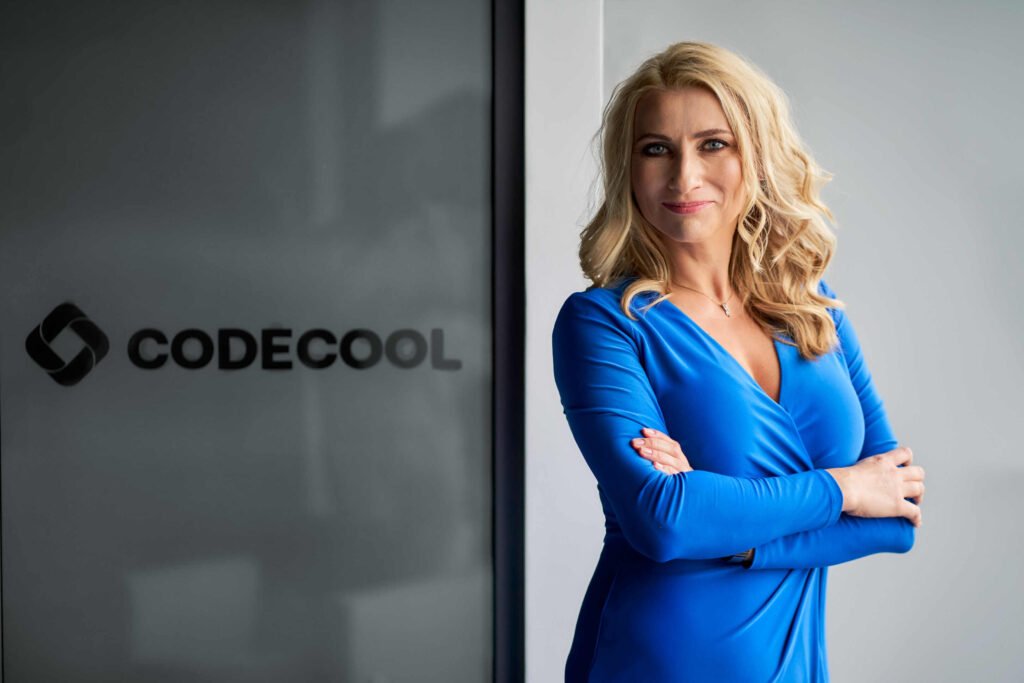
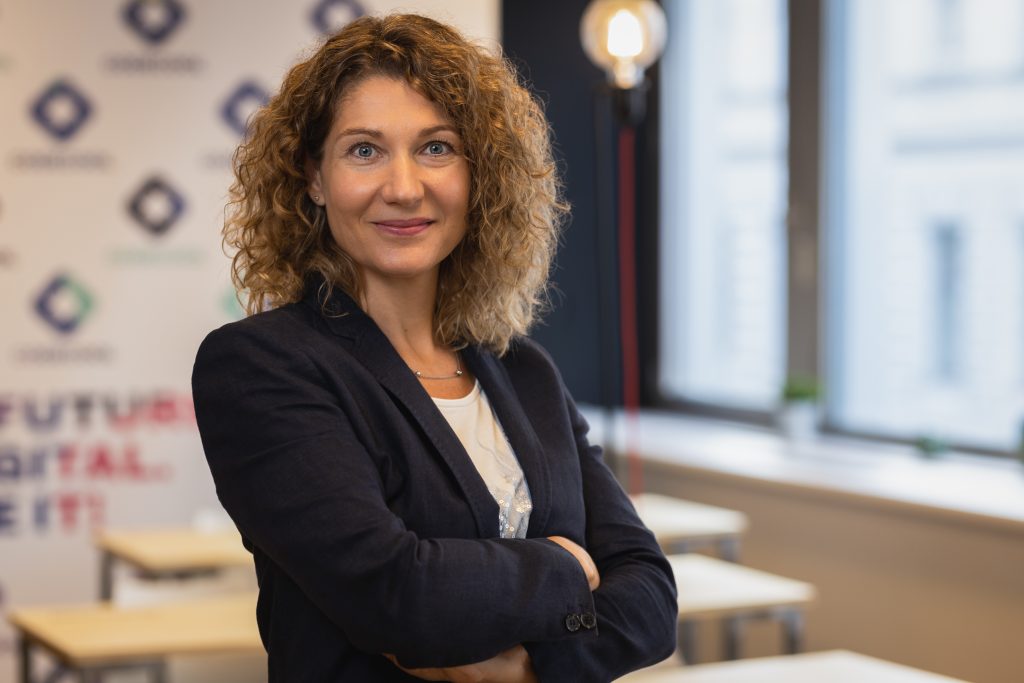
Olga Zelent

In this blog post series we’re sitting down for a chat with people making the Codecool vision happen. Please meet Olga Zelent, Country Manager of Codecool Poland.

Olga Zelent

If you want to meet inspiring people, Codecool is a great place to be. Everyday we meet hundreds of smart, ambitious and cool students that study with us to change their careers and our shared digital future. And we meet innovative, great leaders with a vision from hiring companies, that employ our students to build a digital future. But it’s not only our students and partner company leaders who inspire us. We also make sure to work with colleagues that are equally amazing, and make the Codecool mission and vision come to life.

Last time we talked to Sigrid Hantusch-Taferner, Country Manager of Codecool Austria. Missed the article? Make sure to catch up now.

This time we had the chance to sit down with another inspiring Codecool leader about her current goals, challenges and outlook on the future. We’re super excited and proud to introduce you Olga Zelent, Country Manager of Codecool Poland!

Olga, how would you introduce yourself, if you were not allowed to mention your work? 🙂

I’m a bookworm, a sports-addict, a theatre junkie and a yogini :heart: I respect all beings, and strongly support equality, especially equality of women in all walks of life (and also in business, IT and boards). I am totally in love with Italy, especially the southern part of this stunning “paese”. I am super happy to be a mom of almost adult teenager Hubi, and sweet doggie Chico. 

What is your work now actually? What are you responsible for?

As a country manager, I’m responsible for the general management of the local business activities of Codecool in Poland. My main duties include scaling up the Polish branch. As always, people are the most important for me so I strongly focus on my team’s wellbeing. Motivating the team and working together is crucial to meet our ambitious targets. 

My job in the end is to make sure we attract more and more talented students, and partner up with more and more corporate partners in Poland, who focus on innovation and digitalisation, looking to either grow or re-skill their teams.

What did you do before?

Originally I’m coming from a totally different area: I am a lawyer by education and I have a background in the pharmacy market. After learning everything I could about the field in sales, operational and general management positions for 10 years, I felt I needed a change. I found information technology and the idea of taking part in shaping our digital future super exciting, so I decided to start anew in this new area. And I never looked back since. 

Why did you decide to come work for Codecool?

Before joining Codecool, I already gained experience in IT at a big digital service provider, and also as a scaling-up expert. I spent some years working for one of our competitors, another Polish programming school as well. I made my decision to join Codecool in July because I saw that my experience could come just at the right time for the local business, and also because the Codecool mission really impressed me.  

I wanted to be part of changing people’s lives for the better by providing them quality, accessible IT education and helping them land their first tech jobs. I already knew the market, I knew what it meant to grow the company from a start-up to a scale-up, and I was excited that I could contribute to closing the digital skill gap in Poland.

Olga Zelent Codecool
What's the biggest goal that you set out for yourself in Codecool?

We’re working on making Codecool the first choice for people who want to learn coding really well, but without having to study for long years. Codecool is more than a bootcamp and better than a university, and we want to grow it bigger to bring this ground-breaking type of programming education closer to even more people and companies. 

I couldn’t do all this without a great team, so my first task here was to strengthen the stability and motivation of the local team. Our next, shared goal is to make Codecool a leader in the alternative tech education market in Poland.

What do you see as your biggest challenge currently?

Our biggest challenge on the market today is to show that our offers are not empty promises, but true propositions. We offer a real job guarantee, actual post-payment options, and high quality, project-based education for our students.  And we offer quality candidates with agile project experience and advanced programming and soft skills for our partner companies. Our competitors are fast to repeat all our promises, but they fail delivering on them. The result is a loss of trust impacting the whole market, and Codecool, too, obviously. 

We are doing our best to show Polish people and companies that we can be trusted to deliver on all our promises and make no compromises about keeping our end of a learning or partnership agreement. I know it all sounds too good to be true, but we really managed to come up with a unique business model that works, and when we promise something, then we truly mean what we say.

What trends do you see in the world that impact your work at Codecool most?

We see that the pandemic brought a significant change of attitude in big companies. They’ve started to see more value in re-skilling and up-skilling their existing workforce instead of letting go employees and hiring new ones to grow the digital skillset of their organisations. They are now trying to build stable, loyal, strong in-house digital teams by retaining and  motivating their best people, as well as enriching their skillsets through quality tech training. 

Codecool is not only about open trainings, we can be valuable allies in building digital skills in-house. We have a solid track record of quality corporate re-skilling and up-skilling training programs, as well as full-scale internal academy solutions. Our courses are always tailor-made to the exact business needs of our partners, because every organisation and every digital strategy is different.

Why do you think hiring companies should partner up with Codecool?

We’re quick, flexible and effective. We offer great junior programmers that we ourselves would be happy to work with. Who have the motivation and skills to deliver value in the jobs from day one as proactive members of any team. The hiring process of Codecoolers is fast and painless, too, while our corporate solutions are tailored to our partner’s specific needs and exact requirements. Internal academies powered by Codecool have a proven track record of re-skilling and up-skilling existing employees to work together in highly effective digital teams. 

Where do you think Codecool is going in the short and long term?

In the short term, we’re becoming the first choice for more and more people thinking about a career change to IT, and for more and more companies with ambitious digital strategies and a mature approach to tech talent recruitment and digital skill development. 

In the long term, we’re growing into being the leading programming school, and digital educational and hiring partner in Europe.

How do you see our shared digital future?

I see a bright future with our lives, economy and markets entirely built on digital solutions. And I see teams of digitally skilled people building these solutions in cooperation, using not only advanced technology, but also strong soft skills for a better, fairer, more inclusive digital future.

Your top 5 favourite Codecool blog posts from 2021

man reading blog post on mobile

Read again and get new inspiration from your favourite articles by Codecool about training, recruitment and management from last year.

man reading blog post on mobile

It’s almost the end of the year, a great time for some nostalgia. We thought we’d look back and see which of our articles you enjoyed the most last year, which ones generated the most heated discussions, and which ones inspired you most. It was great reading back all your thoughts in comments on LinkedIn under some of them, or just see how many likes and other emojis each got. 

Here goes the top 5 of your favourites. Enjoy (re)reading them!

This was by far your number one favourite post this year. It’s about what we found to be the biggest obstacles to closing the ever growing IT talent gap. The fact that it was so popular shows how important the topic today is, and how many companies struggle with the gap.

4 of the 7 main reasons we found about why it’s still there were:

  1.  Going digital beyond IT, or the fact that more and more digital positions are opening outside of IT, too, in business departments
  2.  COVID-driven digitalisation of not just those innovation areas in previously defined digital strategies, but also forced, quick digitalisation of further, business-as-usual processes
  3. Inflating prices in some countries raising salaries of anyway-not-cheap tech professionals, too
  4. Growing EU and VC funding creating more-and-more IT jobs to fill, especially from 2014 on
Curios about the remaining three? Read the article now, and get inspired about the complex background of this global challenge.

We found that quite an intense discussion started under this post on LinkedIn. It seemed that everyone has an opinion about this controversial topic, and loved seeing your arguments and examples.

Our view,  explained in the post in detail, is that university education has many values, and there are positions where it’s absolutely necessary to have as a background, but there are many more, where it is not. We looked into some statistics from a related research, looked at reasons why we’re biased towards university graduates, and how it can be harmful. We also gave practical advice on how to adjust your selection criteria, if you decide to drop the university degree from your list of primary filters for a candidate.

The article was posted last January, but it still does have its relevance. Open to consider its facts and arguments? Read it (again) here.  

Have you seen the meme, where a woman jumps from a burning building with a sign saying “2020” down into a huge round sheet stretched out by firefighters, only to bounce back and fly into another burning building through the window, with a sign saying “2021”? Well, let’s just say, 2021 didn’t really bring the relief of the pandemic situation and it’s effects that everyone hoped for in the beginning of 2020. 

Recruitment faced its own challenges, after the initial freeze in 2020 through gradual revival, but complete overturn to online and remote operation. The difficult part of writing this article wasn’t the collecting of the challenges, it was to show the opportunities. But we managed, and this became one of your favourites from our blog posts this year.

Wonder how the impersonal, tech-dependent online recruitment process can bring advantages? How the insecurity of jobs in 2020 resulting in lower number of candidate open for a change could work for you? How the digital skills gap can shake your HR strategy up in a good way? Give the article another go, and collect fresh inspiration.

Besides closing the tech talent gap in general, getting more women into tech has been a major focus for companies all over the world in the past years. Since we wanted to do something, too, we created the CoderGirl Scholarship in Q3 2021. The scholarship allows talented and determined women and girls to learn tech for free with us with a guaranteed position in the end,  matching their new skills . We even started a whole new Cyber Security Specialist Course solely for women, with scholarship places only, in November.

In the article, we brought you some facts and figures about the gender gap, as well as some interesting examples when digital product launches went bad only because there were no women involved in the development. We also asked you be part of the change and join us in inviting more women into tech. 

Doesn’t ring a bell? (Re)read the article and be inspired.  

This las one on our (your) list was actually our very first post in 2021. It was a very personal look back at 2020 and look ahead at 2021 by Jozsef Boda, global CEO of Codecool.  It’s quite interesting to reread it and see how we realised our plans (like our series B expectations and the opening of our newest campus in Austria). 

How does he evaluate 2021 and what are his expectations for 2022? You can soon find out from another similar post to come early next year. 

Until then, read (again) this article for a bigger context and some nostalgia.

The above are just a few examples, of course. There were quite a few other blog posts you really liked, like our collection of inspiring podcasts, a success story of one of our graduates featured in a BBC StoryWorks video about our school, and a behind the scenes guide to how we put our company values into practice in tech training.

If you’ve enjoyed reading our blog posts this year,  make sure to subscribe to our Codecool Business newsletter for more.

Stay with us and keep getting inspired for a better digital future in 2022, too.

Kövess be minket a Linkedin oldalunkon is!

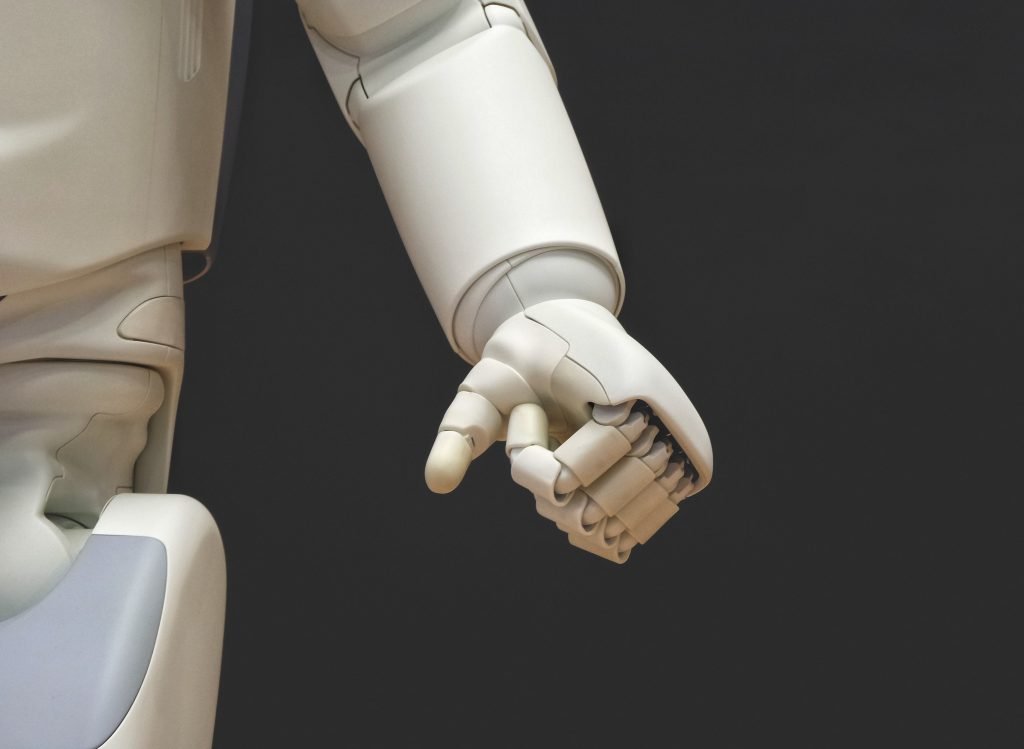
Artificial Intelligence – friend or a future foe?

Artificial Intelligence (AI) has the power to change the world, for the better or the worse. But let’s not think in such a black and white manner. Let’s explore the top arguments for and against AI, and try to discern if this exciting technology is about to cause our doom or eternal bliss.

Just stop and think about AI for a second. What pops into your head? Is it a sense of hope and optimism about our future? Or an eerie feeling that leaves you wondering if humanity is in danger?

You’d be right not to have a biased view. There’s a lot to consider here, and we’re here to recap on the key factors. 

The world of robots, automation, and the bright – or not so bright – future of humanity are all complex matters. And we’re bringing you the top 4 arguments for, and against AI. But first, let’s sort out the basics.

The difference between AI and ML

The two terms don’t mean the same thing even if people tend to use them interchangeably.

  • AI, that is Artificial Intelligence is the bigger, more complex concept. To create Artificial Intelligence means to simulate the thinking capability and behaviour of humans in machines.
  • ML, that is Machine Learning, on the other hand, is happening when an AI learns from data without being programmed to do so.

So AI is to mimic human intelligence and get machines to carry out tasks in a smart, humane way. All the while ML allows machines to learn from data and become even smarter overtime.

AI at the moment is pretty far from where Skynet is in The Terminator, but that doesn’t mean it won’t get there at a point in the future.

So what is AI currently capable of?

Well, amazing things for sure, but not world dominance. It can do:

  • Profiling – Based on a person’s actions, choices, and preferences. Just think about your Netflix or Spotify recommendations.
  • Predictions – Using data to predict future events. Remember those projections and charts about the pandemic? Yup, that was AI in its prime.
  • Pattern recognition – To find patterns in behaviour, and to show the anomalies. It’s there when Google suggests things, or when Gmail finishes your sentences.
  • Natural language – To understand the way humans communicate, and to be able to react in a similar way. Think Siri and Alexa, but also chatbots that pop up on your screen.
  • Object identification – It can detect objects that it was trained to recognise. Think self-driving cars and in-time recognised obstacles.
  • Goal achievement – This is present in video games, where you play against the computer. The ML algorithm can learn on its own in any environment, and win, with maximised outcome.

So yes, AI is already advanced but it’s nowhere near the state to dominate the world. And we’re still a long way from the singularity.

Still, even in its “infancy”, it can be harmful and cause disruptions to our societal fabric. Let’s see why some loud voices in the discussions surrounding AI say that it will cause our doom:

What are the top 4 downsides of Artificial Intelligence?

Just look at the TV shows and movies of our time. They endlessly project and predict a dystopian future, and you might be inclined to think in terms of The Matrix or The Terminator when it comes to AI. Because in the end, robots might really win, take our jobs, and destroy the world.

Now, if we look at the actual negative traits of this amazing technology, the picture becomes a tad more realistic, but it still causes concern in a lot of people. AI is currently not – and hopefully will not become – an all-powerful, all-knowing consciousness that sets out to destroy humanity. The more realistic negatives lie in the details and AI’s general faults that come with such a versatile, smart technology. 

These are the main negatives:

1. AI makes critical choices but is inherently inhumane

Algorithms have been tasked to make life-altering choices many times. And not all instances have gone by without accidents. Self-driving cars are the future but there’s still a lot to learn for the AI brain. Just check the Moral Machine for an eerie kick of mistrust towards the technology. Algorithms might be able to think more efficiently than humans, but they need to be taught what is and isn’t humane.

2. AI causes unemployment and replaces humans in jobs

This is the most complex argument among all and it needs deeper investigation. AI, in general, can add value to jobs with various augmentations, however, automation technologies that use ML will likely replace humans in the long run. Research shows that 48% of experts believed AI will replace a large number of blue- and even white-collar jobs. This will create income inequality, increased unemployment, and slowly but surely a breakdown of the social order.

3. AI discriminates

Artificial Intelligence frequently fails to recognise and censor racial slurs but that’s just the tip of the iceberg. Algorithms often amplify societal problems, like gender bias or the spreading of false information.

4. AI is a risk to our personal privacy

Do you feel watched? That’s because you probably are when you’re out and about living your daily life. 75 out of 176 countries globally are actively using AI for surveillance. Facial recognition is a prime example of unwanted attention and can be used to passively watch people without their approval.

What are the top 4 reasons to root for an even smarter AI?

The positive list is just as impressive as the negative side. AI really does have the potential to change lives for the better and to take humanity to a utopian future. AI fans believe that it depends on us, humans, where we take this technology and how we use it. AI can definitely already help increase productivity and is therefore a major objective in current digital strategies of innovative companies.

1. AI improves efficiency

Since data is worth more than oil, it’s necessary to process it with the utmost accuracy. And there’s nothing more efficient than AI when it comes to data processing. It’s quick, accurate, and processes data in real-time.

2. AI can eradicate human error

The AI workforce will never make mistakes because of stress, tiredness, or illness. Especially when it comes to risky, even dangerous tasks like inspecting roofs. In the case of these jobs, AI can replace the human element and mitigate incidents. Just think humans on top of roofs doing extremely dangerous tasks. Now change up the picture and let a drone fly there, able to notice and fix problems on the spot. In many instances, it’s safer and faster to let AI do the job.

3. AI makes everyday life simple and convenient with smart technology

At the moment, smart homes are not the norm, but in an optimistic view, AI will power entire smart cities in the future. Life is more simple and convenient thanks to smart technologies, and many people think that this will only get better with time.

4. AI improves our health and supports people living with disabilities

One of the main benefits of AI lies in helping people who otherwise couldn’t live a fulfilling, independent life. At the moment, Siri, Alexa or Cortana help millions perform simple tasks. But these solutions will exceed all expectations soon. Smart thermostats, lighting, and plugs can be automated to work on a schedule, and apps like Wheelmap already provide users with critical information like wheelchair accessibility. What’s more, deep learning algorithms are already better at identifying skin cancer than dermatologists.

And where do you stand on Artificial Intelligence?

Now that we’ve seen all the pros and cons, what do you think about the state of AI? And where do you think it will take us? We believe that what we do with this technology depends on us, people, to a great extent, and especially on today’s developers. 

If you’ve set your mind on utilising AI for efficiency and productivity in your company, you’ll need digital professionals who’re at the top of their game to set that AI up, and develop your systems so that help get there. With our help, you can find the right people who’ll take your organisation through a successful digitalisation.

Also, as more and more jobs become automated, it’s critical for your businesses to have a strategy in place that can help your employees develop new skills. We can help with re- and upskilling your existing teams to give your employees the digital skillset that your organisation might be lacking now.

Reach out and let’s talk business! We’ll help you speed up the delivery your digital strategy and business goals.

Hope to talk to you soon.

Meet cool leaders: Sigrid Hantusch-Taferner, CM @Codecool Austria

Sigrid Hantusch-Taferner

In this new blog post series we’re sitting down for a chat with people making the Codecool vision happen. Please meet Sigrid Hantusch-Taferner, Country Manager of Codecool Austria.

Sigrid Hantusch-Taferner

If you want to meet inspiring people, Codecool is a great place to be. Everyday we meet hundreds of smart, ambitious and cool students that study with us to change their careers and our shared digital future. And we meet innovative, great leaders with a vision from hiring companies, that employ our students to build a digital future.

But it’s not only our students and partners that inspire us. We also make sure to work with colleagues that are equally amazing, and make the Codecool mission and vision come to life.

We had a chat with one of these colleagues about her current goals, challenges and outlook on the future. We’re super excited and proud to introduce her to you finally. Please meet Sigrid Hantusch-Taferner, Country Manager of our newest school, Codecool Austria.

Sigrid, how would you introduce yourself, if you were not allowed to mention your work? 🙂

I am a family person who is constantly looking for new experiences, and enjoys adventure and action with family and friends. I love nature, and prefer to be outside in the mountains to hike, climb, bike or ski.

What is your work now actually? What are you responsible for?

As Country Manager, I am currently responsible for getting the Vienna location up and running. I try to pay particular attention to what can work well in Vienna and combine those approaches with the successful existing experiences from the other countries.

In addition to the business aspects, it is particularly important to me to create a good team structure and a cool workplace. Also, to enable the students to receive the best possible training.

What did you do before?

For the last 10 years I was sales and marketing manager at a digital learning solutions provider. Before that, I had many years of experience in sales of e-recruiting and software solutions.

During my studies, I focused on knowledge management and eLearning, which prepared me well for a job in education.

Why did you decide to come work for Codecool? What do you like most about your new workplace?

The Codecool business model immediately convinced me: the market needs IT specialists now and in the coming years, and we help people to gain new qualifications.

Personally, of course, I was intrigued by the challenge of setting up a location here in Vienna. And most of all: I like the people at Codecool 🙂 

Sigrid Hantusch-Taferner 2
What's the biggest goal that you set out for yourself in Codecool?

My biggest goal is to continuously improve over the next 3 years, and become a well-known and renowned training institution here in Austria.

What do you see as your biggest challenge currently?

Our biggest task today is to reach our potential students with the right message. We want them to see Codecool positively, as a great place to start a future-proof career.

What trends do you see in the world that impact your work at Codecool most?

The most important trend impacting us today is the growing talent gap. The baby boomers are now retiring, while, of course, everything will be digitally controlled in the future – from city administration to our cars and our stoves.

Where do you think Codecool is going on the short and long term?

I believe that re- and up-skilling people who are already employed is becoming more and more important.

In the long term this means that we are becoming more and more the corporate partner to offer tailor-made training and further education for special needs.

Why do you think hiring companies should partner up with Codecool?

Hiring companies can get great junior talents from us. Talents, who really want to change their lives, and who are enthusiastic, and well-prepared for their first tech job.

How do you see our shared digital future?

Together we will manage to solve social, economic and ecological problems through digital transformation.

It’s our chance to make the world we live in an even better place.

What to expect from your junior programmer – 5+1 things to look out for

Junior developers on the job market today can possess amazing skills, and can even show up to an interview with great references. To make your hiring process easier, we created an outline on the skills and hallmarks of a great junior developer in 2021.

Defining what type of professional you need in your growing IT team can be a challenge. Do you need an experienced veteran who is able to make quick decisions or is ready to mentor their colleagues? Or maybe you could achieve more by hiring a motivated junior professional, who’s willing and eager to deliver high-quality work under supervision. Your business needs both juniors and seniors to thrive because they add value on different levels.

There’s a catch: one company’s definition of “senior programmer” could be the next company’s ideal junior developer. For example, one developer could be considered “senior” with respect to Java development, but at the same time be considered “junior” at HTML5. So categorising and labelling applicants according to their experience is not a cookie-cutter process. Plus, there are many more things you can expect from your next junior colleague apart from having some experience. 

On another note, age-old hiring practices are becoming outdated. For example, university degrees are becoming less and less of an expectation, and you can expect juniors to have some experience nowadays. Plus, more and more companies are opening up their positions globally, even overseas due to the changes that the pandemic has brought. You have the option to recruit junior developers from all over the world and offer them remote positions.

But before we dive into the topic of juniors, let’s quickly explore the skills and capabilities of a senior developer for some context.

What can you expect from a senior developer?

Programmers in a senior role usually have 5+ years experience at a certain technology.

Seniors should be critical thinkers and practice full ownership. They are the ones you can trust in an organisation to keep the big picture in their minds as challenges and problems arise. Seniors ideally place responsibility on themselves first, whether or not their team is succeeding. Apart from being responsible, seniors are generally experts at:

  • Liaising with internal and external customers and stakeholders
  • Leading and mentoring teams
  • Driving projects and keeping the big picture in mind
  • Having an innate understanding of software systems and architecture 
  • Advanced understanding of frameworks, technologies, testing, and troubleshooting methods
  • Analysing business needs and user expectations
  • Ability to lead and mentor teams and drive projects

There are a number of areas where a seniors excel. However, having a team full of seniors could be an over-kill, because junior developers can also be a great addition to your organisation.

So what exactly can you expect from a junior developer?

When we talk about a “junior developer” we usually think of someone who has 1 to 3 years of experience in any given technology. 

As a general rule of thumb, we can say that juniors should be able to perform technical tasks independently,  but they will need some governance and consultation on a general basis. They should focus more on the code and sub-tasks assigned to them by seniors, and less on the big-picture, architecture and strategy.

In short, these are the things you can expect from a junior developer in the year 2021:

  • 1) Have a basic understanding of technologies and development
  • 2) Have demonstrable, relevant experience
  • 3) Understand agile practices
  • 4) Deliver high-quality work under supervision
  • 5) Possess great soft and interpersonal skills
  • +1) Have a strong drive to learn and progress

Let’s dive deeper into each point, and explore why they are important to have in a junior developer.

1) Have a basic understanding of technologies and development

A junior shouldn’t focus on the big picture, and should rather get busy with working on specific features of a product. But having a knowledge of what processes are involved in creating a software will make everybody’s life in the team easier. So a junior should ideally know how the development cycle goes, and it’s more than ideal if they’ve been through the entire development process a couple of times before. 

Technology-wise, your business will define what skills are most valuable, but you can expect a good junior programmer to know around 4-6 programming languages. Juniors should be excited to learn the technology stack that’s relevant for your business, so expect them to be eager and willing to learn new things. 

Top junior developer candidates will have an innate understanding of the development cycle and will know their way around the processes and the roles. So expect your junior to understand the software development process and where they fit into the big picture.

2) Have demonstrable, relevant experience

In terms of hiring, experience is still golden in the eyes of companies– but the type of experience someone has is a game-changer. Experience can be gained through personal projects, at a programming school, during an internship, or at university. So experience doesn’t always have to come from a full-time job. The bottom line is to see relevant experience on your candidate’s CV because you can expect any junior to be able to demonstrate some type of work.

You can expect junior developers to show up to the interview with a solid project portfolio and relevant programming experience. 

3) Understand agile practices

Agile software development is the universal best practice in software development right now, and around 92% of business owners think that the key to their company’s success lies in agile.

Hiring a junior developer who knows their way around sprints, or is up to make a team-based decisions will prove to be a great pick when your team works in agile. Of course, you can’t expect every candidate to have worked on a live project with agile methods, however, you can expect your new junior colleague to have a basic understanding of agile practices.

A great junior candidate will be well-prepared to start working in any software development team. You can expect them to understand what Scrum, daily standups, sprints, retrospectives, client demos, and collaborative work are. 

4) Deliver high-quality work under supervision

A junior should be able to work independently, but will need some supervision, guidance, best-practices and mentoring from senior colleagues from time to time to be able to progress and deliver the best quality of work. It’s a more senior colleague’s place to make decisions and to mentor junior colleagues, but a junior should demonstrate the motivation and the energy to learn and progress. Still, you can definitely expect a junior to be able to work on their own and to find solutions to smaller issues by themselves. Having a great work ethic and a keen eye for details will prove to be amazing features in your new junior developer.

An ideal candidate will be a confident, self-sufficient professional who won’t shy away from putting in the work to solve a challenge. Still, it’s great if they know when to ask a question or look for support from their peers. You could ask your candidate: “When was the last time you had to ask for help, why, and were you able to solve the challenge then?” Expect junior developers to have a great answer to this question, and to have an inner drive to learn and excel at their work.

5) Possess great soft and interpersonal skills

Your new junior colleague should be able to adapt to your company culture and team dynamics quickly and seamlessly. This process will be a whole lot easier with a colleague who has great social skills and who possesses certain soft skills.

Imagine a scenario where your new junior developer is expected to demo their work, but appears  to be uncomfortable presenting themselves in a professional way. Or think about initial conflicts that can arise during a colleagues onboarding and first few months. How will your new junior handle constructive criticism, communicate with their colleagues, and adapt to the changes that are bound to happen?

We know that soft-skills are in the focus of many hiring managers today, and they are just becoming more and more important by the day. Skills like presenting, feedback giving and receiving, time management or conflict management will all be invaluable in your new junior colleague. So expect them to have great soft skills, and you’ll have a faster time onboarding and integrating them into your team.

+1) Have a strong drive to learn and progress

Companies work in a changing environment, and digital transformation comes with a continuous change in processes and technologies. A great junior sees changes not as a threat, but as challenges to solve. They are happy to learn and implement new technologies, processes and ways of work. 

Personality-wise, look for a demonstration of motivation and genuine energy, plus a willingness to learn from mistakes when you’re interviewing juniors. Apart from the points on our upcoming list, expect your new junior to be open to constructive criticism, and have a real drive to progress at their craft. By paying attention to these qualities, you can make sure that your new colleague is excited and ready to learn and work in your team.

During the interview, you could ask your candidate to tell a story where they were able to learn from a mistake and get them to explain how they handled the initial criticism. Or you could ask them to tell when they supported their team, even though they did not 100% agree with the direction the team wanted to take. Hearing these stories could give you a great general idea about the type of person your candidate is, and about the level of support and commitment they can give.

Ready to find your next junior developer?

If you’re looking for a candidate who has a checkmark next to every item on this list, consider partnering with Codecool. Codecool graduates are great junior developers that can tick all the boxes on your list of expectations, and help your organisation grow. Our motivated junior professionals can deliver high quality work from day 1 in your projects.

Interested? Get in touch with us and let’s talk business. We’re excited to hear from you!

One step ahead in closing the IT talent gap – the ESSA skills report is out

ESSA (European Software Skills Alliance) looked into missing skills necessary to fill about 1.6 million digital job vacancies in Europe until 2030. Codecool is on mission to close the tech talent gap by disrupting digital education, also as a working member of the ESSA Consortium.

Today in Europe, developers are the most wanted professionals in the software sector and this trend will accentuate. The companies of tomorrow will also need people that have a good understanding of the day-to-day business activities. 

That’s why soft skills and business knowledge need to be integrated — in the way we train individuals for software roles, but also in the way we think and embed software in our organisations.

Developer is the most popular software role

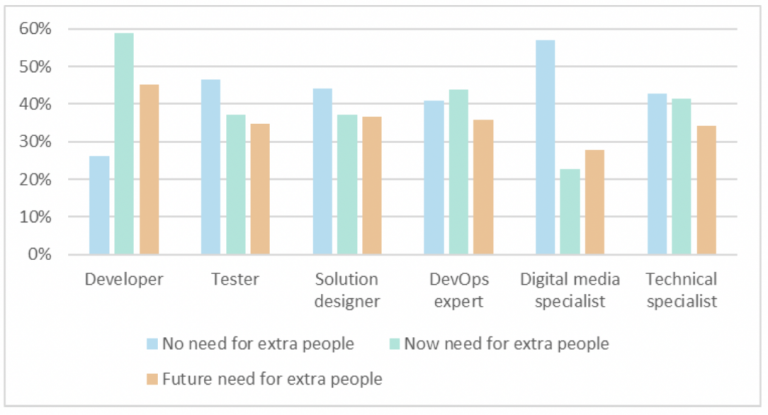
In its 2020 The Future of Jobs Report, the World Economic Forum listed the top 20 job roles where the demand will skyrocket. Almost all jobs on that list are ICT related — with developers firmly holding the 10th position. A trend largely confirmed by our recent findings where 45% of organisations estimated they will need extra developers in the next five years.

ESSA graph 1
2021 ESSA Europe’s Most Needed Software Roles and Skills report “Need for extra people per role profile”

Programming and professional hard skills are in high demand

The ESSA report goes further and tentatively identified the skills in highest demand among software professionals.

Needless to say, hard skills like programming are the most in-demand with Java, Javascript, SQL, HTML, PHP, C++, C#, and Python being the most needed programming languages. But what is important is for software professionals to have a solid understanding of programming principles, so that they can quickly and more easily adapt to new languages.

It has been discussed that profession-related skills are also to be developed.

“Even more important than teaching particular IT skills, like IT framework or programming languages, is teaching how to understand the business. Only if you are able to understand the purpose of the software solution that you are building, you can deliver a valuable product.”

In this regard, our report findings show that security management, agile project management, and software development lifecycle skills are needed and that software professionals with an understanding of the business are the assets organisations are looking for — now and in the future.

Soft skills are key

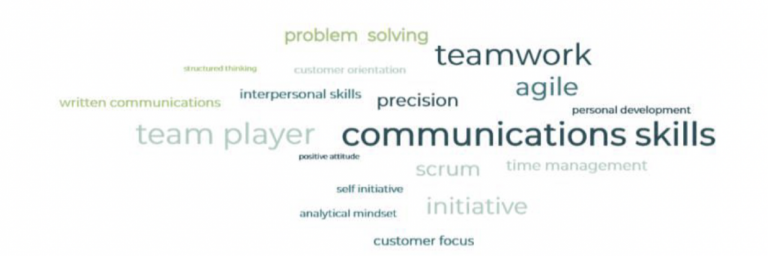
Again, looking at the predictions of the World Economic Forum (2020), we can only confirm and strongly advise people with software roles to not only grow their hard skills, but invest in non-technical (transversal) skills like personal soft skills or interpersonal skills: critical thinking & analysis, self-management, teamwork, and communication skills.

2021 ESSA Europe’s Most Needed Software Roles and Skills report “Soft and other skills for developers”

Of course, soft skills are harder to assimilate when only relying on theoretical knowledge. Thus, it is important to introduce more systematically real-life projects into learning and training curricula.

It's about the details

In October 2021, ESSA released a full report exploring current (and future) needs for software skills in Europe. During the next step, together with the rest of ESSA members we will contribute to addressing the conclusions of the report in a comprehensive document — the European Software Skills Strategy. Visit the ESSA website for more details about the initiative.

In the meantime, we at Codecool are already working hard on bringing better digital education to Europe. Already in 4 European countries, in Austria, Hungary, Poland and Romania, we’re offering mentor-led, project-based developer and other digital skills courses. We’re building on our mastery-based learning methodology and tried-and-tested curricula, and putting an extra focus on developing soft skills, both in our open courses and in our tailor-made corporate solutions. We make career changes affordable and change lives with our job guarantee, post-payment options and the CoderGirl scholarship. 

Learn more about who we are and what we do, and reach out to discuss how we can help filling your software skills needs.

Your employee has changed – new ways of management in post-covid times

We all feel that the pandemic may or may not be over yet. In fact, it seems that we may just be entering a 4th wave in many European countries, and are already in the middle of it in some other parts of the world. However, several countries experienced a relieving break recently after the 3rd wave, in many cases with employers opening up their offices for workers again for the first time since the virus hit us all so badly. And many of these employers experienced a subtle change in the character and attitude of their workers at the same time.

We at Codecool decided to open our offices when the time was right, and not much later invited our students back to the classrooms, too. But we also felt that the pandemic has changed us, our colleagues and our students (among whom may be your next junior programmer colleague, who knows). We felt that we’re just not the same anymore, but also that it’s not so easy to get around this feeling. It’s not so simple or black-or-white. We may be facing another lockdown and return to stricter work rules, and possibly a full WFH (work from home) setup in the coming weeks or months. But we want to be aware of the nature of change we’ve already went through, get prepared for whatever may come next, and maybe adjust the ways we do management in the meanwhile.

Adapting to Change

So how are we all different after 1+ year of isolation? Why exactly? What should we do or not do about the change? How will Codecool graduates be different from previous years’ alumni, and what will they be like at their brand new work places?

We decided to dig in just to find a load of amazing research and articles already written on the subject. And then opted for a brief summary of the insights we found most interesting and eye-opening.

We then grouped the insights around 4 topics:

  1. Work from home
  2. Speedy digitalisation
  3. Health and wellness prioritised
  4. Global crisis mode

Let’s jump in! See if you find some of these insights familiar or inspiring yourself.


1. Work from home

With the abrupt enforcement of social distancing as the primary means to slow down the new pandemic, WFH quickly became the standard way of working early last year. A Eurofound research showed that about 37% of the EU workers transitioned to WFH, 24% for the first time ever. Previously an employee benefit, WFH was now enforced in a non-negotiable way – only wherever it was feasible, of course. Essential / non-essential service, as well as work requiring physical proximity / work allowing remote setup quickly became relevant labour categories.

The solitude and isolation of single-household workers impacted introverts and extroverts differently, but in general increased depression, boredom and anxiety. In larger households WFH increased familiar disruption taking our focus, and therefore leading to stress. It also shifted our priorities to family and private life. 

With management moved to remote mode, too, self-management became key and many times a challenge, including flex time management, and especially over-work, paired with unchanged performance (resulting in lower efficiency). Previously rare Zoom calls taking over our work days proved especially draining and stressful in this period.

On the upside, some people experienced a bigger freedom in parallel with the breakdown of physical ties to the office. They started to appreciate the mobility, digital way of work and their new-found relative independence from day-to-day micro-management.

Makes sense, right? Been there, done that. Now wondering, how did all this change your employee and how you should change your ways as a manager?

Here are a few changes paired with useful tips:

→ Balance out changed productivity

Long isolation makes socialising and personal connection both desired and unusual.  Workers may be less productive in the office, too, especially in the beginning, because of spending too much time enjoying each others’ company. The experience may also be draining for them, too, because it’s all new and tiring to have people around again. What can you do? Let them be. Let your workers enjoy just being with their colleagues and take their time talking over coffee or take long lunch breaks. They need this for a healthy balance, to be able to perform on WFH days or overtime.

→ Take back from hands-on management

After experiencing self-management your team might react to your old management style differently now. Take back from managing your workers in general, including micro-management, encourage self-management, increase scope of ownership, make conversations instead of directly assigning tasks, build on the trust you have built out during the remote work period. This will not only help your colleagues deal with the situation, but also you, to grow as a leader.

→ Leave WFH options open

WFH can grow on you, even if you had trouble getting used to it in the beginning. It used to be an employee benefit before for a reason after all – it’s convenient, comfy and practical. Even those workers not particularly fond of the new setup might now expect having the option to work from home time-to-time. Others may not want to return to the office at all, and there are many preferences in between. Make sure to find out how your colleagues feel about the topic and try to take their preferences in consideration when updating your WFH policies. A little flexibility and generosity will go a long way and might actually become a decisive factor for your employees in the end when planning their future career at or outside your company.  Plus, WFH might mean faster, simpler and less expensive labour for your company – you just have to adjust your management style in the long run (→ see also previous point)

2. Speedy digitalisation

In parallel with transitioning work to employees’ homes, companies were forced to move their products, services, processes and channels online, too. Meaning those, that were actually able to, because of their industry, competency and agility. Many others, outside of the non-essential service categories experienced severe disruption, sometimes irreversible losses and went down together with whole industries. And we could see anything in between, too, in different industries, including layoffs, hiring freezes, working time caps, mandatory holidays and pay-cuts.

Workers of digitalising companies had to face further challenges in parallel with moving work home. They had to get used to and manage brand new digital work tools, processes and products, all of these sometimes requiring new tech skills, too. This made them question their own work status, abilities, confidence and blurred the lines of previously clear career prospects. And they had to get to learn to work with a new type of connectedness, digital connection, which gained so much ground in times of social distancing.

They also saw the world of work becoming not just a much more digital, mobile, connected and global, but also an insecure place where people can lose their jobs from one day to another, many times with no feasible “plan b”-s to quickly bounce back to.

Sounds familiar? We’ve all been part of this and we’ve all been impacted one way or another. 

Here are a few things you can do about some of the changes left on your employees:

→ Go agile now

One shared trait of organisations surviving and thriving after the 3 waves of the pandemic is agility. It’s not too late to go (more) agile even now, it’s rather a must. We just learnt how an unforeseen global crisis can stop our world and force us off our beaten paths. Can we really expect something like this to not happen again? Better get prepared now. Prepare your teams and processes to act fast on change in opportunity or demand, recover from an unexpected fall and continue to operate in some alternate setup. Go creative and think out of the box together – and don’t try to predict the way things will turn out, rather hack your future by preparing for as many options as possible building on an agile way of thinking and frameworks.

→ Apply new ways of reskilling fast

Newly digitalised businesses require new digital skills from employees.  It’s high time to prioritise strategic skill planning and rapid reskilling. According to Forbes the 2 key skills needed to manage uncertainty and digitalisation of the future are coding and empathy. Codecool‘s developer courses help build a strong foundation of both coding and soft skills, using a project-based curriculum and agile workplace-like setup. They are available for individuals and companies, too, both for absolute beginners and more advanced professionals. 

→ Automate part of the work

Whatever can be automated, should be now. Maybe it’s a bigger challenge in your industry than in some others, but think tasks instead of whole jobs. Especially routine tasks which used to be done in-person previously, but must now be solved online can be good candidates for automation. Think of it as just one more step ahead, to manage higher demand, changed WHF work-load and also, your employee’s motivation.

3. Health and wellness prioritised

With a global pandemic at the center of all the shake-up, our and our loved ones’ physical and mental health quickly gained priority on our list of concerns. What contributed to this? The strictness, urgency and extent of different protective measures, the questions around the nature and seriousness of the new virus induced disease, the risk to our health, isolation and / or being closed in together with our families, plus the media hype on top of it all had their share. 

Stress levels rose, and depression and anxiety cases became common even in people not directly impacted. Those who fell sick got an extra dose of the mental burden, too, plus experienced mild to serious physical symptoms and even have had to start getting used to the fact that some kind of post-covid symptoms might also impact their lives even on the long run (possibly hindering their performance at work, too). And many others, who experienced loss and tragedy have still have to learn to survive and live a full life, or at least regain some of their motivation to be able to function, and not just at work. All this resulted in people in general starting to reprioritise health and wellness, valuing rest and off-work time more than before, turning inwards and also to others with more compassion. 

You can help your employees with these issues, too.

→ Make their physical health your priority

Supporting your employees in keeping safe from or dealing with health issues should be a no-brainer. It’s also in your best interest to do everything you can to help your workers maintain their good health. Consider how you can contribute from facility management through work-time policy review to employee benefits system adjustments. Small changes matter, too. 

→ Use office space to help mental recovery

Let the work place take on a new, important role, to give space to healing through community experience. You might even want to adjust the size, function and outlook of the work space to support this new role. It should encourage team and 1-to-1 connection, fun moments and quiet withdrawal, too. Provide for random encounters, scheduled social ceremonies and sufficient personal space and time.

→ Provide access to professional mental support 

Endorse and communicate the idea that it’s OK not to be OK. Notice and avoid toxic positivity. But in the first place, accept that as an employer it’s in your best interest to care about the mental health of your workers. Don’t try to solve the new challenge in-house, find a professional partner to help your employees with consulting, coaching or team sessions.

4. Global crisis mode

Accept that the global pandemic is in fact a crisis, and you’re crisis managing. We’re all in this together, which makes the situation even more overwhelming for everyone. We all feel lost in the middle of the information overload, sensationalist news and conspiracy theories. We question our priorities and values, and also our purpose. Not so sure anymore what we should want from life. 

All of these problems may sound like aspects way beyond your managerial scope and competence. But you should care if you want to retain and motivate your employees once again. And the good news again is that you can actually make a difference.

→ Stop the infodemic 

This pandemic is also a “digital epidemic” causing information overload. To stop it on an individual level “social media distancing” can help. As a manager you may want to share only relevant and updated information about the situation. 

→ Make the situation clear 

Management in times of uncertainty, change and complexity requires clear communication. Aim at simplicity and transparency. Besides telling your employees what will happen, what will not happen and what you expect from them, make sure to use their words, ask for their feedback and answer their questions the best you can. You can’t and shouldn’t know everything, but whatever you know communicate with clarity. It restores a level or safety, strengthens trust and creates openness in the organisation. 

→ Give a sense of purpose 

Reinforcing your shared purpose might also be important for your employees in these uncertain times. When everything is being questioned, including what we should believe in and strive for in life, a sense of purpose and connection to work and how it benefits customers might help them more then ever. Make sure you make the occasion into a discussion rather than an announcement. Spend time to understand their needs and expectations and build on these.

Sounds like a lot of changes and to do’s? We feel you. 

But instead of thinking expectations, try to look at all these tips and insights as opportunities. We at Codecool do our best but still don’t yet do everything suggested above. The point is that we do our best and that we show that we care.

And we also do care about your future employees, also because we are training them right now. Besides turning our students into the best junior programmers you’ll find on the market, we’re helping them strengthen their soft skills and work together with them in an agile framework. 

All this to make sure they’ll not only be able to code, but also to cope – whatever challenges we all might face next. 

Follow us for more on Linkedin!

Whether you need IT specialists or you are looking for company trainings, you will find the solution with us.


The Codecool Way: 4 Core Values we Follow to Disrupt Tech Education

Company values are important: they can define a company and its brand, help communicate corporate identity and keep everyone aligned with the agreed strategic directions. If done well, they have a direct impact on core activities, shaping the way everyday work is being done at the company.

We at Codecool have been trying to follow 4 simple values for years in our everyday work:

  1. Courage – to explore new things and push limits.
  2. Transparency – sharing information and expressing ourselves, not just when comfortable.
  3. Quality – in whatever we do.
  4. Fun – to also enjoy what you do, so that you become even better at it.

But words are just words. They may sound cool, and we may check out an invisible to do list with them as any serious organisation that should have a list of core values does. But if there is no action behind them, they mean nothing.

So the tricky part about values is not even defining them  – especially that you better define them based on what you really believe in and what you actually do. It’s much more challenging to be always true to our values. How to apply them in different situations, with everyone and at all times. Even when it would be faster, cheaper or simpler to just not bother.

We follow our values in internal processes and ceremonies, among ourselves “in the background”, the way we talk to each other and do our daily work. We follow them when we meet external parties, like our business partners, and they experience them first hand, too, when they welcome graduate Codecoolers in their organisations.  And that’s because we also follow these values when we work together with our students, in the way we facilitate their learning and help them restart their lives in brand new tech careers.

But how exactly do we apply our core values in our training and make them work for everyone impacted?

Let’s dive in.

1. Courage: We step out of our comfort zones

Having courage to explore new things and break conventions is very attractive, but failing can be scary. So pursuing new challenges comes with a price: if we want to stay true to ourselves, we can’t always go the safe way.

You can’t have innovation or deep learning without trying new things. And trying new things naturally comes with failing a few times first. On the upside: the earlier you fail, the earlier you can fix what went wrong, and with the smallest cost possible. 

So we encourage learning by doing and learning from mistakes. We appreciate each failure together. We always give feedback and do a positive reinforcement on failures, as they are a valuable part of the process. For example: “It’s great, that you tried this option and found out that it doesn’t work. What have you learned from this?” 

To achieve innovation and learning via natural failure, we focus on processes rather than outcomes. We aim to create a supportive, fail-safe environment, where real growth can happen, so we also focus our feedback on behaviour, not on personality traits.

For a start, our mentors (we call our trainers ‘mentors’) cultivate a growth mindset. This means that we make sure our students understand and fully believe that with a growth mindset, their skills and abilities can be developed through dedication and hard work. Not by talent, luck, good grades from high school, or an IQ test’s result from last year. It depends on how much they believe they are capable of learning to code. This view creates a love of learning and a resilience that is essential for great accomplishments. To achieve this, we rephrase “fixed mindset” statements. For example, instead of saying “I’m not good in solving math problems” we suggest: “You might not have found your way in solving this math problem, yet. But have you tried … ?”

Learning new things can be intimidating, too. Once in a growth mindset, we finally dare ourselves to move out of our comfort zones to change and to grow. When defining challenges for our students, we concentrate on the “learning zone“, or the Zone of Proximal Development. The learning zone is between the comfort zone and the panic zone – neither of which is a place for learning. In the comfort zone there is nothing new, but in the panic zone there’s way too much. In the learning zone, however, you have the right amount of challenges to tackle. The Zone of Proximal Development inside the learning zone is where the learner gradually moves from learning the first steps with support (of a mentor or peers) towards learning further steps without help (or without ‘scaffolding’).

During the learning process, we make sure to always go step-by-step (sometimes in baby steps). We start routinely questioning ourselves, our beliefs and ways. We turn old stones, reinvent the wheel, understand how and why things work or don’t work, and then most of the time come up with ‘lousy’ new ideas – or at times, with truly ingenious ones. And in the meantime: we analyse, we open our minds, understand how to tackle problems, grow our confidence and learn. We grow – and have a lot of fun in the process.

Besides all this, we do follow-ups and retrospectives regularly. Our mentors also take the courage to face any feedback from our learners, and admit if anything went sideways – then, they focus on these areas of improvement, and turn the feedback into learning opportunities.


2. Transparency: We share and express

Transparency for us means more than just being honest. It means telling the truth at all times and sharing as much information as possible for everyone’s benefit – also with the learners during the learning process.

To support transparent communication, we first establish psychological safety, an atmosphere that facilitates mutual trust and growth.  In a team with high psychological safety, teammates feel safe to take risks around their team members. They feel confident that no one on the team will embarrass or punish anyone for admitting a mistake, asking a question or offering a new idea.

To achieve this we:

  • strive to recognise our own tensions and notice tension in others, that distracts us from being present or feeling comfortable, 
  • communicate tensions in a way that doesn’t hurt others,
  • give a context or a greater perspective about a decision or a behaviour to further enhance involvement and trust,
  • organise ceremonies (sharing/syncing) outside our daily work for bringing up questions or information transparently about things experienced in various situations.

We basically set a good example by communicating transparently, also to encourage others to start communicating transparently, too.

We can use this principle in the following situations:

  1. We give upfront information about the trainings, workshops, etc. We don’t hide any useful information from learners. We tell everyone what will happen, when, how.
  2. We clarify rules, roles and expectations. Then we have a ground to say “no” to learners, if they ask something beyond our agreement.
  3. We consciously avoid having secrets or taboos. What, how and why the mentor/trainer does what she does? It has to be clear for everybody. For example “Why are we doing this exercise?” We give context to the learners – with careful timing of the information, so it helps their learning.
  4. We do regular mappings. We map out our day, the next hour, exercise and even the whole course for everyone in advance. Learners always have to understand the process and where they are in it.
  5. We express our feelings. When our mentor has any tension, they also express it freely. The mentor is not perfect, either, they are a human being with feelings, emotions. For example when learners don’t pay attention, the mentor expresses their feelings about the situation and then asks them to pay more attention.

3. Quality: We put extra work in providing real value

We pursue quality and craftsmanship in everything we do or expect from our students or partners.

For a start, we significantly increase quality of learning outcomes by maximising learning time efficiency through guidance, support and motivation provided by our pro mentors. As opposed to self-paced learning, instructor-led course students are much more likely to finish their studies, and to end up with usable, practical knowledge and skills they can actually implement later in a work environment. They also have much more fun.

One way Codecool mentors engage students and partners for even better result is empowerment. As a start, we define quality together and how exactly we’ll get there.

We follow the principles of subsidiarity – which may sound complicated, but it only means that we tackle problems on the lowest level where information is available to solve them. Meaning that if there is a solution available for the students already for a certain problem, based on their previous project experience, then their mentor will encourage them to find the solution themselves and will not hand it over to them.

Solution focus is a technique we borrowed from Solution-Focused Brief Therapy. It requires future-based thinking and resource consciousness and builds on the notion that “the solution doesn’t care about the problem”. Instead of analysing the problem, we analyse the preferred outcome together with available resources, and derive the possible ways to get there from “top down”, rolling it out backwards from the desired state of final outcome.

The agile methodology is a no-brainer go-to toolset to use in software development context, and we use it extensively, too. We actually go as far as to build our learning schedules around agile ceremonies, and have our students demo their projects in front of real-life “clients”, represented by our hiring partner companies every Friday, from week 1 in their learning journey.

We also believe in efficient, goal-focused meetings and learning sessions. We respect each other’s time, arrive on time and keep timeframes at all times – but that’s only one side of the story. 

We start every meeting with a check-in round where we discuss how everyone feels, so that we can “arrive”, that is put outside problems behind by acknowledging them and sync the mood of the team. This may sound like an overkill or waste of time, but skipping it is just not worth the 10 minutes it saves. People tend to focus and participate more actively and efficiently after this short routine, and the time saved indirectly is a lot more than how long the whole thing takes.

We also do a check-out in the end, to share how we feel then and if there’s anything more to share, to make sure we maxed out our time spent in the meeting together.

Apart from these generic meeting routines, we also do short attendance meetings each and every morning with our students.  At this meeting everyone (including mentors) answers one simple, casual random question generated by a bot (like what’s the one TV show that always makes you laugh, or who is you favourite superhero and why). We don’t react to replies, we just share and listen. The purpose is to kick-off the day on a positive tone and consciously bring in the human element into our work and learning every day, which is also a key tool for building a teal organisation with high standards for quality.

And last, but not least, we build on the 4 principles of doing by non-doing, which in our case is basically a coaching attitude pursued by mentors. The principles are the following:

  1. We don’t know the one single truth: The mentor/trainer doesn’t know the truth, only shares knowledge by her experience. Everyone can challenge the mentor’s or others’ thoughts, ask open questions and start a constructive debate.
  2. We don’t judge: We give specific feedback on behaviours, and we don’t apply labels to people.
  3. We don’t take over responsibility from others, especially from learners: The one who is working hard is actually learning by doing. If the mentor/trainer works hard, it means they learn a lot themselves, but not necessarily the learners. For example that’s why the mentor cannot touch the keyboard of a learner as a rule. We also say: learners should spend most of their time practicing, communicating, elaborating on a task. The main responsibility of the mentor/trainer is to facilitate learning, but the ownership is with the student – they own their own learning, for the best possible result. 
  4. We don’t give solutions: We don’t tell the tricks and give final answers. The learning process is more important than the final answer. Our approach is coaching – we help the learners with questions, guidance, motivation.

Some people intuitively interpret ‘non-doing’ as something passive, laid back or lazy. But if no action is needed, then doing anything may already be ‘overdoing’. In fact, sometimes action can do more harm than good.

If we are growing a plant and we have created the right conditions for growth with healthy soil, sun and water, there comes a time when the very best way to ensure the growth of the plant is simply to leave it alone. More water, more sun, more fertiliser won’t help, in fact, too much of any of these may stifle the growth of the plant. We remain attentive, connected to the plant’s needs but for the time being, doing nothing is just what is needed. 

We do our best not to kill our plants, but let them grow and reach their highest quality.


4. Fun: We make sure everyone enjoys the ride

Choosing Codecool is a life-altering choice for both our day-time course students and our colleagues – so we always put fun high on the list of priorities. If you enjoy something, you’ll become better at it. It’s that simple.

We do believe that learning and work can and should be a fun, light-hearted, and possibly a flow experience, too. We don’t take ourselves very seriously either. We make sure to be able to laugh at ourselves as much as possible.

Our students learn technologies and new skills via life-like, but still playful and fun project assignments, instead of boring, heavy textbooks and frontal lectures.  

A fun learning experience will bring a better end result because of the positive association:

  1. We experience how we all (including the mentor) are just human beings. We all make mistakes, and we laugh at ourselves, together.
  2. We focus on the journey, the experiment of learning something new. This adventure, the discovery can be very enjoyable, genuine fun.
  3. We share interesting small details, fun facts, all related to the topic.
  4. We do more interactive, practice-oriented sessions, and fewer frontal sessions and presentations. Learners will remember the “experience” most: when they were moving, talking, practicing, laughing, etc.


That’s basically it – and of course a lot more. But listing all the ‘secret’ ingredients of our learning method and routines is just not possible in one article. 

We know that every company is different, and your values at your company must be different, too – not better, nor worse, just different. Hope you found this insight to the Codecool values and our ways of working with them inspiring, and that we made you think about yours. 

What core values do you have at your company? What do you do to follow them every day?

Stop and think about them sometime, and find more creative ways to be true to them. It will be well worth your time.


Boost Team Productivity: Follow These 4 Rules of Doing by Non-Doing

Looking to learn new ways to make your team productive? Non-doing doesn’t exactly sound like a productivity spell, but it can become one. Let’s see, how. 

As we are slowly returning to some kind of a new normal and exploring hybrid work options, productivity challenging online meetings, home office days and virtual team setups remain our reality.

Managing a learning organisation, team energy and effectiveness has never been more more tricky, than in this almost-post-pandemic era. We have to learn new ways to stay productive again, even if they make us leave our comfort zones for a change.

Non-doing doesn’t exactly sound like a productivity spell, but it can become one. The idea is not new at all, but it might just be time to revive it.

Where does the concept come from and what does it even mean?

It’s an ancient idea that’s certainly stood the test of time, having first appeared in the great Chinese philosopher Lao Tzu’s writings over 2000 years ago. And although “wu wei” literally means non-doing or non-action, it’s anything but a form of passivity.

Think of non-doing as effortless action: getting the greatest outcome possible by doing the least possible.

Why is it relevant today?

But why should we embrace this very concept in an age of constant change, competition and pressure to perform?

For starters, because it’s time for leaders reinventing their management styles.

In the golden age of the knowledge society, autocratic management (even the parental style, with the kindest possible intent) is hardly ever a good strategy. The most successful companies and teams out there aren’t the ones that always follow the rules but the ones that don’t think twice before completely rewriting them. And they tend to have managers that expect the same from their employees.

In a game where creativity wins it all, good leadership isn’t about instructing, dictating or checking. It’s more about asking, inspiring and supporting. In other words, non-doing.

Here are our 4 don’ts, if you want to master the art of effortless action.

1. Don’t try to be a know-it-all

A company culture based on non-doing is built on the fact that no one holds the Philosopher’s Stone. Meaning that no leader or team member has the ultimate truth.

Why is this important?

First, because there is no Philosopher’s Stone – and noone is infallible.

Second, because if you obsess about single truths, you’ll encourage unhealthy group dynamics. Whether you’re in a meeting or in a classroom, if your feeling of being right shoots up, so does your feeling of authority right away. Authority limits flow, creativity and innovation.

When building a supportive environment instead of a domineering one, finding a single right solution or flashing your insight will loose its significance. You’ll embrace the search and remain open to experiment, take risks and even stay silent, as needed.

2. Don’t put people in boxes

Aka the number one rule for a strong feedback culture: try not to stick labels on people, whether positive or negative.

For example, if you say “You’re smart!” to someone, nobody will know what exactly was good about their work, including them. Similarly, if you tell someone they’re slack, you basically imply that there’s something wrong with them as a person, not helping with constructive feedback to improve.

That’s why labelling is one of the biggest obstacles to development both for individuals and a company as a whole.

Don’t put stars or talents on a pedestal, but put the valuable behaviours in the spotlight. Make sure these are transferred among people, supporting learning, growth and motivation at company level.

3. Don’t offer ready-made answers

In a non-doing organisational culture, employees value attention more than solutions.

So if someone has a problem, others shouldn’t tell them how to solve it, but help them find the answer instead. Even if this means that a task will take longer or require more attempts.

How will that help?

If you hand ready-made solutions to someone on a plate, you also take away something crucial: the opportunity to learn. If you want someone to grow, you need to assist them with creating a learning environment in which they themselves go through trial and error.

On the side, you’ll boost their motivation and who knows, even you might learn something new in the process.

4. Don’t take away responsibility from others

In other words: “No pressure, no diamonds”. The saying rings as true as ever: people can only improve if they’ve got responsibility, if what they do is meaningful and has consequences.

Autocratic leadership (including micro management) withdraws this power, as it takes away the possibility from others to become and remain in charge of their own work and growth.

So just because you think you’re better or faster at a task, don’t take it over from others.

If an employee would like to change something at the company, and it doesn’t directly violates shareholder interest or personal safety, consider letting them do it. The company is as much theirs as yours, and they need to experience this. Try make every project run by whoever is the most motivated. Work actively on creating a sense of ownership, and enjoy the benefits.


We at Codecool actively and consistently practice non-doing, or non-teaching at our courses. We facilitate discovery by learning instead of providing all the answers upfront. This way Codecoolers gain a deeper knowledge, enhance their creativity, develop a passion to learn more – and have much more fun.


Obviously, there are situations when non-doing is not  good idea. If a fire breaks out, please ring the alarms, and don’t wait for a team consensus on possible even better solutions and learning opportunities.

The point is: the house is not always on fire, and you shouldn’t act like it is. Start with noticing if you do, and try something different for better results: try non-doing instead.

”The Future will be More Digital. The Question is: Who is going to Design It?”

We were there at Masters of Digital online conference last week to discuss the status and future of tech education in Europe.

Masters of Digital 2021 virtual summit presented an amazing line-up of digital leaders, brains and ideas from all over Europe on 3-4 February last week. The organiser was DIGITALEUROPE, the leading trade association representing digitally transforming industries in Europe. The event was subtitled „digital as the driver for Europe’s recovery”, and focused on the bright future and equally exciting present of European tech.

Codecool’s CMO, Anna Ferenczy, was also invited to the main stage panel „Digitally Enlightened: New World, New Skills” on day one of the event. The digital experts on the panel discussed what the upskilling landscape in Europe looks like now and where we go from here.

Spoiler alert: digital upskilling not only has a huge growth potential, it is actually an essential enabler in closing the widening tech skills gap.

The four experts invited to the panel represented both business and government sides, educators and support bodies, early and adult education experts, international and local organisations:

  • Una Fitzpatrick, Director, Tech Ireland
  • Anna Ferenczy, Chief Marketing Officer, Codecool
  • Mette Lundberg, Director of Politics and Communications, IT-Branchen, Denmark
  • Norberto Mateos Carrascal, EMEA Territory Business Consumption Director, Intel

The discussion covered a wide array of topics including:

  • enablers to make tech careers more inclusive,
  • necessity of early digital education for all
  • recent generic changes in career prospects,
  • COVID 19’s impact on tech education trends,
  • remote work and education insights, and
  • digital innovation’s impact on the environmental crisis.

We collected some insights from the discussion that we found especially inspiring.


1. „We should not take European tech education for granted.”

As Norberto Mateos Carrascal of Intel highlighted, if we look outside Europe we soon realise how fortunate we are in Europe on a global scale to have tech and education systems in place, available to a large part of the population.

However, we must see that there are still huge differences between regions regarding access to these systems, and even if there is access, we sometimes cannot fully utilise it.

We must provide the infrastructure where it is missing, and educate the educators on how to use technology.

COVID 19 challenged us to move both public and private education online, for kids and for adults, too, from one day to another. We could soon see how much public education in general lags behind private institutions in the use of digital tools across Europe, due to many times outdated infrastructure, curriculum and skills. Private schools, on the other hand, like Codecool, are more flexible and were able to make the switch fast and without disruption.

Mette Lundberg highlighted that you can see clearly in kids in online classes today that they are more passive, less engaged, have lower energy and don’t participate much.

Panelists agreed that this is because the quality of online education must also be improved. We need to bring excitement to online education, significantly upgrade the online student experience.

Ways to achieve this include trying curriculum innovation, implementing AI, and hybrid learning options (like Codecool’s model of varying individual coaching sessions with larger webinars and small team work activities).

Anna Ferenczy added that cooperation between the government and private schools can also be a powerful enabler of more accessible digital education.

2. „Heavy tech users don’t necessarily have tech skills.”

Mette Lundberg pointed out a basic misunderstanding about tech skills, namely that even the new, digital generations are not as digital as we might think they would be. She highlighted that although most children become superusers of technology at an early age today, still they don’t know how to create technology, they lack basic tech skills. The Danish IT Industry Association started a digital education program in Danish elementary schools to change this, and it has already reached 15,000 children.

In a quick poll 25% of the panel’s (obviously rather tech oriented) audience also admitted to being addicted to their mobiles and having no tech skills whatsoever. Confirming the fact that probably most non-tech oriented, but tech user adults lack creative digital skills, too.

A member of the audience challenged the panelists whether it is really useful to teach tech skills when tech is changing so fast.

The experts agreed that in the education of the future workforce soft or meta skills, like computational thinking, creativity, and effective learning are much more important than actual programming skills. Anna Ferenczy highlighted that employers today value a solid combination of soft skills combined and tech skills, too.


3. „Diversity is not just a moral or ethical question. It’s also about profit.”

Una Fitzpatrick talked about a highly productive collaboration of a group of businesses with the government about the „Connecting Women in Technology” program, which aims at shifting the gender balance in digital employment, by attracting, promoting and encouraging women in STEM careers.

She explained that you have to make tech careers attractive to women to make an impact, and that this work starts at an early age in schools, and continues at the workplaces that need to offer a female friendly environment, use accessible language, and provide promotion opportunities for women.

Anna Ferenczy pointed out that diversity should not only be a key moral and ethical consideration, but also a financial and productivity based one. One recent research found that companies with women executives in their boards realised bigger share price gains, stronger revenue growth and higher profits.

Una Fitzpatrick added that there is a huge potential in and a need for providing access to tech education and jobs to the growing aging population of Europe, too.


4. „It’s not even about the future anymore. It’s about now.”

Anna Ferenczy mentioned that while we are all aware of a growing global IT skills gap, there are also more than 3/4 of a million jobs in Europe that companies cannot fill today.

We must realise that everyone should be prepared for constant learning during careers. We don’t have the luxury anymore to only study in the beginning of our lives, and then work from that knowledge in the next 40 years. Due to constant and accelerating innovation jobs are continuously changing, so people need to change their skills, too. This will only get faster in the close future, so everyone should start upgrading their learning skills.


The 45-minute panel discussion could only scratch the surface of some key ideas and concepts shaping the future and present of digital reskilling in Europe.


The organiser DIGITALEUROPE, together with BBC StoryWorks Commercial Productions also created a landmark film series, titled ‘Digitally Enlightened’, to help sharing great ideas and success stories across Europe. The series explores how a common vision would help digital innovation scale up and flourish to the benefit of consumers and companies.The series will also feature an episode about how Codecool is disrupting tech education in Europe to narrow down the digital skills gap and change people’s lives by helping them start their tech careers, at the same time.

Photos: DIGITALEUROPE