Twice as many students and the best IT education

How could Codecool continue a steep growth in 2021? What’s in the plans for 2022? Jozsef Boda, CEO of Codecool shares the details.
When you think about just for a moment how we expected 2021 to look like in 2020 … Well, things haven’t turned out quite as we expected then, have they?

Back then, we thought that by the end of 2021 the pandemic will be long over. After the first and then several more shocks, after the first and the second wave, with the help of the vaccines our lives can get back to some kind of a new “normal”, but at least a more stable state. Well, it didn’t quite happen like that. 

Due to waves 3 and then 4 in 2021 we were “in and out” of our school in Hungary, changing from on-campus to online education several times. In Romania, it was online with minimal breaks. While in Austria, just after opening our school and our very first group of Codecoolers starting in November, we had to switch to online classes in line with restrictions. 

Things are changing

But there was one big difference compared to 2020: however unexpected these sudden changes were, we were already prepared for them. We have successfully overcome unexpected challenges in 2020, too, but we weren’t even surprised in 2021. And we managed to turn them to our advantage even more efficiently – for example with further improving the online version of our flagship, full-stack programmer course, reaching much more aspiring students with it then with the offline version, available only for those living close to our schools. Who would have thought in 2019 or even 2020 that we’d get there? Not us for sure.

We have never thought we’d hire new colleagues fully online, not to mention senior managers, but we solved this, too, with no problem. Obviously, most of our graduates were hired by our partners in a fully online process, too. We grew up to the new challenges together.

In the meantime, we haven’t even noticed that we’ve entered the “new normal” we’ve been waiting for – probably because it looked a little different than what we expected. It was clear in 2020 already that things will never go back to how they were before, but we were not sure what they would end up like. By today, one thing stands out as the main characteristic of our new, post-breakout world: constant, significant change. What’s also apparent is that those who are agile enough to adapt and build on change will succeed. One simply can’t afford to wait for things to stabilise. That’s a waste of time, a losing strategy.

Codecool’s 2021 in a nutshell

We’re so lucky and proud to have achieved so much in 2021, too. Let me mention just a few things:

  • We’ve placed our 2000th Codecooler at one of our hiring partners. Our first students graduated 6 years ago. We’re so happy that 80% of them are still with their first employer, the one we found for them. It’s a true confirmation of our shared success.
  • We’ve launched our very first scholarship programme, the CoderGirl Scholarship. Together with our corporate partners we want to invite and motivate many more women to start tech careers. The most talented and motivated girls and women from those applying to Codecool can now get a chance to study completely for free with us.
  • We’ve opened our very first school in Western Europe, in Austria. Together with Hungary, Poland and Romania, now we’re present in 4 countries already. Another step closer to becoming a leading IT education institute in Central Europe in 1 or 2 years, and later in the wider region. 
  • We’ve launched new open courses. The one-week “Intro to IT” Course was first introduced in Vienna, while the six-month Cyber Security Specialist Course in Budapest. We’ve launched the fully online version of our Full-Stack Developer Course in all the Codecool countries, and helped more than 300 Hungarians to new, future-proof tech careers taking our short courses, fully financed by the local government. 
  • We’ve further developed our corporate re-skilling and up-skilling training services, and launched comprehensive, tailor-made digital academies at some of our corporate partners.
  • Numbers taken out of context can only tell a part of the whole story. Still, the fact that we’ve managed to grow our revenue by 40% year-on-year in 2021, might mean something. It definitely means that we’re a stable partner for our students choosing us to help them switch to a new career, and also to our corporate partners, counting on us to boost the digital skillset of their organisation in the short and long term.

What we see is that digital transformation at companies is speeding up, now in departments and functions previously requiring only non-tech, business-side competencies. More and more capacities and skills are needed in IT, as well as in newly forming, business-side digital roles, and we can’t even come  close to meeting the market demand, due to the limited number of our graduates. We’ve managed to place each and every Codecool graduate last year who chose to take our job guarantee, while developing and delivering more fully tailor-made corporate training programs than ever before.

We would like twice as many students to  start studying with us in 2022 than in 2021. But we accept no compromise on quality, what’s more, we will further improve our courses and services, just like ourselves. 

Our Full-Stack Development Course

We are more than a bootcamp, and better than a university. A one-year, comprehensive programming course with a job guarantee and post-payment options not only providing a wide and deep knowledge of software development, but also a real job at one of our corporate partners. We would like to make this offer to even more ambitious and committed career-changes in 2022, so we’re extending our job guarantee to the online version of our Full-Stack Development Course in every Codecool country.

We can only be efficient and authentic at the same in what we do, if we are efficient and authentic ourselves. If all our colleagues truly believe in the mission, values and education methodology of Codecool, and if they can also represent them and share them with others. The way to achieve this was different 6 years ago, when we were a young, promising start-up venture, and it is different today, when we are a mature, internationally present, and still dynamically growing scale-up company.

To increase our flexibility and innovation power despite the sudden growth of our own organisation, too, we’ve started a comprehensive mid-management development programme. And to keep up with the demand for our corporate services, a dedicated professional team will be responsible for the development and delivery of our corporate training programs and internal academy solutions from 2022.

Education is important for us!

And now that I’ve mentioned our organisation and my colleagues – let me say thank you to them for their valuable work all year in 2021. Because the thing is that it wasn’t about getting lucky. Whatever we’ve achieved as Codecool is the result of their hard work. Each and every of my Codecool colleagues has contributed to our successes with their enthusiasm, perseverance and skills, and I’m personally really grateful that I have the chance to have been working on shared goals together with them every day.

As a final conclusion, I have to say that after 2020, 2021 was another year full of challenges. The successes we’ve achieved haven’t come easy. We’ve worked for them really hard together. I admit, I got quite tired by the end of the year. I needed the holidays to recharge my batteries. 

But I’m starting the new year full of new energy and motivation, I hope you feel the same. I trust that we’ll have an as exciting and fruitful year in 2022, as we had in 2021. 

I wish a happy and successful new year to all of us, and that we make even more dreams come true, by helping even more successful, future-proof, tech careers to start, together.

Follow us for more on Linkedin!

Find your match – 5 tips to hire better tech talent

Still looking for the perfect junior developer? Or you’re just beginning the process of searching for a new addition to your team? We’re here to help you upgrade your recruitment practices and find great talent while you’re on the search.

The war for great tech talent is as real as ever. On top of the ever growing digital talent gap, the information you have on candidates is often insufficient. So it’s hard to make quick, yet well-balanced decisions during the hiring process.

It’s even more difficult to assess the skills of junior developers, often without a track record. They come from widely different backgrounds, often lacking professional experience, which means a lack of information for you. Do they work well in a team? Is there up-to-date, relevant knowledge behind the points you see listed on their CVs? Can they handle challenges, conflicts, and constructive feedback? All these questions left unanswered can lead to you not hiring a promising candidate and passing great developers by.

So what more can you do to find the best talent, on top of your current efforts? Read on to find our 5 tips. 

But first, let’s see the top challenges hiring managers face while recruiting juniors.

Hiring junior developers? Here are some typical challenges

From CodinGame’s latest developer survey, we learned that finding qualified developers was 2021’s biggest recruitment challenge for 61% of HR professionals. No wonder it’s difficult to recruit great junior developers either. The process isn’t easy for a number of reasons, and it’s weighed down by some typical challenges:

Job portals are useful, but have their limits

It’s natural to start searching for candidates on job portals, however, they can give an illusion that the talent pool is smaller than it actually is. Profiles don’t usually follow strict conventions and often lack information, therefore it’s difficult to compare them. And even when candidates create amazing profiles, it’s good to keep in mind that they’re able to write just about anything about themselves. Missing reliable information on candidates often results in overlooking good developers and going too far with mediocre ones.

Future potential is hard to estimate

It can be tempting to hire someone for a specific programming language that they’re a pro at currently. However, a great junior’s job is to be a motivated learner too, to be able to grow into an invaluable senior later. Someone with amazing tech skills might be the obvious first choice. Then, the same person might turn out not to have the motivation to learn or adapt to their new workplace, get frustrated by challenging projects or be hurt by or indifferent to constructive feedback. It would be amazing to see the future potential of candidates next to previous experience and studies, but it’s really difficult in a classic hiring process.

University degrees are not that relevant for tech positions

You’d assume that degrees help you filter out the best candidates. However, we learned from CodinGame’s latest developer survey that close to 80% of HR professionals around the world already recruit developers with non-academic backgrounds. Asking for a degree in today’s climate can drive away young developers. What’s more, it doesn’t really help you either

The process takes ages

Your first instinct might be to invite a candidate to as many rounds of interviews as possible. To meet your decision-makers and to get to know them as much as you can. To give them filtering assignments, or invite them to assessment centres. But jumping through too many hoops can cause applicants to lose interest in the process. They might simply move on if it’s too dragged out.

But how can you learn more about your candidates?

We already wrote about what you can expect from junior programmers on the job market today. But what if you’re still looking for the right developer in the first place?

Here are our tips:

1. Visit your candidates and check them out at work

It’s a pain point in developer recruitment that you cannot really get a realistic knowledge of your applicant’s ability to code and present until you’re working with them. The usual way to do this is through a technical interview, an on-the-spot coding exercise or an assessment center. These are great solutions, but will not always lead to accurate results.

We rather suggest you to request to watch live demos of junior programmers at a programming school. Go see demos online or in-person, or invite promising students to your premises to do demos. You can get to know candidates much better this way, and check their individual skills in terms of coding, presentation, and interpersonal skills, and select the best ones for an interview. This is also a great employer branding opportunity for you, and an amazing chance for juniors to get to know you as their future employer. 

Codecoolers demo their work to peers and hiring managers every Friday. If you’re interested to see them, reach out.

2. Pick a pro hiring partner that starts with understanding your needs

To speed up the hiring process and to make your recruitment efforts easier, it’s one of the best solutions to get a sourcing partner that really knows you, your business, and your needs. If they understand the way you do business, they’ll know what type of developer could fit in there.

Is it worth it though, to find a partner like this? Well, that’s something you have to decide for yourself. 

At Codecool, we approach every new partnership with a fresh start, asking deep-dive questions about a partner’s business, culture, hiring needs, teams, tasks, preferred hiring practices, and a lot of other topics. After a short and effective briefing we’ll make sure that you meet only the best, most fitting junior developers that match your exact requirements. 

And we are fast – you can have your new junior signing your contract in as fast as 5 days after you request one later.

3. Compare juniors based on an extended candidate profile

While external recruiters can bring you a number of developers to interview, they usually have time to talk to a candidate only once on the phone after finding them on Linkedin. This is a great starting point and can save you time. 

Still, you’ll have a higher chance of finding great employees if you pick recruiters who have an active, personal connection with the developers that they’ll recommend to you. Recruitment Managers at Codecool take the time to get to know each and every Codecool graduate personally. Based the information you shared about your requirements previously, they’ll know whom to recommend to you, and can share detailed info on each candidate‘s skills, ambitions and personality.

4. Ask to see their project portfolio

While looking for the right junior programmer, you can face a simple yet daunting problem: a junior is usually not going to be the one to present you with an extensive, jaw-dropping project portfolio. However, a portfolio is what can best showcase a programmer’s actual skills and interests, so it’s usually a super important source of information when hiring digital professionals.

Our students document all the projects that they work on during their time with us. During our flagship Full-Stack Development course, they finish 20+ lifelike Scrum development projects and 50+ individual coding challenges and assignments. They’re continuously practicing their newly learnt technical and soft skills, and get used to handling different project roles, too. What’s more, after successfully completing the course, they spend their time working on their personal ‘love projects’, which are usually even bigger and more ambitious projects compared to what they’ve been doing before.

5. Look for truly informative CVs

We all know that recruiters spend 6-8 seconds reviewing a CV before they decide on the fate of an applicant, and around 80% of CVs don’t get shortlisted at all. So it’s just natural that while looking at multiple, inherently different CVs and trying to compare them with one another, a number of great junior developers can slip through the cracks. Plus, so many details that look dull on paper could be game-changers when shown off in the right way. Not to talk about irrelevant, or fake information that some candidates put on their resumes.

Our juniors all use the same standard, concise, informative CV format, which makes it easy to compare them. It’s not just a simple CV stating facts, but an interactive showcase of their projects fuelling great conversations at technical interviews. Individual Codecooler’s work and contribution to projects can be checked in detail through the CV, and all information included is guaranteed to be 100% legit and relevant.

Tech talent recruitment can be better

If you’re looking for your next developer, consider partnering with Codecool. We have a big and active network of quality tech talents and flexible recruitment processes, offering you quick access to top talents.

Growing your teams? We can help you find your next junior who could be in your team in just a couple of days after you contact us. The complete hiring process takes 4 to 7 days for our clients, from briefing through shortlisting and interviews to sourcing agreement. You won’t be wasting time or resources, and be ready to start work with your new developers quickly and efficiently. If you’d like to hire a senior developer or a complete new team we can help with that, too. 

Don’t let your best colleagues go. We are also here if you’re interested in up-skilling or re-skilling your existing employees. We’re happy to tailor our flexible training programs to your exact needs, and turn them into your most valuable and skilled digital resources.

Your own internal digital academy powered by Codecool can cover the hiring, training and onboarding of your tech teams and colleagues, and provide continuous training for existing employees, in line with your actual strategic priorities.

Interested in what Codecool has to offer you? Let’s talk! Please be invited to visit one of our Demo Days on any Friday, too, online or in person, and check out the skills and capabilities of our students.

Hope to talk to you soon.

Your top 5 favourite Codecool blog posts from 2021

man reading blog post on mobile

Read again and get new inspiration from your favourite articles by Codecool about training, recruitment and management from last year.

man reading blog post on mobile

It’s almost the end of the year, a great time for some nostalgia. We thought we’d look back and see which of our articles you enjoyed the most last year, which ones generated the most heated discussions, and which ones inspired you most. It was great reading back all your thoughts in comments on LinkedIn under some of them, or just see how many likes and other emojis each got. 

Here goes the top 5 of your favourites. Enjoy (re)reading them!

This was by far your number one favourite post this year. It’s about what we found to be the biggest obstacles to closing the ever growing IT talent gap. The fact that it was so popular shows how important the topic today is, and how many companies struggle with the gap.

4 of the 7 main reasons we found about why it’s still there were:

  1.  Going digital beyond IT, or the fact that more and more digital positions are opening outside of IT, too, in business departments
  2.  COVID-driven digitalisation of not just those innovation areas in previously defined digital strategies, but also forced, quick digitalisation of further, business-as-usual processes
  3. Inflating prices in some countries raising salaries of anyway-not-cheap tech professionals, too
  4. Growing EU and VC funding creating more-and-more IT jobs to fill, especially from 2014 on
Curios about the remaining three? Read the article now, and get inspired about the complex background of this global challenge.

We found that quite an intense discussion started under this post on LinkedIn. It seemed that everyone has an opinion about this controversial topic, and loved seeing your arguments and examples.

Our view,  explained in the post in detail, is that university education has many values, and there are positions where it’s absolutely necessary to have as a background, but there are many more, where it is not. We looked into some statistics from a related research, looked at reasons why we’re biased towards university graduates, and how it can be harmful. We also gave practical advice on how to adjust your selection criteria, if you decide to drop the university degree from your list of primary filters for a candidate.

The article was posted last January, but it still does have its relevance. Open to consider its facts and arguments? Read it (again) here.  

Have you seen the meme, where a woman jumps from a burning building with a sign saying “2020” down into a huge round sheet stretched out by firefighters, only to bounce back and fly into another burning building through the window, with a sign saying “2021”? Well, let’s just say, 2021 didn’t really bring the relief of the pandemic situation and it’s effects that everyone hoped for in the beginning of 2020. 

Recruitment faced its own challenges, after the initial freeze in 2020 through gradual revival, but complete overturn to online and remote operation. The difficult part of writing this article wasn’t the collecting of the challenges, it was to show the opportunities. But we managed, and this became one of your favourites from our blog posts this year.

Wonder how the impersonal, tech-dependent online recruitment process can bring advantages? How the insecurity of jobs in 2020 resulting in lower number of candidate open for a change could work for you? How the digital skills gap can shake your HR strategy up in a good way? Give the article another go, and collect fresh inspiration.

Besides closing the tech talent gap in general, getting more women into tech has been a major focus for companies all over the world in the past years. Since we wanted to do something, too, we created the CoderGirl Scholarship in Q3 2021. The scholarship allows talented and determined women and girls to learn tech for free with us with a guaranteed position in the end,  matching their new skills . We even started a whole new Cyber Security Specialist Course solely for women, with scholarship places only, in November.

In the article, we brought you some facts and figures about the gender gap, as well as some interesting examples when digital product launches went bad only because there were no women involved in the development. We also asked you be part of the change and join us in inviting more women into tech. 

Doesn’t ring a bell? (Re)read the article and be inspired.  

This las one on our (your) list was actually our very first post in 2021. It was a very personal look back at 2020 and look ahead at 2021 by Jozsef Boda, global CEO of Codecool.  It’s quite interesting to reread it and see how we realised our plans (like our series B expectations and the opening of our newest campus in Austria). 

How does he evaluate 2021 and what are his expectations for 2022? You can soon find out from another similar post to come early next year. 

Until then, read (again) this article for a bigger context and some nostalgia.

The above are just a few examples, of course. There were quite a few other blog posts you really liked, like our collection of inspiring podcasts, a success story of one of our graduates featured in a BBC StoryWorks video about our school, and a behind the scenes guide to how we put our company values into practice in tech training.

If you’ve enjoyed reading our blog posts this year,  make sure to subscribe to our Codecool Business newsletter for more.

Stay with us and keep getting inspired for a better digital future in 2022, too.

Kövess be minket a Linkedin oldalunkon is!

What to expect from your junior programmer – 5+1 things to look out for

Junior developers on the job market today can possess amazing skills, and can even show up to an interview with great references. To make your hiring process easier, we created an outline on the skills and hallmarks of a great junior developer in 2021.

Defining what type of professional you need in your growing IT team can be a challenge. Do you need an experienced veteran who is able to make quick decisions or is ready to mentor their colleagues? Or maybe you could achieve more by hiring a motivated junior professional, who’s willing and eager to deliver high-quality work under supervision. Your business needs both juniors and seniors to thrive because they add value on different levels.

There’s a catch: one company’s definition of “senior programmer” could be the next company’s ideal junior developer. For example, one developer could be considered “senior” with respect to Java development, but at the same time be considered “junior” at HTML5. So categorising and labelling applicants according to their experience is not a cookie-cutter process. Plus, there are many more things you can expect from your next junior colleague apart from having some experience. 

On another note, age-old hiring practices are becoming outdated. For example, university degrees are becoming less and less of an expectation, and you can expect juniors to have some experience nowadays. Plus, more and more companies are opening up their positions globally, even overseas due to the changes that the pandemic has brought. You have the option to recruit junior developers from all over the world and offer them remote positions.

But before we dive into the topic of juniors, let’s quickly explore the skills and capabilities of a senior developer for some context.

What can you expect from a senior developer?

Programmers in a senior role usually have 5+ years experience at a certain technology.

Seniors should be critical thinkers and practice full ownership. They are the ones you can trust in an organisation to keep the big picture in their minds as challenges and problems arise. Seniors ideally place responsibility on themselves first, whether or not their team is succeeding. Apart from being responsible, seniors are generally experts at:

  • Liaising with internal and external customers and stakeholders
  • Leading and mentoring teams
  • Driving projects and keeping the big picture in mind
  • Having an innate understanding of software systems and architecture 
  • Advanced understanding of frameworks, technologies, testing, and troubleshooting methods
  • Analysing business needs and user expectations
  • Ability to lead and mentor teams and drive projects

There are a number of areas where a seniors excel. However, having a team full of seniors could be an over-kill, because junior developers can also be a great addition to your organisation.

So what exactly can you expect from a junior developer?

When we talk about a “junior developer” we usually think of someone who has 1 to 3 years of experience in any given technology. 

As a general rule of thumb, we can say that juniors should be able to perform technical tasks independently,  but they will need some governance and consultation on a general basis. They should focus more on the code and sub-tasks assigned to them by seniors, and less on the big-picture, architecture and strategy.

In short, these are the things you can expect from a junior developer in the year 2021:

  • 1) Have a basic understanding of technologies and development
  • 2) Have demonstrable, relevant experience
  • 3) Understand agile practices
  • 4) Deliver high-quality work under supervision
  • 5) Possess great soft and interpersonal skills
  • +1) Have a strong drive to learn and progress

Let’s dive deeper into each point, and explore why they are important to have in a junior developer.

1) Have a basic understanding of technologies and development

A junior shouldn’t focus on the big picture, and should rather get busy with working on specific features of a product. But having a knowledge of what processes are involved in creating a software will make everybody’s life in the team easier. So a junior should ideally know how the development cycle goes, and it’s more than ideal if they’ve been through the entire development process a couple of times before. 

Technology-wise, your business will define what skills are most valuable, but you can expect a good junior programmer to know around 4-6 programming languages. Juniors should be excited to learn the technology stack that’s relevant for your business, so expect them to be eager and willing to learn new things. 

Top junior developer candidates will have an innate understanding of the development cycle and will know their way around the processes and the roles. So expect your junior to understand the software development process and where they fit into the big picture.

2) Have demonstrable, relevant experience

In terms of hiring, experience is still golden in the eyes of companies– but the type of experience someone has is a game-changer. Experience can be gained through personal projects, at a programming school, during an internship, or at university. So experience doesn’t always have to come from a full-time job. The bottom line is to see relevant experience on your candidate’s CV because you can expect any junior to be able to demonstrate some type of work.

You can expect junior developers to show up to the interview with a solid project portfolio and relevant programming experience. 

3) Understand agile practices

Agile software development is the universal best practice in software development right now, and around 92% of business owners think that the key to their company’s success lies in agile.

Hiring a junior developer who knows their way around sprints, or is up to make a team-based decisions will prove to be a great pick when your team works in agile. Of course, you can’t expect every candidate to have worked on a live project with agile methods, however, you can expect your new junior colleague to have a basic understanding of agile practices.

A great junior candidate will be well-prepared to start working in any software development team. You can expect them to understand what Scrum, daily standups, sprints, retrospectives, client demos, and collaborative work are. 

4) Deliver high-quality work under supervision

A junior should be able to work independently, but will need some supervision, guidance, best-practices and mentoring from senior colleagues from time to time to be able to progress and deliver the best quality of work. It’s a more senior colleague’s place to make decisions and to mentor junior colleagues, but a junior should demonstrate the motivation and the energy to learn and progress. Still, you can definitely expect a junior to be able to work on their own and to find solutions to smaller issues by themselves. Having a great work ethic and a keen eye for details will prove to be amazing features in your new junior developer.

An ideal candidate will be a confident, self-sufficient professional who won’t shy away from putting in the work to solve a challenge. Still, it’s great if they know when to ask a question or look for support from their peers. You could ask your candidate: “When was the last time you had to ask for help, why, and were you able to solve the challenge then?” Expect junior developers to have a great answer to this question, and to have an inner drive to learn and excel at their work.

5) Possess great soft and interpersonal skills

Your new junior colleague should be able to adapt to your company culture and team dynamics quickly and seamlessly. This process will be a whole lot easier with a colleague who has great social skills and who possesses certain soft skills.

Imagine a scenario where your new junior developer is expected to demo their work, but appears  to be uncomfortable presenting themselves in a professional way. Or think about initial conflicts that can arise during a colleagues onboarding and first few months. How will your new junior handle constructive criticism, communicate with their colleagues, and adapt to the changes that are bound to happen?

We know that soft-skills are in the focus of many hiring managers today, and they are just becoming more and more important by the day. Skills like presenting, feedback giving and receiving, time management or conflict management will all be invaluable in your new junior colleague. So expect them to have great soft skills, and you’ll have a faster time onboarding and integrating them into your team.

+1) Have a strong drive to learn and progress

Companies work in a changing environment, and digital transformation comes with a continuous change in processes and technologies. A great junior sees changes not as a threat, but as challenges to solve. They are happy to learn and implement new technologies, processes and ways of work. 

Personality-wise, look for a demonstration of motivation and genuine energy, plus a willingness to learn from mistakes when you’re interviewing juniors. Apart from the points on our upcoming list, expect your new junior to be open to constructive criticism, and have a real drive to progress at their craft. By paying attention to these qualities, you can make sure that your new colleague is excited and ready to learn and work in your team.

During the interview, you could ask your candidate to tell a story where they were able to learn from a mistake and get them to explain how they handled the initial criticism. Or you could ask them to tell when they supported their team, even though they did not 100% agree with the direction the team wanted to take. Hearing these stories could give you a great general idea about the type of person your candidate is, and about the level of support and commitment they can give.

Ready to find your next junior developer?

If you’re looking for a candidate who has a checkmark next to every item on this list, consider partnering with Codecool. Codecool graduates are great junior developers that can tick all the boxes on your list of expectations, and help your organisation grow. Our motivated junior professionals can deliver high quality work from day 1 in your projects.

Interested? Get in touch with us and let’s talk business. We’re excited to hear from you!

One step ahead in closing the IT talent gap – the ESSA skills report is out

ESSA (European Software Skills Alliance) looked into missing skills necessary to fill about 1.6 million digital job vacancies in Europe until 2030. Codecool is on mission to close the tech talent gap by disrupting digital education, also as a working member of the ESSA Consortium.

Today in Europe, developers are the most wanted professionals in the software sector and this trend will accentuate. The companies of tomorrow will also need people that have a good understanding of the day-to-day business activities. 

That’s why soft skills and business knowledge need to be integrated — in the way we train individuals for software roles, but also in the way we think and embed software in our organisations.

Developer is the most popular software role

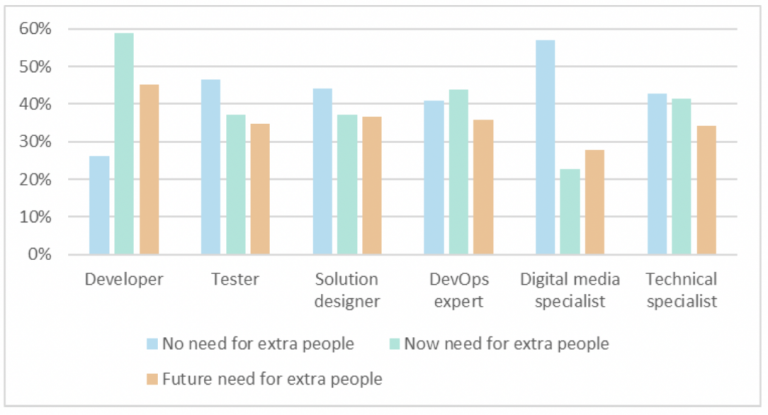
In its 2020 The Future of Jobs Report, the World Economic Forum listed the top 20 job roles where the demand will skyrocket. Almost all jobs on that list are ICT related — with developers firmly holding the 10th position. A trend largely confirmed by our recent findings where 45% of organisations estimated they will need extra developers in the next five years.

ESSA graph 1
2021 ESSA Europe’s Most Needed Software Roles and Skills report “Need for extra people per role profile”

Programming and professional hard skills are in high demand

The ESSA report goes further and tentatively identified the skills in highest demand among software professionals.

Needless to say, hard skills like programming are the most in-demand with Java, Javascript, SQL, HTML, PHP, C++, C#, and Python being the most needed programming languages. But what is important is for software professionals to have a solid understanding of programming principles, so that they can quickly and more easily adapt to new languages.

It has been discussed that profession-related skills are also to be developed.

“Even more important than teaching particular IT skills, like IT framework or programming languages, is teaching how to understand the business. Only if you are able to understand the purpose of the software solution that you are building, you can deliver a valuable product.”

In this regard, our report findings show that security management, agile project management, and software development lifecycle skills are needed and that software professionals with an understanding of the business are the assets organisations are looking for — now and in the future.

Soft skills are key

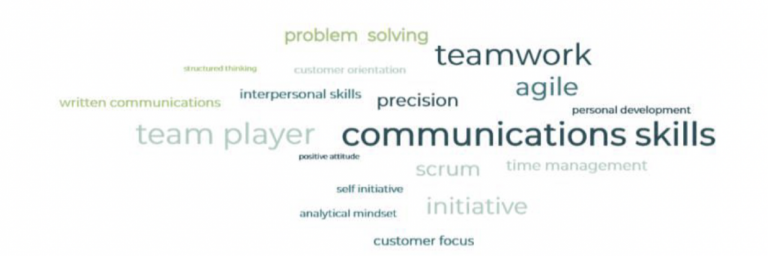
Again, looking at the predictions of the World Economic Forum (2020), we can only confirm and strongly advise people with software roles to not only grow their hard skills, but invest in non-technical (transversal) skills like personal soft skills or interpersonal skills: critical thinking & analysis, self-management, teamwork, and communication skills.

2021 ESSA Europe’s Most Needed Software Roles and Skills report “Soft and other skills for developers”

Of course, soft skills are harder to assimilate when only relying on theoretical knowledge. Thus, it is important to introduce more systematically real-life projects into learning and training curricula.

It's about the details

In October 2021, ESSA released a full report exploring current (and future) needs for software skills in Europe. During the next step, together with the rest of ESSA members we will contribute to addressing the conclusions of the report in a comprehensive document — the European Software Skills Strategy. Visit the ESSA website for more details about the initiative.

In the meantime, we at Codecool are already working hard on bringing better digital education to Europe. Already in 4 European countries, in Austria, Hungary, Poland and Romania, we’re offering mentor-led, project-based developer and other digital skills courses. We’re building on our mastery-based learning methodology and tried-and-tested curricula, and putting an extra focus on developing soft skills, both in our open courses and in our tailor-made corporate solutions. We make career changes affordable and change lives with our job guarantee, post-payment options and the CoderGirl scholarship. 

Learn more about who we are and what we do, and reach out to discuss how we can help filling your software skills needs.

The New CEE Digital Talent Hub: Our Proposal to Tackle the Global Tech Skills Gap

By now we all know that we’ll never go back to the „normal” we once knew. The new normal we are headed may not be fully clear yet, but it’s definitely going to be digital. To get there we’ll have to make at least one big jump in the process, over  the ever-widening digital skills gap. What can help us to make the jump? For one, remote work combined with global recruitment, and a future vision called ‘digital CEE talent hub’.

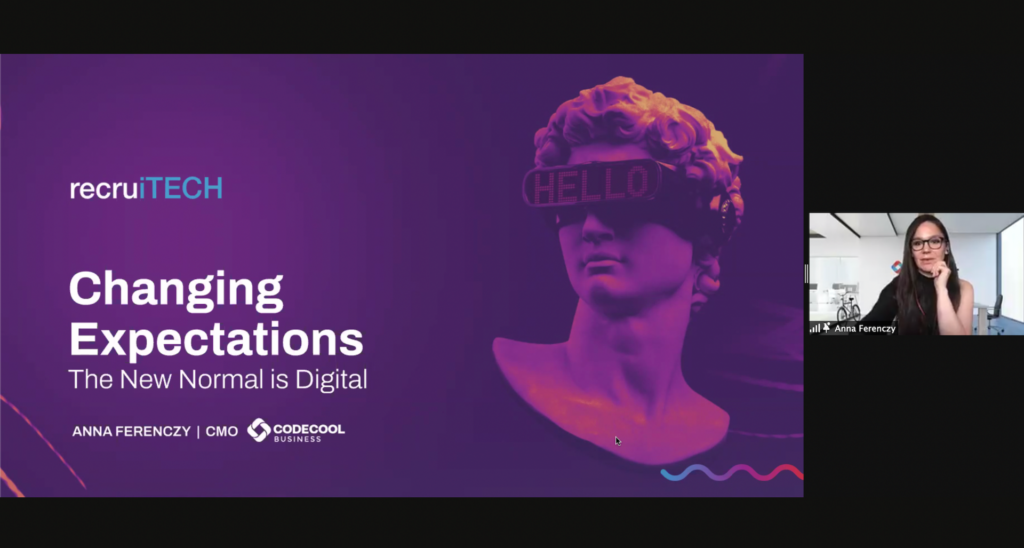
RecruiTECH Romania conference was created to act as a compass for the recruitment profession, to gather and share the best international and national white collar recruitment practices. This year’s event was centered around “(making) the most of a changed labor market with a new perspective and digital tools”.

Codecool CMO, Anna Ferenczy has been invited to share her view on Covid-accelerated digitalisation, it’s impact on the global tech skills gap and a possible solution called ‘CEE digital talent hub’.

Here’s a recap of some key points from her presentation.

Old digital goals and obstacles are so out

Remember the time when we all tried to justify digital transformation plans by cost-cuts and find solutions to organisational siloes and cultural problems? Good old times, right? We never knew our clock was ticking. Would you believe this was just a few years ago, before Covid. In 2017, 48% of corporate leaders used to list scaling down cost as a top 3 digitalisation priority, and listed cultural and organisational bottle-necks as major concerns. And this was just in 2017, according to McKinsey.

And then, a pandemic happened.

Today, digitalisation is a matter of life-or-death, and the global hunt for tech talent is like the 19th century California gold-rush. 87% of leaders see digitalisation as a means of survival, getting ahead of competition or reinventing their business, with only 10%  of them listing cost-cuts as a top priority. And 75% of leaders struggle with hiring the right fit for digital positions.

Quite a turn of winds for digital strategies and efforts, in a blink of an eye.

It’s not just about the future of your business – it’s personal

Today there are about 41 million tech jobs to be filled globally. On top of this 41 million, an additional 149 million new ones will be created by 2025, waiting to be filled.

The new 149 million include jobs in:

  • software development (98 million),
  • cloud and data management (23 million),
  • data analysis, AI and machine learning (20 million),
  • cyber security (6 million) and
  • privacy and trust management (1 million).

Next to the business side of the story, there is a personal aspect as well. More and more people are losing their jobs to digitalisation, forced to reinvent themselves for a high-tech future. The trend has not started today, it has been going on for decades now, but it definitely got a boost last year.

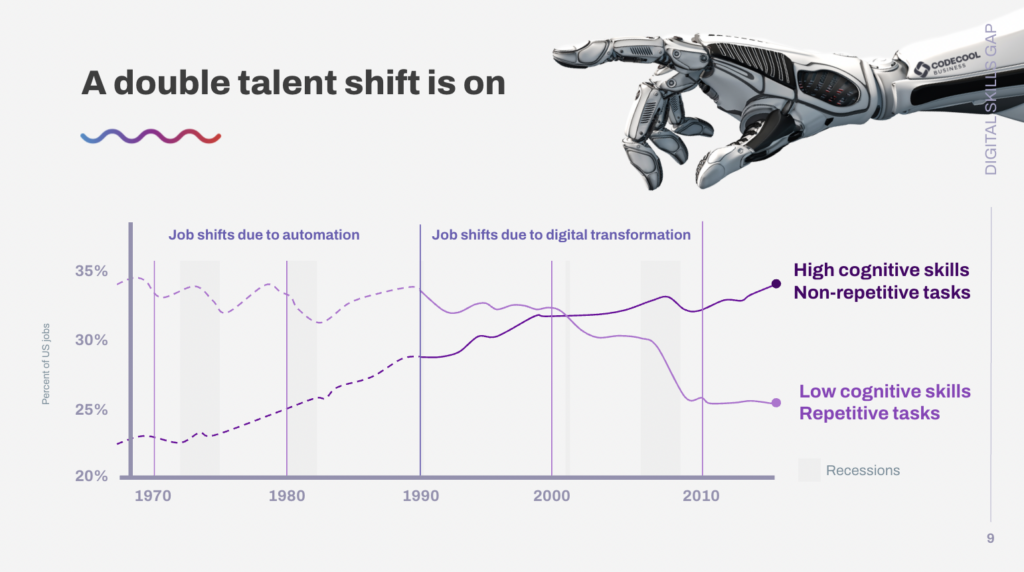
Today we’re in the middle of a new, and very special industrial revolution. For the first time in history not high skill jobs are taken over by the machines, allowing people easily find work in lower skill professions. On the contrary: machines are now taking over repetitive, low-skill tasks, while jobs requiring high cognitive skills are on the rise for the human work force.

This time people will need to substantially re-skill and up-skill to reinvent themselves, or they’ll fall behind. It’s not only digital strategies and corporate competitiveness at stake, but individual lives, too. What does a good up-skilling strategy has to focus on, to prepare for an unpredictable, but surely digital future? Some say, the focus should be on coding and empathy. Coding because the digital future will not just happen by itself, we have to build it first. And empathy, because we’ll have to manage brand new challenges, and reinvent our ways again and again in the meantime.

The gap keeps widening

On the booming digital job market talent is gold. But people are much faster in adapting to a digital lifestyle and way of working than building digital skills or switching to tech jobs. The tech skills gap is wider than ever and it seems to be growing.

There are multiple additional factors at play here:

  • Digitalisation beyond IT – the 149 million new jobs are more or less just the IT positions. But we are also seeing a digitalisation of  classic business functions and traditionally non-tech industries. The trend is viral and no business seems immune to it. This also means that there are now not just tech and IT, but several other industries, companies and departments competing for digital talent, too.
  • Covid-driven digitalisation – last year we were forced to deliver about 10 years’ of digitalisation in 10 months by moving our lives, work, channels and products online.
  • Growing funding –  partly related to the previous points, local governments and the EU alike started to pour money into innovation and digitalisation, creating further openings to fill.
  • Inflating prices – due to economic recession of our turbulent times price have climbed, followed by a a raise in wages, making high-quality talent even less affordable for businesses with a limited budget.
  • Talent mobility – While looking to future-proof their careers, individuals are more open to change their employers, too. And moving their offices online, companies are not restricted by physical distance from talent either. Businesses are now hiring from anywhere (68%), and people are more-and-more willing to apply to jobs anywhere (21%). While flourishing digital hubs like London, UK and Silicon Valley, US are big time winning in the race for talent, local hiring efforts in some countries suffer talent migration.
  • Hiring for a degree – is actually a trend we could change ourselves, unlike the previously mentioned factors, outside our direct influence. By maintaining an outdated preference for tech university graduates hiring managers many time miss the opportunity to grab programming school talents re-skilled in 1 year instead of 5, many times equipped with much more relevant hard and soft skillsets, and and previous work experience.
  • Low diversity – is another trend connected with discrimination we should all strive to change. Changing tech into a gender- and age-inclusive field, as it should be, can only happen via hiring much more women and 30+ or 40+ professionals in tech positions, than we ever did before.

Our proposed solution: the new CEE digital talent hub

The talent gap will not close itself,  especially when even the Silicon Valley is impacted. We must put a lot of work into closing it, and closing it in a way that local businesses become net beneficiaries of the outcome, too, not just business like Google and Amazon.

We at Codecool take our part in this work by re-skilling and up-skilling CEE work force and sourcing digital talent to our partner companies. Instead of university degrees, our graduates have extensive project portfolios demonstrating solid skills in 4 to 6 programming languages and multiple tech platforms, as well as valuable soft skills. More than 30% of them are female (and we are continuously working on raising this ratio), and many of them are 30+, with previous work experience and a high-level of self-awareness on their profiles.

We all need to up our game, and build a massive CEE talent hub together, to fuel global and local innovation at the same time.

We need to act now, tomorrow is already too late.

How will you contribute, starting from today?

Motorola Solutions Launched Developer Academy Powered by Codecool

Motorola Solutions in Poland teamed up with Codecool to train 26 developers in the newly established Motorola Solutions Academy last year. The selected participants attend the 7-months long training programme for free. 

The Academy was founded by Motorola Solutions to tackle the IT talent gap hitting many IT companies across Poland.

Almost 500 people applied to Motorola Solutions Academy, a special training programme developed by Codecool Poland for Motorola Solutions. From the 500 the 26 best were selected in a thorough selection process. 

During the 7-month long education programme the participants learn solid back-end or front-end developer skills from scratch. Graduates are guaranteed to be employed at Motorola Solutions in Krakow.

How were the participants selected?

The recruitment and selection process, as well as the learning path of the programme was tailor-made for Motorola Solutions by Codecool, a leading programming school in CEE. Codecool provides full-stack developer and short-term IT specialists courses across Poland, Hungary and Romania. 

To find the most suitable candidates for Motorola Solutions, the school’s mentors and recruiters:

  1. filtered almost 500 applications,
  2. conducted 100 interviews and
  3. evaluated 80 beginner level coding task submissions.

What's next?

The free training programme started in December 2020. Students are spending 6 to 8 hours per day from Monday to Friday for 7 months to learn their brand new profession. 

The curriculum is structured around an alternating weekly schedule. One week participants have lectures and workshops at Motorola Solutions, as the pandemic situation and the current regulations allow. The other week they work individually or in teams on their own projects. 

Students not only learn the latest technologies, but also improve on their soft skills to ensure a smooth onboarding to the Motorola Solutions after their training.

The Motorola Solutions Academy vision

“Motorola Solutions is an ever growing company with a high demand of IT professionals. Multiple new employees join our Krakow office each month. We run different software projects from developing critical communications, command & control systems or intelligent public safety applications, to creating an image analysis software with artificial intelligence. 

As finding the right talent on the market is often time-consuming and challenging, we decided to walk a different path. 

With the support of Codecool we set up the Motorola Solutions Academy to train the exact talents we need. This cooperation gives us an opportunity to benefit from the proven, practice-oriented education method of Codecool, and combine it with the knowledge and values important for us.

We look forward to starting working together with these highly motivated students Codecool found for us”, commented Jacek Drabik, President of Motorola Solutions Polska.

We are proud to make Motorola Solutions Academy happen

“Working on Motorola Solutions Academy has been one of our most inspiring projects in Poland. 

We truly believe that the way Motorola Solutions chose to fight against the labor shortage is one of the most effective ones. While the recruitment process, the development and the implementation of the education programme was outsourced to Codecool, the integrated programme fully reflects Motorola Solution’s needs. 

At the end of the 7-month training 26 ready-to-work employees will join their team. They will know the technologies used by the company, the projects they are going to work on, and the company itself. Onboarding costs will have been saved as well“, said József Boda, CEO of Codecool.

3 IT Recruitment Challenges in 2021 – and Why They are Actually Opportunities

Obviously, there are much more than three challenges that recruiters must face today.

Low diversity, shrinking networks, corporate hiring and individual career-change freezes, virtual recruiting, a growing digital talent skills gap… And the list could go on.

We picked the last three from the above list because we believe they are not only very pressing problems today, worsened by the pandemic, but also because they are connected somehow. If we look at them closely we might find that they are not just challenges, but also opportunities.

If managed well, they may become our chance to gain advantage in a strained race for digital growth.

How?

Let’s check it out.


1. Virtual recruitment is the new normal​

After being forced to transition to online recruitment from one day to another in 2020, today we see there is no way back. 84% of recruitment professionals in EMEA agree that virtual recruiting will continue post-COVID and 70% believe it will become the new standard.

Many of today’s Gen Y job seekers would not even consider a company with outdated hiring processes. Different job seeker groups may find digital selection processes uncomfortable on the other hand.

How is this a challenge?

It is easy to see. Virtual recruitment can be impersonal, technology is sometimes a challenge or obstacle to overcome, and there is an increased number of irrelevant responses from candidates who would not enter an on-premise, face-to-face recruitment process.

How is this an opportunity?

Digital and virtual hiring can be much faster and cheaper. It supports a global recruitment for remote work, opening up the possibility to hire from a vast talent pool, including an emerging CEE talent hub with multiple benefits. It also offers momentum for realising long planned automation and innovation projects.


2. A career-change freeze trend is slowing down mobility

Prospering industries have been brought down and several individual businesses going strong previously were heavily shaken after the break-out of the pandemic and due to prolonged restrictions, only forecasting the shadow of a possible economic crisis. Initial response after the first shock included hiring freezes and layoffs even at the most stable companies. 

With a growing number of people losing their jobs and a steady income, individual job security started to become more and more important, and career ambitions featuring risky moves less and less urgent, impacting the talent market.

How is this a challenge?

Those who could keep their jobs are more risk-aware now. They are less likely to make a move for more fitting or exciting propositions at a different work place, which obviously decreases the available quality talent pool.

How is this an opportunity?

Your own employees might be in a similar situation and now more interested for internal career opportunities. Providing you with a unique chance for strengthening their loyaltyupgrading the organisational skillset, and at the same time saving the higher cost of layoffs and external recruitment.


3. The digital skills gap keeps widening

There are multiple reasons behind the continuous growing of the tech skills gap, and the discussion about how to close it has been a central one for years now. There are 41 million tech jobs to be filled today, and there will be an additional 149 million to fill by 2025. Besides the software and information tech industry the gap is more and more of a pain point for all other industries, too, and tech skills are now required at more and more traditionally non-technicals positions, too. 

The #1 hard skill to recruit for is coding, besides the #1 soft skill, which is empathy – an enabler to tackle the unforeseeable challenges of a possibly very different, and definitely digital future. And universities just can’t keep up or provide the flexibility to meet the ever-changing and growing market demand.

How is this a challenge?

How it is not, right? Obviously it is already difficult to fill positions that require special digital skills, and even more difficult to find candidates with equally developed hard and soft skills. Digitalisation projects are delayed, and existing digital teams are many times exhausted.

How is this an opportunity?

If digital skills are in high demand at employers, then they are the best bet and attractive targets for self-development for individuals, as investment in the future. Often it is relatively easy to motivate otherwise valuable employees without any IT background to enter re-skilling programs, and IT professionals to up-grade their skills to match newer digital innovation projects. 

Adding more flexible, effective and faster alternative sources of digital talent might also provide a real competitive edge – due the intense race for talent on the market, and the direct impact of the result on the speed and quality of digitalisation. 


Of course, it sounds all nice and easy, and it only gets hard when thinking about how to actually implement the suggested ideas. 

You may very well ask yourself: Where do I start hiring globally? How will I assess applicants from foreign cultures in an impersonal hiring process limited to the virtual space, and how do I manage my deadlines, too? 

How will I offer meaningful and quality internal digital training programs for my employees, suited for the different levels of their knowledge? Or how do I find open digital courses for them that actually meet my exact needs regarding hard and soft skills? 

These are obviously new challenges in themselves, requiring new solutions. 

Solutions like the ones Codecool offers. We are here to help.

We connect CEE digital talent and digital businesses around the world, and make sure to provide candidates with the exact needed skills in the process. We offer accessible open courses and tailored corporate training programs supported by pro mentors leading face-to-face sessions, a project based training method, agile team work and a growth mindset. 

We also offer recruitment services building on our vast junior and senior digital talent network, and successful recommendation system. Corporate digital academies powered by Codecool  find, hand-pick, train and onboard the digital talent our partners need.


Let’s turn your challenges into opportunities. Check out our services, send us a message and let’s discuss how we can help you.

Hope to talk to you soon!

”The Future will be More Digital. The Question is: Who is going to Design It?”

We were there at Masters of Digital online conference last week to discuss the status and future of tech education in Europe.

Masters of Digital 2021 virtual summit presented an amazing line-up of digital leaders, brains and ideas from all over Europe on 3-4 February last week. The organiser was DIGITALEUROPE, the leading trade association representing digitally transforming industries in Europe. The event was subtitled „digital as the driver for Europe’s recovery”, and focused on the bright future and equally exciting present of European tech.

Codecool’s CMO, Anna Ferenczy, was also invited to the main stage panel „Digitally Enlightened: New World, New Skills” on day one of the event. The digital experts on the panel discussed what the upskilling landscape in Europe looks like now and where we go from here.

Spoiler alert: digital upskilling not only has a huge growth potential, it is actually an essential enabler in closing the widening tech skills gap.

The four experts invited to the panel represented both business and government sides, educators and support bodies, early and adult education experts, international and local organisations:

  • Una Fitzpatrick, Director, Tech Ireland
  • Anna Ferenczy, Chief Marketing Officer, Codecool
  • Mette Lundberg, Director of Politics and Communications, IT-Branchen, Denmark
  • Norberto Mateos Carrascal, EMEA Territory Business Consumption Director, Intel

The discussion covered a wide array of topics including:

  • enablers to make tech careers more inclusive,
  • necessity of early digital education for all
  • recent generic changes in career prospects,
  • COVID 19’s impact on tech education trends,
  • remote work and education insights, and
  • digital innovation’s impact on the environmental crisis.

We collected some insights from the discussion that we found especially inspiring.


1. „We should not take European tech education for granted.”

As Norberto Mateos Carrascal of Intel highlighted, if we look outside Europe we soon realise how fortunate we are in Europe on a global scale to have tech and education systems in place, available to a large part of the population.

However, we must see that there are still huge differences between regions regarding access to these systems, and even if there is access, we sometimes cannot fully utilise it.

We must provide the infrastructure where it is missing, and educate the educators on how to use technology.

COVID 19 challenged us to move both public and private education online, for kids and for adults, too, from one day to another. We could soon see how much public education in general lags behind private institutions in the use of digital tools across Europe, due to many times outdated infrastructure, curriculum and skills. Private schools, on the other hand, like Codecool, are more flexible and were able to make the switch fast and without disruption.

Mette Lundberg highlighted that you can see clearly in kids in online classes today that they are more passive, less engaged, have lower energy and don’t participate much.

Panelists agreed that this is because the quality of online education must also be improved. We need to bring excitement to online education, significantly upgrade the online student experience.

Ways to achieve this include trying curriculum innovation, implementing AI, and hybrid learning options (like Codecool’s model of varying individual coaching sessions with larger webinars and small team work activities).

Anna Ferenczy added that cooperation between the government and private schools can also be a powerful enabler of more accessible digital education.

2. „Heavy tech users don’t necessarily have tech skills.”

Mette Lundberg pointed out a basic misunderstanding about tech skills, namely that even the new, digital generations are not as digital as we might think they would be. She highlighted that although most children become superusers of technology at an early age today, still they don’t know how to create technology, they lack basic tech skills. The Danish IT Industry Association started a digital education program in Danish elementary schools to change this, and it has already reached 15,000 children.

In a quick poll 25% of the panel’s (obviously rather tech oriented) audience also admitted to being addicted to their mobiles and having no tech skills whatsoever. Confirming the fact that probably most non-tech oriented, but tech user adults lack creative digital skills, too.

A member of the audience challenged the panelists whether it is really useful to teach tech skills when tech is changing so fast.

The experts agreed that in the education of the future workforce soft or meta skills, like computational thinking, creativity, and effective learning are much more important than actual programming skills. Anna Ferenczy highlighted that employers today value a solid combination of soft skills combined and tech skills, too.


3. „Diversity is not just a moral or ethical question. It’s also about profit.”

Una Fitzpatrick talked about a highly productive collaboration of a group of businesses with the government about the „Connecting Women in Technology” program, which aims at shifting the gender balance in digital employment, by attracting, promoting and encouraging women in STEM careers.

She explained that you have to make tech careers attractive to women to make an impact, and that this work starts at an early age in schools, and continues at the workplaces that need to offer a female friendly environment, use accessible language, and provide promotion opportunities for women.

Anna Ferenczy pointed out that diversity should not only be a key moral and ethical consideration, but also a financial and productivity based one. One recent research found that companies with women executives in their boards realised bigger share price gains, stronger revenue growth and higher profits.

Una Fitzpatrick added that there is a huge potential in and a need for providing access to tech education and jobs to the growing aging population of Europe, too.


4. „It’s not even about the future anymore. It’s about now.”

Anna Ferenczy mentioned that while we are all aware of a growing global IT skills gap, there are also more than 3/4 of a million jobs in Europe that companies cannot fill today.

We must realise that everyone should be prepared for constant learning during careers. We don’t have the luxury anymore to only study in the beginning of our lives, and then work from that knowledge in the next 40 years. Due to constant and accelerating innovation jobs are continuously changing, so people need to change their skills, too. This will only get faster in the close future, so everyone should start upgrading their learning skills.


The 45-minute panel discussion could only scratch the surface of some key ideas and concepts shaping the future and present of digital reskilling in Europe.


The organiser DIGITALEUROPE, together with BBC StoryWorks Commercial Productions also created a landmark film series, titled ‘Digitally Enlightened’, to help sharing great ideas and success stories across Europe. The series explores how a common vision would help digital innovation scale up and flourish to the benefit of consumers and companies.The series will also feature an episode about how Codecool is disrupting tech education in Europe to narrow down the digital skills gap and change people’s lives by helping them start their tech careers, at the same time.

Photos: DIGITALEUROPE

Still Hiring Tech People for a Degree? Think Again

A new survey in Hungary highlights an international problem: hiring for a university degree is still very much a trend and a major obstacle in managing the digital talent gap.

The highlights of a recent tech skills market survey have just been published in Hungary.

In general, the results heavily underline what we have been seeing for years about the growing tech skills gap not only in Hungary, but in several other European countries and globally as well. While we would expect the recent workforce shift towards tech narrowing the gap, due to COVID and the economic recession (and in some countries, like the UK, this is actually very much visible), the speed of digital transformation is also accelerating, presenting a significant growth in demand at the same time, and confirming a growing skills shortage on the long run.

Given the general conclusion, there was one particular insight from the survey that stuck out for us: the fact that university degree is still listed as a minimum requirement for 72% of IT jobs. And obviously this is a major obstacle to digitalisation. The number stands for the Hungarian market, but we understand that this might be an international problem. We felt that this didn’t make much sense, especially given the talent shortage, and decided to explore the reasons.

Many IT jobs do require the skills you get at a university, that is in-depth understanding of the why’s and how’s of information science, all the high-level and founding concepts behind how computers, systems and programmes work. And that is totally fine. But what we see from our experience, at our partners and on the market in general, is that the majority of IT jobs do not require those levels of academic insight.

What they do require on the other hand are:

  • practical skills that can be put to use as fast as possible in projects,
  • solid knowledge of up-to-date programming languages and / or digital fluency in line with current technological trends and innovations,
  • experience with an agile way of working – or at least, any work experience,
  • soft skills, like communication, team work, presentation skills, creativity, and
  • a strong drive to work and learn more.

Many of these missing from the otherwise totally valuable skillset that a university is building.

What do you get when hiring otherwise smart candidates with a degree, but without the above traits? Disappointment.

  1. Many times, struggles during and extra time invested in onboarding,
  2. higher churn (uni graduates also tend to look more for a ROI on their higher investment of time and money in education by prioritising fast career development), and
  3. sometimes a step-back from diversity and an equal opportunity culture – by indirectly selecting candidates from higher status, more well-off families that could afford supporting their kid while studying for 4 to 5 years.

Why asking for a degree almost as a routine then? Especially given the apparent tech talent shortage. It is many times a working go-to hiring strategy in the case of easy-to-fill positions with multiple over-application. (Not saying it’s a good one to find the best candidate, but effective in cutting down applicant numbers.) But why do it in IT where clearly, degree does not always equal quality and there is a huge talent gap we have been hearing about for years now?

Two reasons: because we are used to it, and because we know none better.

At one point companies started to treat a university degree like a secondary school diploma before, as a first filter. Expecting to get the discipline, the class and some alleged pack of soft skills, like communication skills, creativity and empathy with it. Assuming that a person with a degree is better than one without.

We are still very much used to believing that a degree is what gets you ahead, especially thinking with the head of a decision maker at a company. We want our children to go to university when they grow up to make it easy for them to get ahead in life. And it’s fine. But it doesn’t mean that we cannot do something about bettering hiring practices and strategies today.

Our world has changed a lot, since universities were the best indicators of future success in the digital field.

  1. New technologies started to emerge faster than ever – making less flexible university curriculum less relevant, while demanding a bigger variety tech skills in higher capacity not just at IT departments, but all around the business functions, too.
  2. Diversity became a global corporate priority and responsibility, making hiring for degree a questionable choice on ethical grounds.
  3. Tech education out grew traditional higher education territory, with an aim to offer a real alternative to universities with short, intense, hands-on courses, and up-to-date practical skills in in-demand technologies.

And this last point is why the second reason, “we know none better” is so easy to tackle. Obviously, you are rightfully suspicious about the huge number of low quality, super fast digital bootcamp courses. But not all bootcamps and programming schools are created equal.

When evaluating a certification from a school, always check:

  • the length of the course (you may not need 4 to 5 years of university to do the job, but can’t learn full-stack development in 4 months either),
  • the quality of the specific projects the graduate has worked on, and the size of the project portfolio,
  • agile way of working used in learning projects,
  • English language used in daily communication,
  • the weight and scope of soft skill development in the curriculum, and
  • track record of the school, its clients and client references.

Sometimes, hiring a university graduate will still be the best solution. And sometimes not.

We suggest that you make a conscious and deliberate decision about your criteria, instead of going for the filters you’re used to. So that you can find the best match for the open position – and manage the IT skills shortage at your company with even better results in the long run.

Codecool is a leading programming school in Hungary, with further campuses in Poland and Romania, and over 2000 graduates working at 250+ companies all over Europe. Our flag-ship course is our 12+6 months full-stack developer course. We offer up-skilling and re-skilling courses, too, and corporate academy programmes fully covering hiring, onboarding and continuous tech training services. We are proud members of The European Social Simulation Association (ESSA), promoting the development of digital education in Europe.